Guide · General
Best Air Purifier for Dust: What to Check in 2026
Find the best air purifier for dust by matching CADR to room size, checking filter labels, noise and replacement costs before you buy.
By the HearSmart research desk · Updated November 21, 2026 · 12 min read
The best air purifier for dust is the one that delivers enough filtered air for the room at a fan speed the household will use, not the one advertising the highest filtration percentage. The U.S. Environmental Protection Agency's home air-cleaner guide makes the distinction behind that choice: filter efficiency alone does not establish room-wide performance. Delivered airflow, operating time, placement and maintenance also matter.
HearSmart's rankings use one published scoring formula, so this guide applies the same logic to dust purifiers by asking first whether the room gets enough filtered air, then comparing filtration, tolerable noise and running costs. Without comparable manufacturer specifications and dated seller prices, naming one universal winner would claim more certainty than the evidence supports.
Table of Contents
- Match Airflow to Room Size First
- Filter Labels and Airflow Checks
- Noise and Real-World Performance at Home
- Filter Replacement and Running Costs
- Which Purifier Fits Your Dust Problem
- Score Your Shortlist Before You Buy
Match Airflow to Room Size First
A dust purifier must move enough filtered air through its intended room. Room floor area comes before filter branding, because even an efficient filter can't capture particles that never reach it.
The Association of Home Appliance Manufacturers' 2018 sizing guidance recommends a CADR of at least two-thirds of the room's floor area. The following minimums are calculated from that rule, rounded up to the next whole number. For household dust, the relevant specification is dust CADR, not an unspecified airflow figure.
Minimum dust CADR by room floor area
| Room floor area | Minimum dust CADR | Typical room |
|---|---|---|
| 100 sq ft | 67 | Small bedroom |
| 120 sq ft | 80 | 10 by 12 ft room, AHAM 2018 example |
| 150 sq ft | 100 | Medium bedroom |
| 200 sq ft | 134 | Large bedroom or small living room |
| 300 sq ft | 200 | Open-plan living area |
These are calculated sizing benchmarks, not measured results for those rooms. Room descriptions are illustrative, and buyers should confirm the dust CADR on the manufacturer's specification sheet.
Apply the room calculation before comparing features
AHAM's worked example uses the rectangular room shown in the table. Multiplying its length by its width gives its floor area, then applying the sizing rule gives the minimum CADR. The same calculation can be made with a tape measure and a calculator before opening any product listings.
For an irregular room, divide the floor plan into rectangles and add their areas. An adjoining space that remains open shouldn't disappear from the calculation merely because the product is being described as a bedroom purifier.
AHAM reports separate CADR values for tobacco smoke, pollen and dust. Those categories allow comparisons under the same rating system. A product page that publishes only a general airflow figure hasn't supplied the same evidence as a particle-specific cleaning rating.
Practical rule: A room-size headline is a starting point for checking specifications, not a substitute for them.
Operating speed, filter condition, room layout and air leakage can change the result. Floor area also doesn't describe ceiling height or circulation around partitions, so the benchmark shouldn't be mistaken for a guarantee in unusually tall or divided spaces.
Surface cleaning remains a separate purchase decision. A robot vacuum for hardwood floors addresses dust on the floor rather than establishing airborne-particle performance.
Before shortlisting a purifier:
- Measure the space. Record the floor area in square feet, including connected space intended to be treated.
- Find the category. Locate dust CADR on the manufacturer's specification sheet.
- Reject undersized options. Remove models whose published dust CADR falls below the calculated minimum.
Filter Labels and Airflow Checks
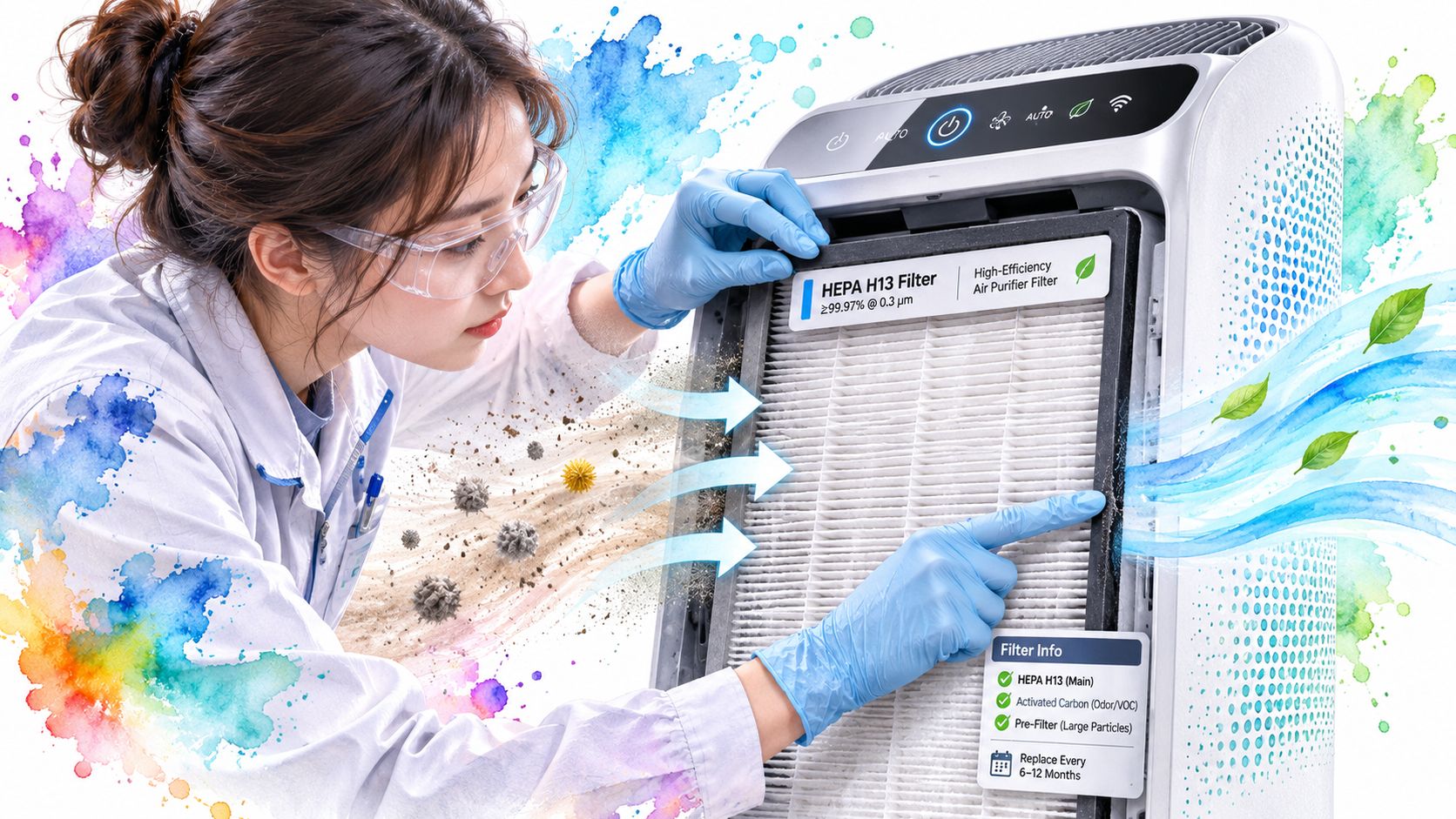
The EPA's home air-cleaner guidance states that a HEPA filter can theoretically remove at least 99.97% of airborne particles measuring 0.3 micrometers. That is a filter-efficiency benchmark, not a promise that the same proportion of dust will disappear throughout a room. The guidance doesn't attach a study year to that benchmark.
Purifier labels and what each one proves
| Label or rating | What it tells the buyer | Where to check |
|---|---|---|
| HEPA designation | Filter meets the high-efficiency benchmark described above, measured at the filter | Manufacturer specification sheet |
| Dust CADR | Volume of filtered air delivered, rated for household dust | Manufacturer specification sheet or AHAM-verified listing |
| Smoke CADR | Volume of filtered air delivered, rated for fine smoke particles | Manufacturer specification sheet or AHAM-verified listing |
| Below-1-micrometer statement | Manufacturer states that the unit removes most particles below that size | Product documentation |
| Intended room size | Size range the manufacturer says the unit is designed to serve | Manufacturer specification sheet |
A filter's appearance doesn't establish its rating. The designation and supporting specifications need to come from product documentation.
Efficiency and airflow answer different questions
Filter efficiency describes capture as air passes through the filter. CADR describes delivered particle-cleaning capacity. A highly efficient filter moving little air may remove fewer total particles than a slightly less efficient filter moving substantially more air.
This distinction changes how buyers should compare premium filtration claims. A label suggesting exceptional filter performance doesn't resolve whether the assembled purifier moves enough cleaned air through the intended space. The fan, filter resistance and operating setting all remain relevant.
Mechanical filters can capture airborne dust, pollen, animal dander, dust-mite allergens and some mold particles. However, dust already resting on furniture, carpets or bedding isn't passing through the machine. Visible dust accumulation and airborne-particle concentration are related problems, but they aren't interchangeable measures of success.
Read particle-size claims in their original context
The EPA's 2020 air-cleaner guidance, updated on its agency page in 2026, advises selecting a room-sized unit with a HEPA designation, a smoke CADR or a statement that it removes most particles below 1 micrometer. For virus-oriented filtration, that guidance also describes manufacturer statements covering particles from 0.1 to 1 micrometer.
Those recommendations concern airborne-particle filtration, including respiratory aerosols. They don't make household dust and respiratory aerosols identical, nor do they make smoke CADR interchangeable with dust CADR. Buyers should retain the category attached to each rating rather than combining unlike numbers in a comparison.
Every HearSmart ranking opens with a specification table showing starting price, free plan or trial, platforms, compatibility, direct purchase or sales-contact requirements, and a key category specification. For a dust comparison, the useful evidence is the documented filtration designation and applicable cleaning rating, not the presence of extra table fields.
The purchase conclusion is straightforward: verify the filter and the delivered airflow separately. A purifier supplements source control and regular cleaning. It doesn't replace either.
Noise and Real-World Performance at Home
A purifier that meets its room-sizing claim only at a speed the occupants won't tolerate presents an operating problem, even if its laboratory rating is sound. The highest fan setting rarely turns out to be the most useful household setting.
The EPA's technical discussion of residential air cleaners identifies noise as a practical limitation: people may turn cleaners off when higher airflow becomes too loud. That supports a purchasing test based on usable airflow, not maximum airflow alone. A unit that delivers its rated cleaning rate at a volume the room can absorb hour after hour outperforms, in practice, a stronger unit left switched off.
Compare operating patterns, not just maximum specifications
| Operating scenario | Intended use | What to verify |
|---|---|---|
| Continuous quiet operation | Routine particle capture while the room is occupied or used for sleep | Noise and power at the selected speed, plus cleaning performance at that setting if published |
| Short high-speed cleaning | Additional capture while cleaning activities disturb settled dust | Whether the higher setting is tolerable and how the machine returns to its normal setting |
| Automatic operation | Fan adjustments without repeated manual changes | Which particle measurement controls the fan and whether manual override is available |
For continuous operation, a bedroom buyer should examine the decibel rating at the intended overnight setting. A specification describing only the quietest speed doesn't establish noise at a useful cleaning rate, and a maximum CADR doesn't establish cleaning capacity in sleep mode. Both figures have to come from the same fan speed to support a fair comparison.
Vacuuming or changing bedding gives a practical occasion to run the fan harder for a short period. The purifier remains an addition to cleaning, not a reason to stir up dust deliberately, and its intake and outlet should stay clear under the manufacturer's clearance instructions.
A maximum setting that stays switched off contributes no cleaning while it's off.
Keep uncertainty separate from a correction factor
Laboratory ratings allow controlled comparisons. A furnished home introduces different air paths, sources and operating choices, so published CADR figures carry no household discount in this guide; buyers should work from the manufacturer's numbers at the speed they plan to run.
That uncertainty shouldn't be replaced with an invented adjustment either. Buyers can record what the manufacturer publishes at the intended speed and treat missing low-speed performance information as unknown rather than filling the gap with a guess.
The best quiet air purifiers comparison provides a relevant starting point for noise-sensitive households. The deciding question stays the same: whether the machine can hold a useful setting for sustained periods without prompting occupants to silence it.
Filter Replacement and Running Costs
Filter count belongs in the budget before purchase. Under a clearly hypothetical maintenance schedule, replacement every 60 days means about six changes annually, while replacement every 90 days means about four. Those are planning examples, not universal manufacturer recommendations.
The actual interval must come from the selected model's maintenance documentation. Pet hair, frequent activity and heavier dust loading justify closer inspection, but they don't establish a replacement deadline for every filter design.
Annual running cost worksheet
| Cost line | How to calculate | Where to find the input |
|---|---|---|
| Filter changes per year | Days in the annual budget divided by the documented replacement interval in days | Manufacturer maintenance page |
| Filter cost per year | Seller price on the checked date multiplied by changes per year | Seller product page |
| Pre-filter or washable parts | Listed price multiplied by replacement count per year | Product documentation |
| Electricity per day | Wattage at planned fan speed multiplied by hours per day, divided by 1,000 | Manufacturer specification sheet |
| Electricity per year | Daily kilowatt-hours multiplied by 365 and the local price per kilowatt-hour | Utility bill |
The conversion and annualization figures in this worksheet are calculation constants, not product-performance claims. Filter purchases are discrete, so an annual budget should also account for when the installed filter needs replacing.
Price the setting that will be used
A hypothetical unit drawing 50 watts for 24 hours daily, at an assumed electricity price of 0.30 currency units per kilowatt-hour, uses 1.2 kWh daily, 438 kWh annually and costs 131.40 currency units annually in electricity. These are arithmetic results from invented inputs, not a seller quote, measured purifier result or current utility tariff.
The important input is wattage at the planned operating speed. Maximum rated power may overstate ordinary consumption, while a quiet-mode figure may understate consumption if the household frequently uses a stronger setting.
- Separate cleaning from replacement. Wash a component only when the manufacturer identifies it as washable.
- Inspect loading. A clogged filter can restrict airflow even though the fan still runs.
- Date every price. Record the seller's replacement-filter price and the date checked, because prices can change.
- Budget the complete system. Add electricity, replacement filters and any separately replaced pre-filter parts.
A low purchase price doesn't establish low ownership cost. The fair comparison uses the same intended operating pattern for every shortlisted unit.
Which Purifier Fits Your Dust Problem
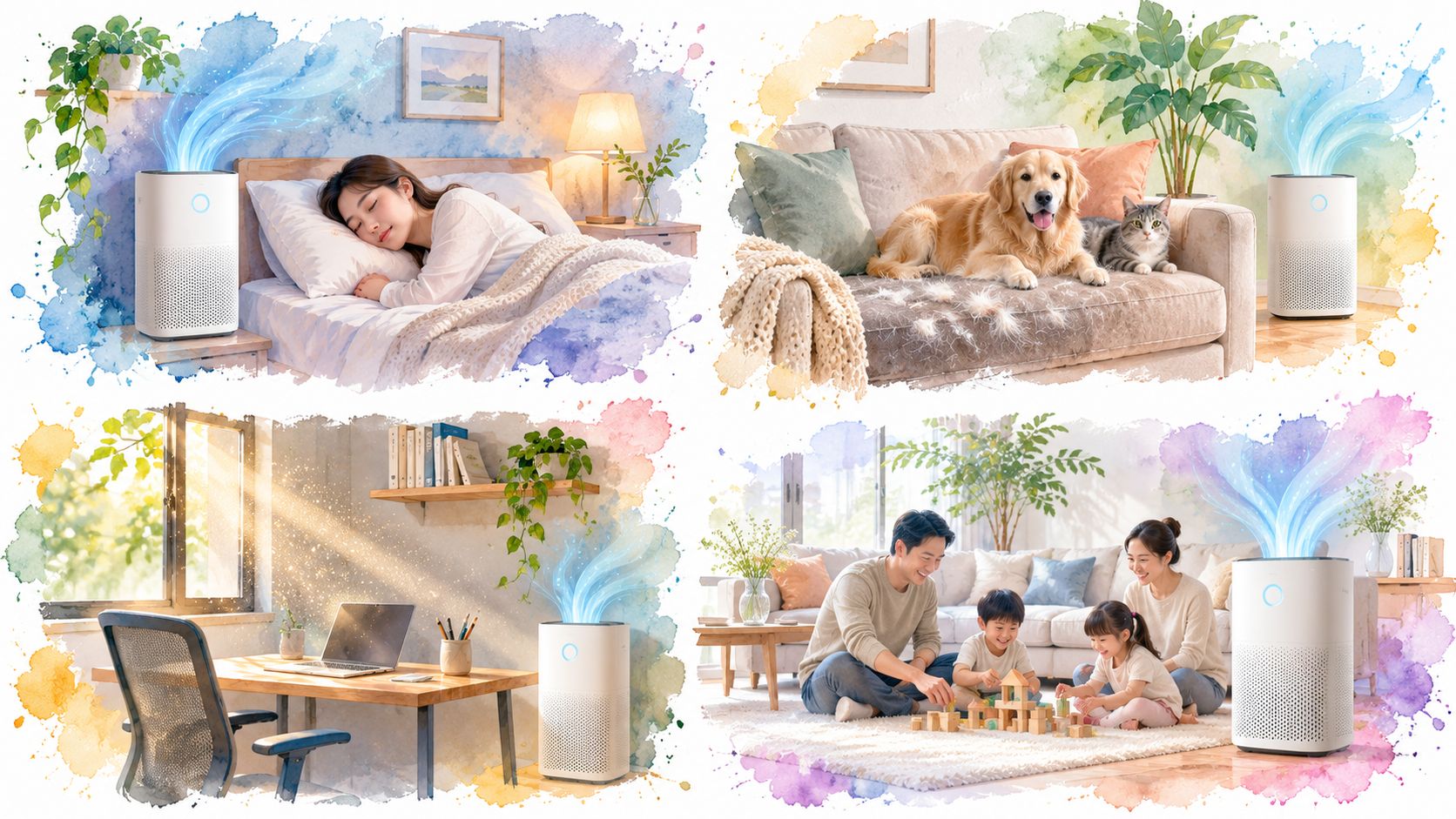
The right purchase changes with the household. A bedroom needs tolerable overnight operation; a pet household needs manageable maintenance; a connected living space needs sufficient delivered airflow. These situations shouldn't receive an identical recommendation merely because the products share a filter label.
A bedroom with dust allergy
Consider a sleeper who switches off distracting appliances. The suitable shortlist includes room-sized units with documented filtration and a quiet setting that can remain on overnight.
Verdict: After the airflow requirement is met, prioritize acceptable overnight operation. The deciding number is the decibel rating at the intended sleeping speed, not the lowest noise number anywhere on the product page. There's no universal sleep-tolerance threshold established by the cited guidance.
A home with pets
A pet resting area creates a practical maintenance challenge as hair and dander collect nearby. A washable pre-filter, where specifically documented, can make routine cleaning easier, but the main filter's care instructions remain separate.
Place the purifier near the occupied area without obstructing its airflow or ignoring manufacturer clearances. The deciding number is the documented filter interval, tested against the household's realistic maintenance budget. Cleaning floors and upholstery still needs its own plan, for which a cordless vacuum comparison is relevant.
An open-plan living area
A household using the open-plan example in the sizing table should assess the entire connected area, rather than only the seating zone. Positioning the unit near an active circulation path may help intercept resuspended particles, provided the location leaves the air path unobstructed.
Verdict: Choose by published dust-cleaning capacity before decorative fit. The deciding number is dust CADR. A compact unit with a broad coverage headline isn't equivalent to a documented particle-cleaning rating.
A household with asthma or vulnerable occupants
The EPA's 2014 home air-cleaner guide explains that a dust CADR of 250 represents particle reduction comparable to adding 250 cubic feet of clean air per minute, while cautioning that actual performance may differ. The same guide distinguishes particle removal from demonstrated health benefits and warns that children, older adults and people with asthma or allergies may not receive complete protection.
Health boundary: A particle-cleaning rating is not a medical-treatment claim.
Here, dust CADR remains the equipment-selection number, but no purifier number establishes medical protection. The unit should support source control and appropriate medical advice, not replace a treatment plan.
Score Your Shortlist Before You Buy
A unit passes the shortlist test only when every criterion is documented and acceptable. An unknown running cost or an unusable overnight setting isn't resolved by a strong filtration label.
Complete these checks before applying the scorecard:
- Measure the intended space. Calculate its minimum dust CADR using the room-sizing rule.
- Confirm the published category. Record dust CADR, not a general fan-airflow figure.
- Check filtration wording. Copy the HEPA designation and any particle-size claim accurately.
- Match noise to operation. Find the decibel rating for the planned overnight setting.
- Calculate upkeep. Use the maintenance schedule, replacement prices and planned electricity use.
- Record purchase terms. Save the seller price and the date checked.
Shortlist scorecard by purchase criterion
| Criterion | What to record | Pass rule |
|---|---|---|
| Filtration | HEPA designation and any stated particle-size claim | Specification names HEPA or documents the fine-particle removal statement |
| Room coverage | Dust CADR and intended room size | Dust CADR meets the calculated room minimum |
| Noise | Decibel rating at planned overnight speed | Setting is acceptable for bedroom use |
| Maintenance | Filter interval, pre-filter type and yearly filter count | Replacement count and cost are known and affordable |
| Price | Dated seller price and annual running cost | Ownership cost fits the household budget |
Choose on documented fit
HearSmart ranks gadgets, home gear, money products, apps, travel and everyday services using one public formula. Prices in its rankings are the US prices shown on each maker's own store when checked, not promises that those prices remain available.
Air-purifier best lists are useful for assembling candidates, but the household's completed scorecard should determine the purchase. A more expensive model doesn't earn an exception from the airflow, noise or maintenance requirements.
Measure the intended room, collect the shortlisted models' specification sheets and complete the running-cost worksheet before ordering. Use HearSmart's air-purifier comparisons to narrow the options, then buy the unit that clears the room's airflow requirement at a noise level the household will accept every day, with filters and electricity it can afford to keep paying for.
Spotted an error in this guide? Email editorial@hearsmart.org