Guide · General
Best Smartwatch for Sleep Tracking: 2026 Accuracy Guide
Compare the best smartwatch for sleep tracking by sleep sensitivity, wake accuracy, battery and value, using sourced 2025 and 2024 study data.
By the HearSmart research desk · Updated November 17, 2026 · 15 min read
Even the best device in a 2025 six-tracker validation study correctly classified only 52.15% of the periods that polysomnography defined as wake, and the weakest managed 27.64%, according to the PubMed Central record of that wrist-worn device comparison. Polysomnography, the laboratory reference method, records brain activity, eye movements and muscle activity. The six watches were scored against it, epoch by epoch. On wake detection, none of them cleared 53%.
That figure resets the question most buyers ask. Sleep tracking isn't one skill. It's two. The first is telling sleep from wake. The second is splitting sleep into light, deep and REM stages. A device can be strong at the first and mediocre at the second, and marketing copy collapses both into a single accuracy number that no peer-reviewed study reports.
This guide reads the figures the way a validation lab would. It separates sleep-wake detection from stage estimation, gives the sample size and the year behind each number, and says which figures should change a purchase and which should be ignored.
Table of Contents
- Best Smartwatches for Sleep Tracking at a Glance
- How to Read Sleep Accuracy Figures
- Sleep Stage Accuracy Across Brands
- Battery, Comfort and Overnight Charging
- Sleep Insights, Apps and Real Cost
- Matching a Watch to Your Sleep Goal
- Choose Your Sleep Watch and Check Its Numbers
Best Smartwatches for Sleep Tracking at a Glance
The Apple Watch Series 8 posted the strongest sleep and wake agreement among the six devices tested in 2025, with a mean Cohen's kappa of 0.53, sleep sensitivity of 96.27% and wake specificity of 52.15%, per the peer-reviewed performance study comparing commercial wearables with polysomnography. The Fitbit Sense followed at a kappa of 0.42, sensitivity of 93.33% and specificity of 48.80%. The Fitbit Charge 5 recorded 0.41, 91.68% and 47.51%.
Those three are the devices the paper ranked on both measures. The rest of the field appears below with whichever measure was reported for it.
Table 1. Sleep and wake accuracy of six wrist-worn trackers, 2025 study. Ranked by wake specificity.
| Device | Sleep sensitivity | Wake specificity |
|---|---|---|
| Apple Watch Series 8 | 96.27% | 52.15% |
| Fitbit Sense | 93.33% | 48.80% |
| Fitbit Charge 5 | 91.68% | 47.51% |
| Whoop 4.0 | Not reported | 40.13% |
| Withings ScanWatch | Not reported | 31.09% |
| Garmin Vivosmart 4 | Not reported | 27.64% |
What the two columns measure
Sleep sensitivity is the share of real sleep periods, as defined by polysomnography, that the device scored as sleep. Wake specificity is the share of real wake periods that the device scored as wake. High sensitivity paired with weak specificity describes a watch that calls quiet wakefulness sleep, which inflates reported sleep time without ever looking wrong on a duration chart.
The table is ordered by the second column for a reason. Sensitivity is the easy metric to score well on, and the three devices with published figures sit within five points of each other. Wake specificity runs from 52.15% down to 27.64%. That spread is what separates a tracker that can show a fragmented night from one that smooths it into a single block.
Where the figures stop
Whoop 4.0, Withings ScanWatch and Garmin Vivosmart 4 have no sleep sensitivity figure in the published results used here, so those cells read not reported rather than carrying an estimate. Only their wake specificity appears.
One inconsistency inside the same paper is worth flagging. The study's main results give the Fitbit Charge 5 wake specificity as 47.51%, while its wake-epoch breakdown gives 47.67%. Table 1 shows 47.51%. Both numbers come from the same source.
All six percentages describe agreement under study conditions, with a specific firmware and scoring method, not a promise about any individual wearer. A watch that scored 52.15% on wake in a lab cohort can score higher or lower on your wrist, in your bedroom, on a night when you wake four times. For anyone comparing the best smartwatch for sleep tracking, these are the numbers to hold next to a product page, and the next section explains what the underlying statistics mean.
How to Read Sleep Accuracy Figures
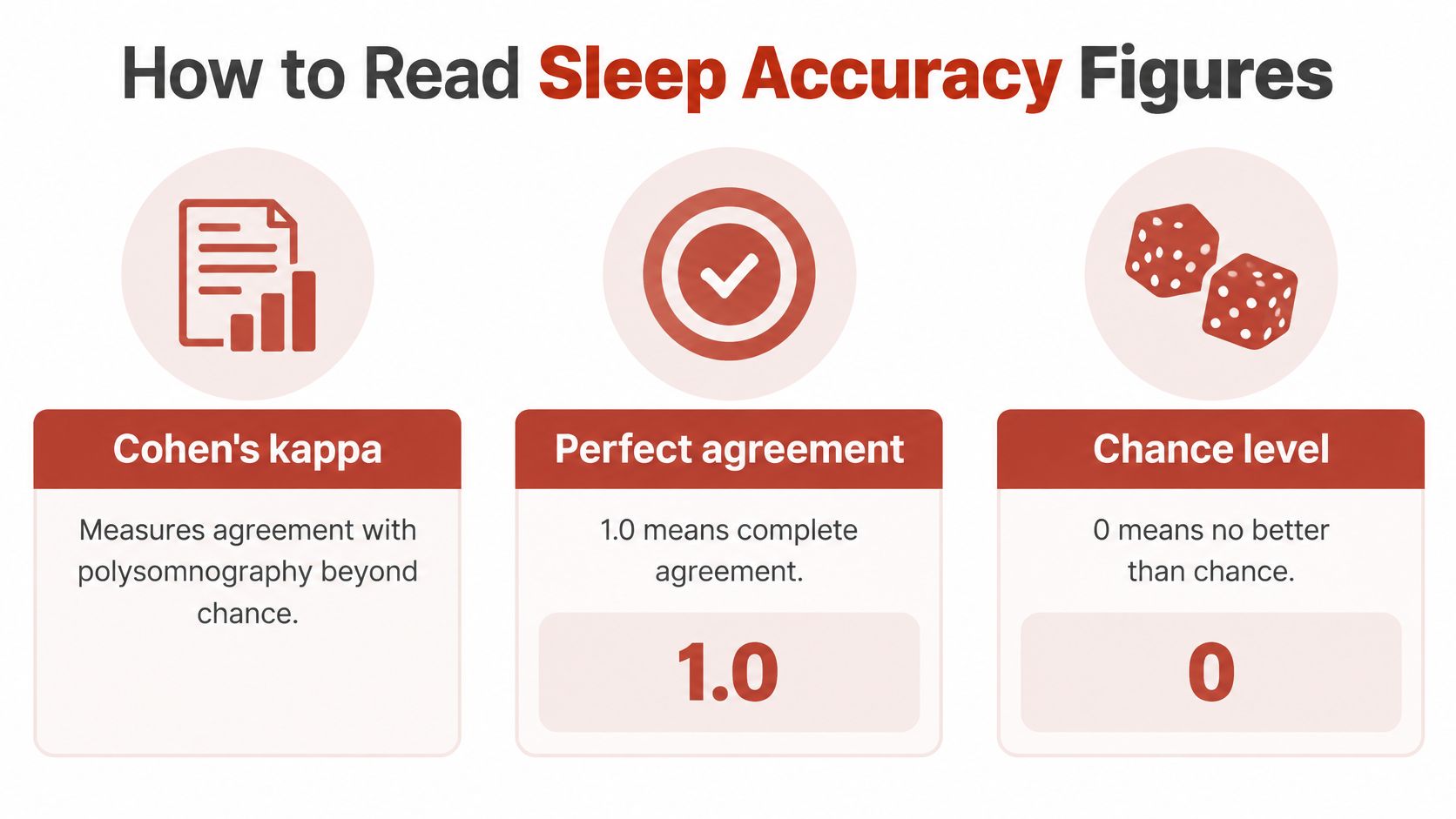
Cohen's kappa is the figure most validation studies lead with and the one buyers understand least. It measures how much better than chance a device agrees with polysomnography. Zero means no better than chance. One means perfect agreement. A kappa near 0.5 is moderate agreement: measurable, reproducible in a lab, and nowhere near a clinical measurement.
The harder question is which kappa a study is reporting. A two-class score only describes how well the watch separates sleep from wake. A four-stage kappa describes how well it tells light, deep and REM apart. A watch can clear the first bar comfortably and still fail the second, which is why a strong headline number and weak stage estimates regularly coexist in the same device.
Why one accuracy percentage fails
A manufacturer that prints a single accuracy figure is almost always reporting sensitivity, the easiest metric to score well on. It counts how often the device says sleep when the laboratory says sleep, and it stays silent on how often the device says sleep while the wearer lies awake.
The 2023 comparison makes that gap concrete. Researchers analyzed 349,114 scoring epochs from 11 consumer sleep trackers against simultaneous polysomnography, as reported in the 2023 multi-device validation study archived in PubMed Central. The best device reached a macro F1 score of 0.69 across sleep-stage classes. The lowest reached 0.26. Same metric, same reference test, a 0.43 spread on a scale where 1.0 is perfect.
Macro F1 averages a device's performance across the wake, light, deep and REM categories, giving each stage equal weight. That design is the point. Light sleep dominates a typical night, so a tracker can look strong on a duration-weighted average while mislabeling deep or REM entirely. Equal weighting removes that cover. If a product page never mentions macro F1, stage-specific kappa or wake specificity, it has published nothing you can check.
The insomnia gap
Validation work in people with insomnia shows the same weakness pushed further. Consumer trackers in that population detect sleep reliably but detect wake poorly, so they tend to overstate total sleep time and sleep efficiency while understating how long the wearer spent awake. That is the failure mode to watch: a device reporting a long, efficient night to someone who lay awake through much of it.
The working rule: treat sleep sensitivity, wake specificity and stage-level agreement as three separate figures. Any claim that merges them into one accuracy percentage should be discounted, and a product page that omits all three tells you nothing checkable.
HearSmart scores each product on three criteria: Performance 40%, Ease of use 25% and Value 35%, with the same weights for every product. That is a consistent way to rank features against price, but it is not a validation result, and a high guide score does not make a watch agree with polysomnography. The sleep statistics collection holds the sourced population figures on short sleep and diagnosed disorders that give these accuracy questions their stakes.
One night's deep-sleep or REM number is not a polysomnography result and should never stand alone in judging whether sleep is adequate. Smartwatch data earns its place across weeks and months, where a persistent pattern becomes visible and a single bad night stops mattering.
Sleep Stage Accuracy Across Brands
Stage-level work is where brands diverge most and where the samples get smallest. A 2024 peer-reviewed study in Sensors compared the Oura Ring Gen3, Fitbit Sense 2 and Apple Watch Series 8 with overnight polysomnography in 35 adults aged 20 to 50 without diagnosed sleep disorders, one night each, as recorded in the 2024 Sensors validation study. Thirty-five people and a single night is a thin evidence base. It's also the best stage-level comparison available for these three devices.
Four-stage kappa and the direction of the error
Kappa here measures agreement across four categories, wake, light, deep and REM, beyond chance. The second pair of columns shows what kappa alone hides: which way each device errs.
Table 2. Four-stage sleep agreement and stage errors, 2024 study.
| Device | Four-stage kappa | Light sleep error | Deep sleep error |
|---|---|---|---|
| Oura Ring Gen 3 | 0.65 | No significant difference | No significant difference |
| Apple Watch Series 8 | 0.60 | Overestimated by about 45 min | Overestimated by about 43 min |
| Fitbit Sense 2 | 0.55 | Overestimated by 18 min | Underestimated by 15 min |
The Oura row is the benchmark. It showed no significant difference from polysomnography for wake, light, deep or REM in this study, which is why a ring keeps appearing in stage-level comparisons inside a guide about watches. It's a different form factor and a different wear pattern, and it gives up the on-wrist display to get there.
The Apple Watch row shows the pattern most buyers miss. A kappa of 0.60 looks respectable, and the device overestimated light sleep by about 45 minutes and deep sleep by about 43 minutes on average. A night scored that way reads as more restful than it was. Total time asleep can land close to right while the restful portion is inflated by most of an hour.
Fitbit Sense 2 errs the other way, overestimating light sleep by 18 minutes and underestimating deep sleep by 15 minutes. Its stage chart understates restful sleep. Neither direction is a rounding error, and both are large enough to change what a reader concludes about a given night.
If deep sleep drives the decision, read the error column before the kappa column.
Wake and deep-sleep sensitivity
Magnitude of error isn't the only lens. A separate Brigham and Women's Hospital validation study, reported in ZDNet's summary of the Oura, Apple Watch and Fitbit comparison, measured sensitivity stage by stage. Oura detected 68.6% of wake periods and 79.5% of deep sleep. Fitbit detected 67.7% and 61.7%. Apple Watch detected 52.4% and 50.5%.
Read those six figures next to Table 2 and a buying rule falls out. A device can sit mid-pack on aggregate agreement and still be the one whose deep-sleep estimate you'd trust most, because aggregate kappa rewards the common categories. Check stage-specific sensitivity before you trust a stage chart.
Treat any single night's deep or REM total as an estimate. The sample behind Table 2 is healthy adults, one night each, on one firmware version, and the results shouldn't be carried over to people with sleep disorders or to a later software release without new validation.
Battery, Comfort and Overnight Charging
A tracker produces data only on nights it's worn, so a dead battery shows up in the record the same way a poor sensor does: as a gap. Apple's own specifications for the Series 10 state up to 36 hours of battery life in Low Power Mode, and 8 minutes of charging can provide up to 8 hours of sleep tracking, according to Apple's published Series 10 technical specifications.
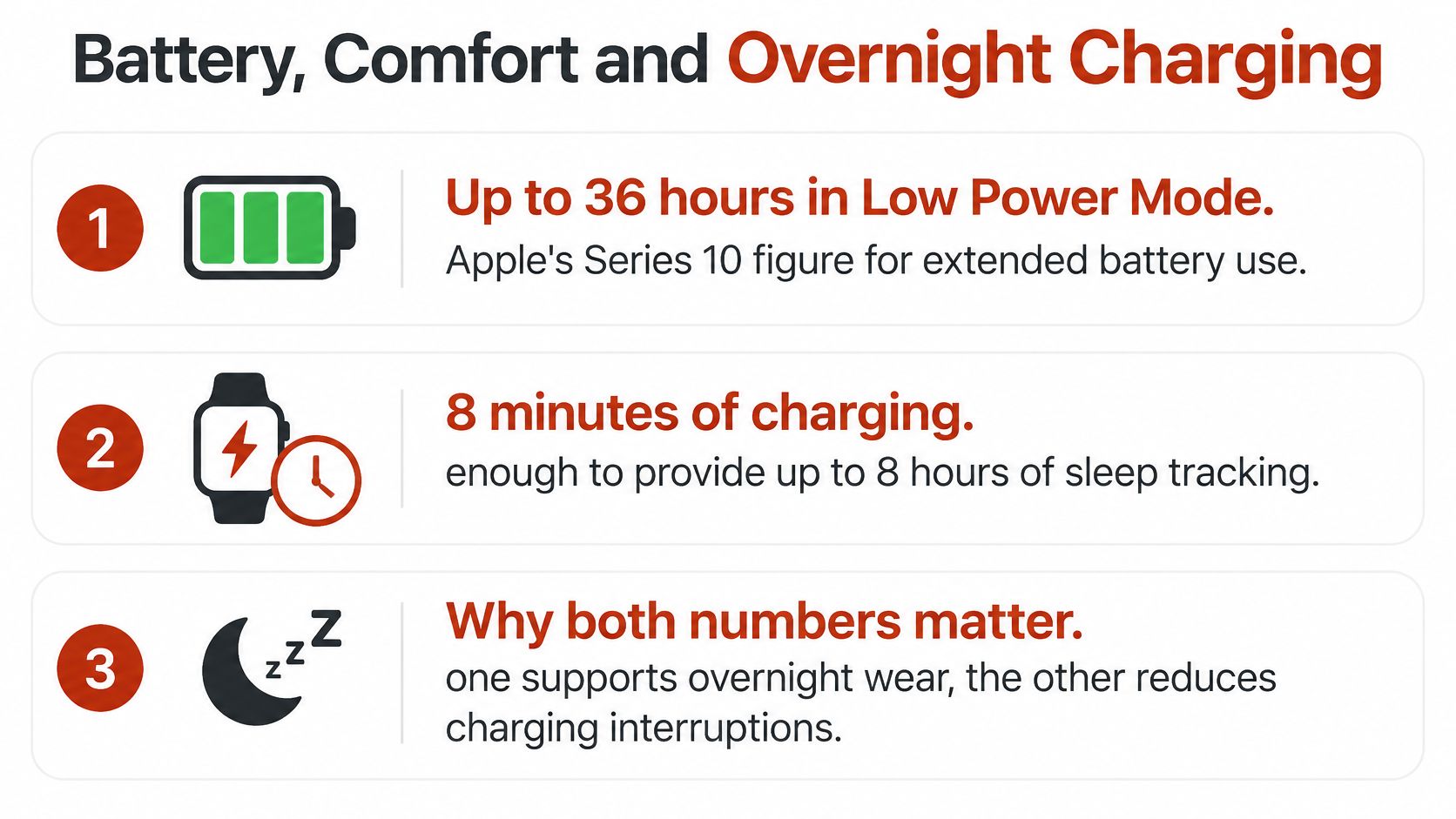
Those two figures answer different questions. The 36-hour number decides whether the watch stays on your wrist through a night and the following day on one charge. The 8-minute number decides whether a forgotten charge costs a full night of data or just a coffee break. And a skipped night is rarely random, since it tends to fall on the evenings when the routine broke down.
Two limits apply. These are manufacturer claims under stated test conditions, not independent measurements, and they describe the Series 10 rather than the Series 8 used in the validation studies above. A battery figure does not transfer across model years, and a charge time measured on one unit says nothing about an older one.
The pre-purchase checklist
- Read battery life in both modes. Normal mode and low power mode carry separate figures, and overnight tracking usually runs in the lower-drain one.
- Find the charge time for one full night. If a top-up takes an hour, the routine only works where you reliably have an hour.
- Decide when charging fits. Morning routine, desk time or early evening. A watch that charges while you sleep is a watch that misses nights.
- Check the sensor back. A raised optical sensor that presses into the wrist can wake you or leave a mark. The case should sit flat enough to wear for seven or eight hours.
- Match the strap to how you sleep. A wrist tucked under a pillow puts pressure on a stiff band. Soft silicone or woven nylon, snug but not tight, keeps sensor contact through the night.
- Confirm automatic start. If tracking needs a manual start every night, you'll forget it within a week.
Before you commit: wear the watch to bed for several nights on a returnable basis, and treat a loose fit as a data problem rather than a comfort preference. A sensor that shifts loses contact and leaves gaps in the record.
Comfort is the one variable no sensor study measures, so a spec sheet can't settle it. Fit decides whether the sensor keeps contact for seven or eight hours straight, and contact decides how much of the night gets recorded.
Sleep Insights, Apps and Real Cost
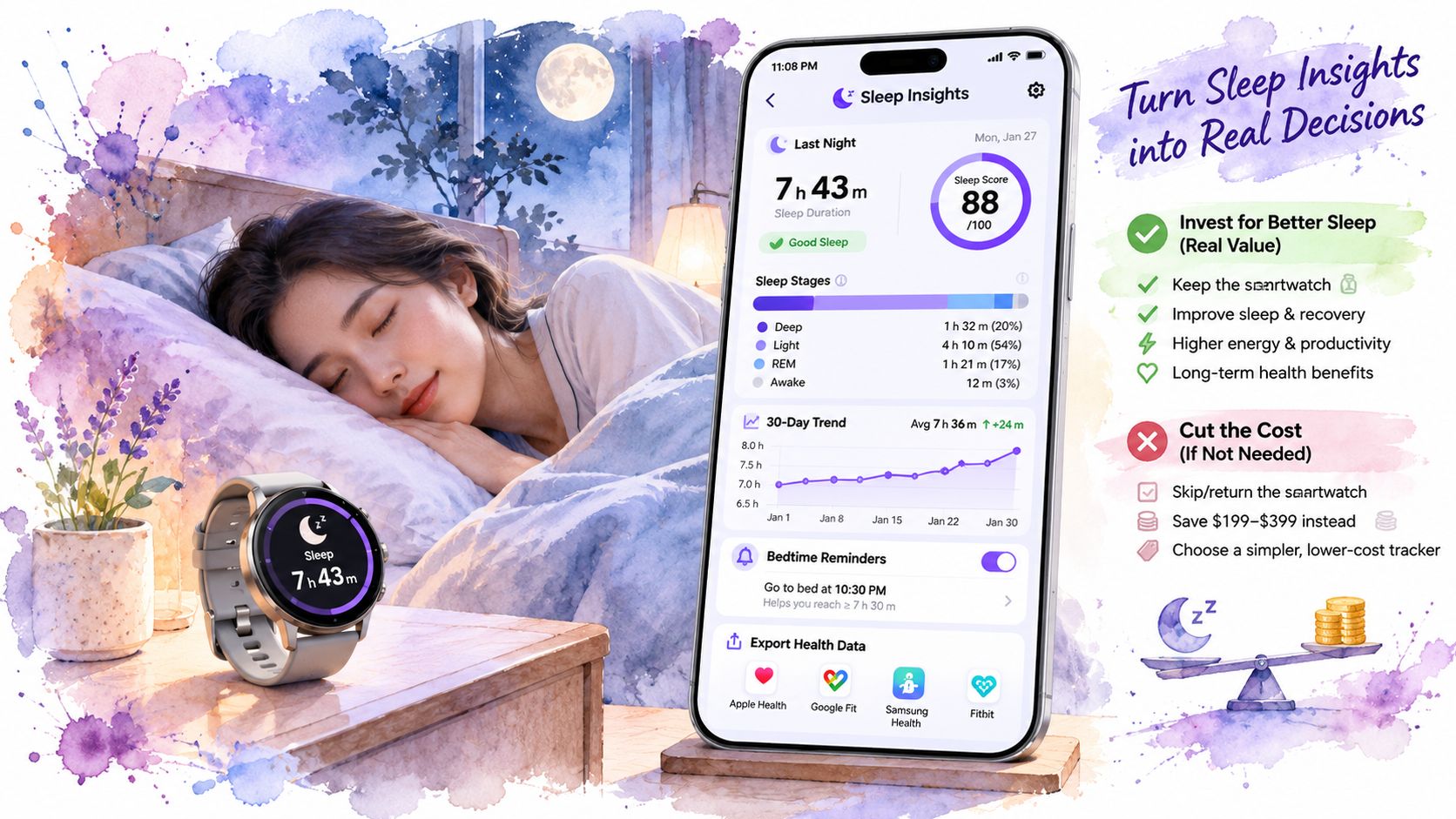
The watch measures. The app interprets, and interpretation is where the subscription money goes. A typical sleep screen shows nightly duration, a composite sleep score, stage breakdowns, a 30-day trend line, a bedtime reminder and an export path into a phone health platform. Most of those inherit the accuracy limits already established.
What the app adds and what it inherits
Duration rests on sleep-wake detection, which makes it the most defensible number on the screen. Stage breakdowns carry the light and deep errors measured against polysomnography, so a nightly deep-sleep total can move substantially while nothing changes in the sleeper.
A sleep score or readiness rating built from heart rate and motion is a weighted summary the manufacturer chose, and those weights aren't published anywhere the buyer can audit. Compare the trend across weeks rather than reading one score as a verdict. Bedtime reminders and smart wake windows sit outside the measurement entirely. They're behavioral tools, and they're often the part that changes anything.
Where the money goes
Three questions settle cost faster than any feature list. Does the core sleep report sit behind a paid tier, or only the extra analysis? Does data export to a health platform without a subscription? Does the app work alone, or does it need a second device on the wrist?
Quote the price from the seller, on the day you check. As a reference point, HearSmart ranks the Fitbit Charge 6, from $129.95 with a score of 8.9, as its top pick in the Best Fitness Trackers ranking, and prices in that ranking are the US prices shown on each maker's own store at the time they were checked. Prices change, so confirm the current figure on the seller's page before buying.
For the app side, the best sleep apps ranking compares what each platform does with data a watch already collects. Add a year of subscription to the device price and pick the paid features you'd use: long-term history, guided programs, a readiness score, or a shareable record for a clinician. If none of those changes what you do the next morning, the free tier is the honest choice.
Matching a Watch to Your Sleep Goal
The right device depends less on the watch than on what the reader wants the data to do. Four situations cover nearly every buyer of a sleep watch, and they point at different products, different accuracy figures and, in one case, a different form factor.
Trends, stages, budget or a clinical concern
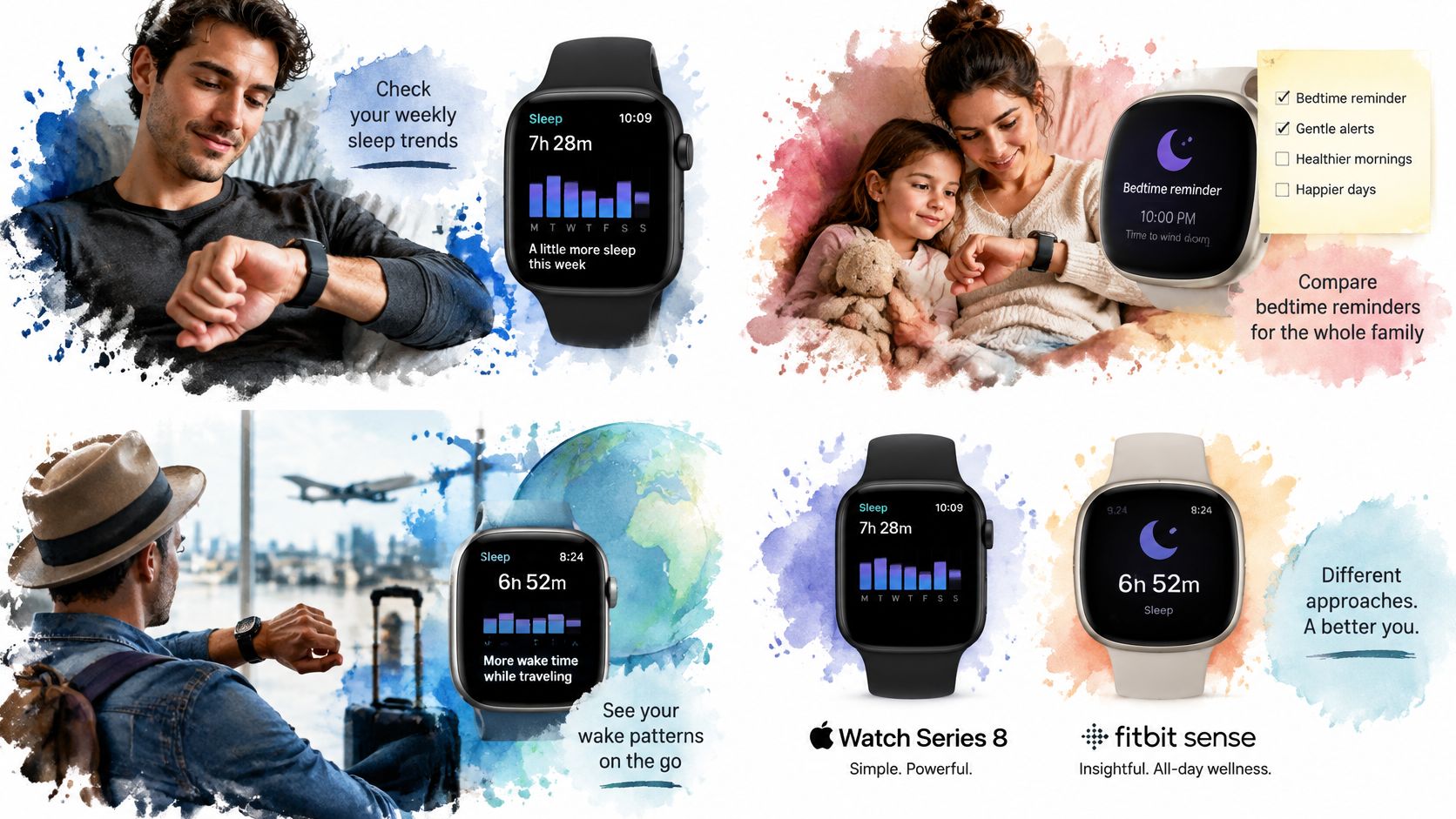
A healthy adult tracking weekly patterns can use the Apple Watch Series 8 or the Fitbit Sense and should read duration and wake patterns rather than exact stage totals. Sleep-wake detection is the measurement the validation literature supports most strongly, and it is the measurement a weekly trend uses.
Someone who cares specifically about light and deep sleep should judge candidates on the error columns in Table 2 before anything else, and accept that the strongest stage-level result in this guide comes from a ring. The best smart rings ranking covers that form factor directly, including the comfort trade-off of wearing something with no display. This is the sharper of the two accuracy questions. A watch can sit close to the laboratory on total sleep time while still overstating deep sleep, so a good-looking summary line does not settle the stage question.
A budget buyer can start lower and accept weaker wake detection. The six-device study shows a wide spread on that measure, so the trade is a known quantity rather than a guess about build quality.
A reader with suspected apnea, insomnia, fragmented sleep or age-related change sits almost entirely outside this evidence base. In a 2025 study of wearable trackers in a sleep-laboratory patient cohort, average agreement with polysomnography did not rule out clinically important inaccuracies on individual nights, as reported in the PubMed record of that patient-cohort study. A rapid review cited in the same body of work found few studies involving people with insomnia, depression or older adults, and reported that REM and deep-sleep estimates were particularly unreliable in the groups most likely to buy a watch for answers.
A watch can document patterns. It cannot diagnose a sleep disorder, and it cannot confirm that deep or REM sleep is adequate, however reassuring the morning score looks.
Why people track in the first place
Motivation shapes the app choice. Many adults say their phone use harms their sleep, and that complaint is a common reason people start monitoring bedtime and screen time together. When that is the goal, a bedtime reminder and a consistent wake time change more than any stage chart.
The clinical cases call for a different discipline. Let the watch build a record of repeated patterns across a fortnight, bring that record to an appointment, and refuse to let a good score talk you out of seeking assessment. The strongest night a watch can show remains a pattern rather than a clinical clearance.
Choose Your Sleep Watch and Check Its Numbers
The verdict is short. The Apple Watch Series 8 showed the strongest wake detection of the six devices in the 2025 comparison, the Fitbit Sense was the next closest, and the Oura ring remains the reference for stage-level work. No watch in this evidence base qualifies as clinically accurate for sleep staging.
The purchase sequence, in order:
- Write down the sleep goal. Weekly trend, deep-sleep detail, or a clinical concern. The answer changes the shortlist before price does.
- Shortlist from Table 1. Sleep sensitivity and wake specificity are the two figures with the widest spread between products.
- Read the stage error columns only if stage totals will decide the purchase.
- Run the charging and comfort checklist and wear the device overnight on a returnable basis where the seller allows it.
- Confirm the price on the seller's own store and note the date you checked it. A quoted price without a date can't be verified later.
- Cost the paid app features separately over 12 months rather than folding them into the device price.
HearSmart's best lists at hearsmart.org cover the adjacent categories, sleep trackers, fitness trackers and sleep apps among them, all scored on one published method. Whichever device makes the shortlist, the ceiling is the same: a watch documents patterns and can support a conversation with a clinician, and it cannot diagnose a sleep disorder.
Start with the goal, not the brand. Write down whether you want weekly trends, deep-sleep detail, or a documented record to take to a clinician, then let that sentence choose the device. Before you pay, open the spec sheet for your shortlist and check three things side by side: battery life in both modes, the charge time for one full night, and the price as shown on the maker's own store with today's date attached. Then wear it to bed for a week and compare the numbers against the nights you remember. If the two don't match, the watch is telling you something about its algorithm, not about your sleep.
Spotted an error in this guide? Email editorial@hearsmart.org