Guide · General
Best Time of Year to Buy a Refrigerator in 2026
Learn the best time of year to buy a refrigerator in 2026, from Black Friday and July Fourth to May clearance, plus rebate rules and delivered-price checks.
By the HearSmart research desk · Updated November 11, 2026 · 11 min read
A Whirlpool French-door refrigerator released in July 2016 was discounted by $500 by November in the Consumer Reports analysis of refrigerator pricing. That drop is the useful starting point: the calendar sets the odds, but release timing can move the low price for a specific unit.
This guide treats the best time of year to buy a refrigerator as a comparison of three inputs rather than a single date: the model's own price history, the delivered price after every charge, and the cost of running the unit after delivery. Check the price on the maker's site before buying, because prices, plans and terms change often. A smaller advertised percentage can still win once delivery, installation, rebate cutoff dates and years of electricity are priced in.
Table of Contents
- Best Months to Buy a Refrigerator
- Why May Clearance Works and What It Costs
- Compare the Delivered Price, Not the Percentage
- Rebates and Deadlines That Change the Timing
- Energy Costs Can Outweigh a Sale Discount
- Choose the Window That Fits Your Situation
Best Months to Buy a Refrigerator
One Samsung French-door refrigerator fell $266 during the July Fourth period, and an LG French-door model came within $50 of its Black Friday low, in Consumer Reports' appliance pricing analysis. Results like those make July Fourth a genuine competitor to Black Friday. Black Friday remains the benchmark because average best prices in the analysis occurred around that event and retailers use it for broad appliance promotions.
The May window behaves differently. Its discounts concentrate on outgoing models as new lines arrive, so a quoted percentage says little until the model's release date and the retailer's inventory position are known. A single month therefore doesn't decide the outcome on its own.
Sale windows compared
| Sale window | Typical timing | Reported evidence | Main trade-off |
|---|---|---|---|
| Presidents' Day sales | February | Refrigerators are eligible in Whirlpool.com's holiday offers, and Fidelity's appliance guide lists Presidents' Day among the sale windows it tracks | Offers exclude taxes, delivery and installation |
| Memorial Day and May model changeover | May | Kiplinger's analysis describes deeper markdowns on outgoing models than on newly introduced ones during Memorial Day and Mother's Day campaigns | Fewer colors, sizes and delivery dates |
| July Fourth promotions | Early July | Selected promotions beat Black Friday lows; one Samsung French-door model fell $266 in Consumer Reports' tracking | Results vary by model and release date |
| Black Friday and Early Black Friday | Late November | Average best prices occurred around Black Friday in Consumer Reports' analysis; Whirlpool's 2026 Early Black Friday offer advertised up to 33% off select appliances | Promotions cover selected products and can end at a stated time |
Each entry records what one source documented, not a forecast for the next sale. The practical use of the table is narrower: it shows no single window wins every year, so a quoted discount should be checked against the seller's current page before it informs a decision.
A baseline and a test
A baseline shows whether a sale price is low in absolute terms. In 2024, the average net refrigerator price fell to $1,057, down $13 from $1,070 in 2023, according to OpenBrand's 2024 annual price comparison. A discount measured against that average reads differently than one measured against a list price the retailer may rarely charge.
Practical rule: Judge a discount against one model's own lowest recorded price, not against a list price the retailer may rarely charge.
The test is simple. Pick one model, record its price in each window at the same retailer, and compare each result with that model's own low. A figure that undercuts the recorded low is a candidate. One that doesn't is a promotion with a persuasive label. The delivered total, rebate deadlines and running cost then decide whether the low sticker is also the cheapest way to own the unit.
Why May Clearance Works and What It Costs
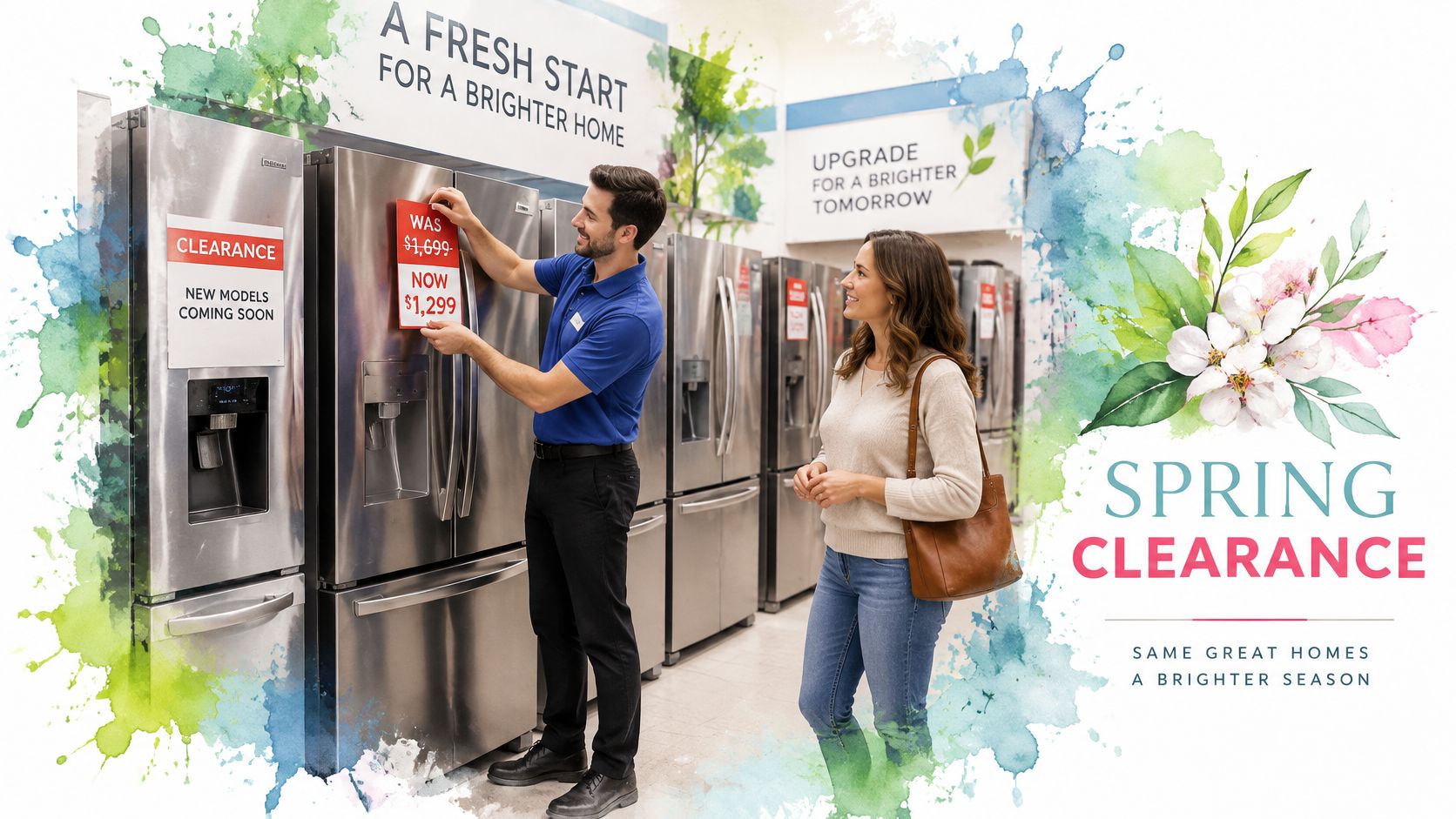
Manufacturers commonly introduce updated refrigerator models in spring or summer, and retailers need floor space for the incoming lines. That inventory pressure is the cause of the May markdown, not the holiday itself. The Fidelity guide to the best time to buy appliances identifies May, particularly Memorial Day, as a favorable window and rates Memorial Day among the strongest annual sales events, with historical Presidents Day discounts of roughly 30% to 50% at major U.S. retailers.
The depth of the cut depends on which side of the changeover a model sits on. In the Kiplinger analysis of the best times to buy household appliances, previous-year refrigerator models may be discounted by as much as 50% in May, while newly introduced models can receive reductions of up to 25% during Memorial Day or Mother's Day campaigns. Previous-generation units often keep core capabilities comparable to the new line, which is where the value sits.
What clearance removes
The cost of May is selection. As outgoing stock sells through, colors, capacities, hinge orientations and delivery dates narrow, so the cheapest unit may not fit the kitchen it's bought for. A household that needs a precise finish, capacity or smart-feature set gets more choice by shopping before clearance, even at a smaller discount.
Checks for any clearance unit should happen before ordering:
- Exact model number: Confirm the full number, since close variants differ in capacity and features.
- Width, height and depth: Measure the opening and the route through doors and hallways.
- Door swing: Verify hinge side and clearance against walls and counters.
- Ventilation clearance: Match the maker's stated gap at the sides, top and rear.
- Electrical requirements: Confirm outlet type and circuit match the specification.
- Ice-maker plumbing: Confirm a water line exists or price the work to add one.
A clearance deal is only a deal when those specifications match the space.
Compare the Delivered Price, Not the Percentage
Sale terms decide what a percentage covers. Whirlpool's Presidents' Day sales page, updated in 2026, lists refrigerators among eligible major appliances, limits discounts to new orders placed on Whirlpool.com, and excludes taxes, delivery, installation, uninstalling and haul-away, subject to availability. The same page lists an Early Black Friday promotion offering savings of up to 33% on select major appliances, with refrigerators included.
Those exclusions are the reason the advertised percentage can't be compared across retailers. One seller folds delivery into the price, another charges for it, and a third excludes haul-away of the old unit. Two identical percentages can therefore produce different totals on the same model.
The delivered-price method
- Advertised price: Take the price for the exact model number, not a similar configuration.
- Delivery and haul-away: Add both charges, including removal of the old unit.
- Installation: Add fitting work and any water-line work for an ice maker.
- Sales tax: Add tax on the full taxable amount.
- Extended warranty: Add it only if the household would buy one anyway.
- Cross-window total: Compare that total with the same model's total in another window.
Context on how buyers shop and pay online is set out in HearSmart's online shopping statistics, which readers can use when weighing checkout charges against headline prices.
A larger percentage on a narrower base often costs more than a smaller percentage that includes delivery.
Whirlpool limits its promotions to selected products and can end them at a stated time, so the day with the largest headline figure isn't always the cheapest day to order. The page was updated in 2026 and seller prices, inventory and end dates can change. HearSmart advises readers to check the price on the maker's site before they buy or upgrade, because makers change prices, plans and terms often.
Rebates and Deadlines That Change the Timing
A utility rebate runs on the program's calendar, not the retail calendar, and a missed deadline voids the full amount rather than reducing it. Consumers Energy's appliance-rebate page, marked 2026, states that qualifying ENERGY STAR refrigerators and freezers receive a $25 rebate for electric customers, limited to one rebate per calendar year per household, with compact models excluded. The buyer must purchase and install an eligible appliance, retain the receipt and submit an application, and checks are expected six to eight weeks after application.
Local programs can be stricter. The Omaha Public Power District ENERGY STAR rebate page states that its program relaunched on January 1, 2026, accepts receipts dated on or after that day, requires application within 90 days of the invoice or delivery date, pays within 60 days, and covers only refrigerators of 13.9 cubic feet or larger. Two consequences follow. A purchase made in the days before the relaunch earns nothing under it. An application filed after the 90-day window closes earns nothing either, whatever the receipt shows.
Two programs compared
| Utility | Eligibility limits | Deadline and payment timing | Source and year |
|---|---|---|---|
| Consumers Energy | One rebate per calendar year per household; compact models excluded; receipt retained | Checks expected six to eight weeks after application | Consumers Energy appliance rebate page, 2026 |
| Omaha Public Power District | Refrigerators of 13.9 cubic feet or larger; receipts dated January 1, 2026 or later | Application within 90 days of invoice or delivery; check within 60 days | OPPD ENERGY STAR rebate page, 2026 |
The practical reading is that a rebate's value is binary. File inside the window and it applies in full; file outside it and the amount is zero. A household that already claimed its Consumers Energy rebate this calendar year has nothing left to claim, so its cheapest window is set by price alone. A household in Omaha starts its 90-day filing clock on the invoice or delivery date, not on the day it decides to apply.
Households that stack a rebate with card or app rewards can compare options in HearSmart's guide to the best cashback apps before ordering.
Five checks before relying on a rebate
- Find the utility page: Start with the household's own electricity provider.
- Confirm capacity and model rules: Check size thresholds and excluded categories, such as a minimum capacity or a compact-model exclusion.
- Confirm the purchase-date window: Match the receipt date to the program's start date.
- Keep the receipt: Save the invoice and delivery record together.
- Submit before the deadline: Note the application window at the time of purchase, because it runs from the invoice or delivery date.
An earlier purchase can beat a holiday sale when a rebate budget, household limit or filing deadline closes before the next sale window. Amounts and terms change by utility and year, so the figures above describe two named programs only.
Energy Costs Can Outweigh a Sale Discount
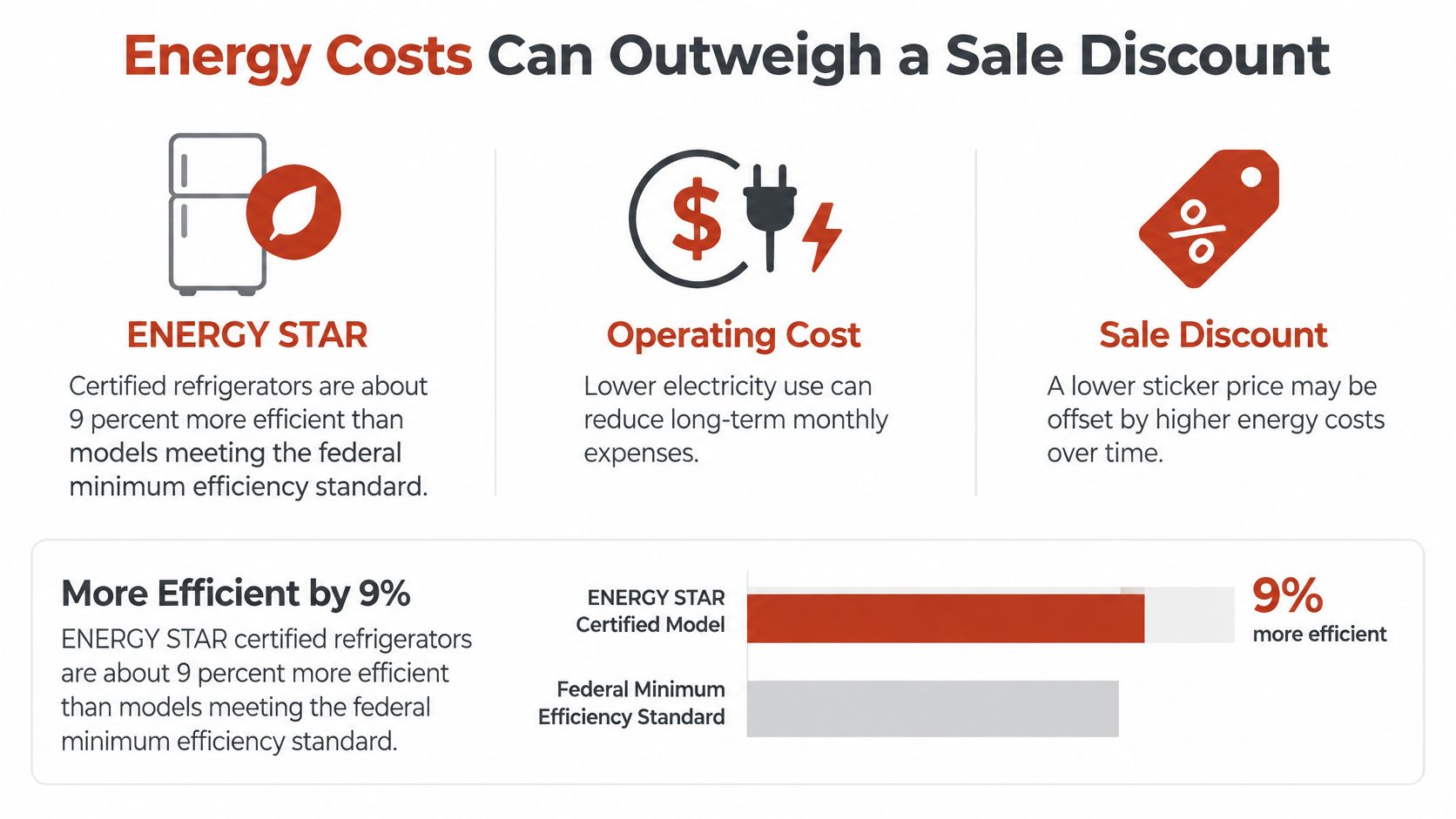
Operating cost is the figure most sale coverage leaves out. The U.S. Environmental Protection Agency's ENERGY STAR refrigerator page, updated in 2026, states that certified refrigerators are about 9% more energy efficient than models meeting the federal minimum efficiency standard. EPA refrigerator material also indicates that replacing an older unit with a new ENERGY STAR model lowers running costs across the appliance's life, and that a second refrigerator kept running in a basement or garage adds to the annual electricity bill.
Published estimates
| Comparison | Published estimate | Source |
|---|---|---|
| Certified refrigerators against federal minimum models | About 9% more efficient | ENERGY STAR refrigerator page, 2026 |
| Replacing an older unit with a new ENERGY STAR model | Lower running cost over the unit's life | EPA refrigerator guidance |
| A second refrigerator in a basement or garage | A higher annual electricity bill | EPA refrigerator guidance |
Percentages undersell what an efficiency gap does over time. An efficient model bought at a modest discount can cost less to own than a power-hungry model bought at a deeper one, because the difference repeats on every electricity bill for the life of the appliance. Actual savings depend on local electricity prices, household usage and the specific model. Readers comparing connected appliances alongside efficiency can check HearSmart's home and smart home statistics for sourced context on household technology.
The total-cost method
- Annual energy use: Find the figure on the label or the ENERGY STAR listing.
- Local price per kilowatt-hour: Multiply annual use by the household's electricity rate.
- Service-life difference: Compare the annual gap between two models across the expected life.
- Utility rebate: Subtract any confirmed rebate from the purchase cost.
- Delivery, installation and disposal: Add all three to reach the true total.
A discounted model that draws more power hands its sale saving back to the utility over time. A household running an old, inefficient unit also pays for every month it waits, so a modest discount taken now can beat a bigger one taken later.
The cheapest refrigerator to buy and the cheapest refrigerator to own are often different models.
The method applies outside the United States, but the figures do not. Buyers in other markets need the local efficiency label and local electricity prices in place of the federal minimum standard and American estimates.
Choose the Window That Fits Your Situation
The right window depends on what the household can't change. A flexible buyer can chase the lowest recorded price, because several models will do. A buyer with a fixed opening, a rebate deadline or a failing unit has fewer degrees of freedom, and the calendar matters less than those constraints.
Situation, window and check
| Buyer situation | Window to watch | Reported evidence | Check before ordering |
|---|---|---|---|
| Fixed budget with a flexible model | Black Friday and July Fourth | Average best prices around Black Friday; July Fourth can beat them (Consumer Reports, year not stated) | Same-model price in both windows at one retailer |
| Accepts a prior-generation model | May Memorial Day changeover | Previous-year models cut up to 50% (Kiplinger, year not stated) | Exact dimensions and door swing |
| Needs a specific finish, capacity or feature set | Earlier shopping, before clearance narrows choice | Selection narrows as inventory sells through (Kiplinger, year not stated) | Model number and color availability |
| Utility rebate deadline or household limit | Before the deadline, even outside a sale | Program terms (Consumers Energy, 2026; OPPD, 2026) | Receipt date window, capacity rule and submission deadline |
| Old unit still running | Buy when total cost beats waiting | ENERGY STAR certified about 9% more efficient (ENERGY STAR, 2026) | Annual energy use and local electricity price |
Two of these rows point away from sale events entirely. A rebate deadline rewards buying before a date the retailer doesn't control, and an inefficient unit charges its owner for waiting. Both cases show why the best time of year to buy a refrigerator is a household calculation, not a fixed month.
The evidence also has limits that readers should keep in view. Several published comparisons don't state the year of the underlying pricing, and the model-level examples describe individual units rather than market averages. They support the shape of the calendar, not a promise about any one model in 2026.
The rule is to buy when the delivered total beats the same-model target and the specifications fit the space. Otherwise, the household sets a price alert on that model and waits for the next window. HearSmart advises readers to check the price on the maker's site before they buy or upgrade, because makers change prices, plans and terms often.
Readers ready to act should run the delivered-price method on the model already shortlisted, add delivery, installation, tax and haul-away, then compare that total with the same model's price in the next window listed above. Readers who want the underlying figures before deciding can work through HearSmart's linked statistics pages, note the publisher and year for each number, and set a target price from the model's own history rather than from a retailer's percentage.
Spotted an error in this guide? Email editorial@hearsmart.org