Guide · General
How to Choose a Mattress: Firmness, Materials and Size
How to choose a mattress by sleep position, firmness, materials and size, with sourced research and return policy checks for 2026.
By the HearSmart research desk · Updated November 27, 2026 · 14 min read

The hardest mattress on the showroom floor doesn't give most adults the best back support, and a brand's firmness label can't predict how a surface will hold up under a different body weight. Knowing how to choose a mattress comes down to four grounded steps: treat firmness as a body-specific fit rather than a quality score, match mattress materials to the joints that bear the most load, confirm spinal alignment through a structured test and multi-week home trial, and compare seller-published return and warranty rules before checking out.
Shoppers often get tripped up because mattress brands don't share a global firmness scale, and a brief lie-down in a store feels nothing like a month of real sleep. Looking at clinical trials, pressure-mapping experiments, and published seller policies side by side removes most of the guesswork.
Table of Contents
- Start With Your Sleep Position and Firmness
- Pick a Material for Your Pressure Points
- Size, Body Weight and Sharing a Bed
- How to Test a Mattress Before You Commit
- Read Return and Warranty Terms Before Paying
- Confirm Your Shortlist and Budget
Start With Your Sleep Position and Firmness
A medium-firm mattress is the safest starting point for most adults, and a sleeper's dominant position decides how far to adjust softer or firmer from that baseline. Firmness works as a health and comfort variable, not a hierarchy where harder automatically means higher quality.
The strongest clinical evidence comes from a 2003 multicentre, randomized, double-blind trial published in The Lancet that enrolled 313 adults with chronic, nonspecific low-back pain who felt discomfort while lying in bed or getting up. Researchers assigned participants either a firm mattress rated at a hardness value of 2.3 or a medium-firm mattress rated at 5.6. After 90 days, the medium-firm group achieved better outcomes for pain in bed, with an odds ratio of 2.36 (95% confidence interval 1.13 to 4.93), along with better scores for pain on rising (odds ratio 1.93) and disability (odds ratio 2.10, 95% confidence interval 1.24 to 3.56).
Those findings carry clear boundaries that shoppers should keep in mind. Because the trial studied adults with chronic low-back pain, it doesn't prove that one single firmness level suits every healthy sleeper. Mattress hardness ratings also aren't standardized globally, so a "medium-firm" bed from one brand can feel noticeably softer or harder than a bed carrying the exact same tag from a competitor.
Matching Firmness to Sleep Position
Sleep posture determines which parts of the body press hardest into the surface and where the spine risks bending out of line. Back sleepers need the lower back supported without the hips dropping deep into the bed, while side sleepers need enough surface give for the shoulder and outer hip to settle cleanly. Stomach sleepers face the opposite problem, since even moderate sink at the midsection forces the lower back into an unnatural arch.
| Sleep position | Firmness to try first | Pressure or support priority | Warning sign |
|---|---|---|---|
| Back sleeper | Medium-firm | Stable lumbar support with no hammock sag | Pelvis sinks below rib cage |
| Side sleeper | Medium-soft to medium | Shoulder and hip pressure relief | Shoulder or hip ache by morning |
| Stomach sleeper | Medium-firm to firm | Limited midsection sink | Lower back arches or feels unsupported |
| Combination sleeper | Medium | Easy repositioning | Effort needed to change position |
Fit rule: Treat a brand's firmness label as a rough starting filter, never as a standardized specification that guarantees spinal alignment.
Shoppers dealing with persistent lumbar stiffness can compare documented specs and suitability notes in HearSmart's guide to the best mattresses for back pain. Once a sleeper identifies the right row in the table above, the next decision is choosing an internal material that relieves pressure at the heaviest contact points without letting the torso sag.
Pick a Material for Your Pressure Points
A firmness label cannot predict how a mattress will cushion a sore shoulder or hip. Two equally firm beds may spread weight differently, so pressure distribution deserves separate attention from perceived softness. Firmness describes a feel, not a quality score.
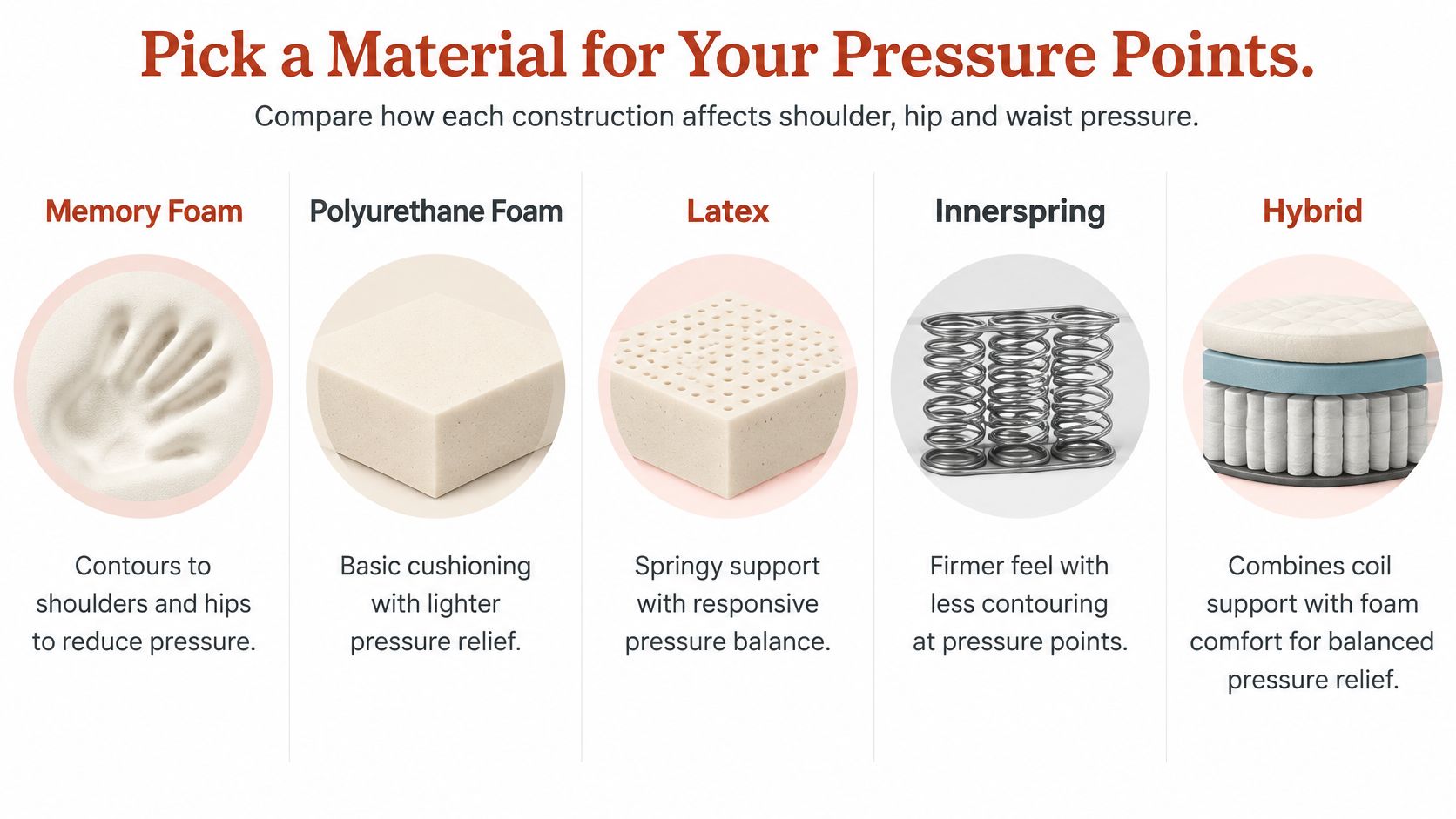
Material determines how the surface yields around the body. Memory foam molds closely around shoulders and hips, creating a cradle that can cushion joints but make position changes feel slower. Standard polyurethane foam provides lighter cushioning and can leave more concentrated pressure under bony areas. Latex responds quickly, combining cushioning with a buoyant feel that supports the waist.
Traditional innerspring mattresses use metal coils beneath thinner padding, producing a bouncier surface with less localized contouring. Hybrid beds combine a coil support core with thicker foam or latex comfort layers. Their pressure relief therefore depends partly on the cushioning above the coils, rather than on the hybrid label alone.
The distinction is similar to a cushion resting on a spring: the top layer shapes contact with the body, while the structure underneath contributes support.
In a controlled side-sleeping posture study archived on PubMed Central, latex produced peak contact pressures 35.1% lower at the side torso and 28.2% lower at the side buttocks than polyurethane foam. These measurements show a difference between the tested surfaces in that posture. They do not establish that every latex mattress relieves pain, or that materials with the same retail firmness label will perform identically.
| Material | Typical pressure-relief behavior |
|---|---|
| Latex | Buoyant cushioning around contact points with quick response |
| Polyurethane foam | Lighter cushioning that can leave pressure more concentrated under bony areas |
| Memory foam | Close contouring around shoulders and hips, with deeper cushioning that can slow repositioning |
| Innerspring | Firmer, springy support with less localized contouring beneath thinner padding |
| Hybrid | Coil support combined with foam or latex comfort layers that cushion contact points |
The table describes construction tendencies, not a ranking. A shopper comparing materials should distinguish relief at a sore contact point from the feeling of sinking into the bed.
Foundations, Durability and Cooling Claims
Paying more for high-density foam or natural latex does not automatically establish a longer service life. Density alone cannot prove durability. Written warranty thresholds for sagging give shoppers a more concrete protection to compare than material labels alone.
The base matters, too. An uneven, worn, or overly flexible foundation can alter support beneath an otherwise suitable comfort layer. Comparing mattresses on a rigid, compatible base helps separate the surface feel from problems underneath it.
Cooling claims require another distinction: feeling cooler and sleeping better are different outcomes. A 2025 trial of a temperature-controlled mattress cover indexed on PubMed reported improved self-reported sleep quality and thermal perceptions, but only minimal changes in objective or biometric sleep outcomes. The authors noted that expectancy or placebo effects might partly explain the subjective improvements. That trial concerned a temperature-controlled cover, so its findings should not be extended to cooling foams or gels.
For hot sleepers, whole-night comfort during a home trial is more useful than a cooling label alone. Before paying a premium, shoppers should compare the seller's published return terms alongside price, rather than assume trial protection is standard. Active temperature-control systems also warrant consideration of noise, electricity use, and maintenance against simpler breathable constructions.
Size, Body Weight and Sharing a Bed
Standard US mattress sizes give shoppers a clear footprint to compare against bedroom walls, doorways, and sleeping partners. A size chart is only a starting point, though, because the bed frame border, headboard depth, and room clearance decide whether a bed fits comfortably in daily use.
| Size | Width x length (in) | Typical case |
|---|---|---|
| Twin | 38 x 75 | Child, narrow room or guest bed |
| Twin XL | 38 x 80 | Taller single sleeper in a dorm or narrow room |
| Full | 54 x 75 | Single adult with limited floor space |
| Queen | 60 x 80 | Most couples in standard bedrooms |
| King | 76 x 80 | Couples who want more room or a partner who moves often |
| California king | 72 x 84 | Taller sleepers who need length over width |
Support under the frame matters just as much as the outer dimensions, especially for wider Queen, King, and California king models that need center-beam reinforcement. Shoppers pairing a new bed with a platform, slatted base, or box spring can review compatibility and load-bearing specs in HearSmart's guide to the best mattress foundations.
Why Body Weight Changes Effective Firmness
One of the biggest blind spots in mattress shopping is treating firmness as a fixed property of the bed rather than an interaction between the bed and the person lying on it. Research reviewed in a PubMed Central paper on mattress firmness and sleep found that higher body weight was associated with more neutral spinal alignment on firmer mattresses, while lower-weight participants maintained better alignment on softer mattresses. Say a lighter sleeper and a heavier sleeper test the exact same "medium" mattress: the heavier sleeper compresses the comfort layers deeper and experiences the bed as softer, while the lighter sleeper barely compresses the top foam and experiences the bed as firmer.
Evidence in this area still has limits that deserve plain reporting. An experimental study highlighted in the same literature found that medium firmness improved sleep measures for participants with moderate BMI, yet it enrolled only 12 people and noted that much earlier mattress research relies on subjective surveys rather than physiological measurements. That small sample means moderate-BMI findings shouldn't be stretched into a blanket rule for heavier side sleepers or lighter back sleepers.
Couples with substantially different body sizes or temperature preferences face a real trade-off on a shared surface. A mattress firm enough to keep a heavier partner's hips level may feel unyielding under a lighter partner's shoulders, and two people lying together change how the comfort layers flex. Before settling on a size or model, keep three practical checks in order:
- Measure the delivery path first: Confirm bedroom floor space plus hallway turns, stairwells, and doorway widths before ordering a King or California king.
- Check total bed height: Add the height of the bed frame, foundation, mattress, and any topper together so getting in and out of bed stays comfortable.
- Count every regular sleeper: Account for partners, children, or pets who share the bed when deciding between a Queen, King, or California king.
How to Test a Mattress Before You Commit
A quick five-minute lie-down in a store rarely reveals how a bed behaves at three in the morning. Using a two-stage fit test gives shoppers a repeatable way to screen out poor matches before money changes hands.
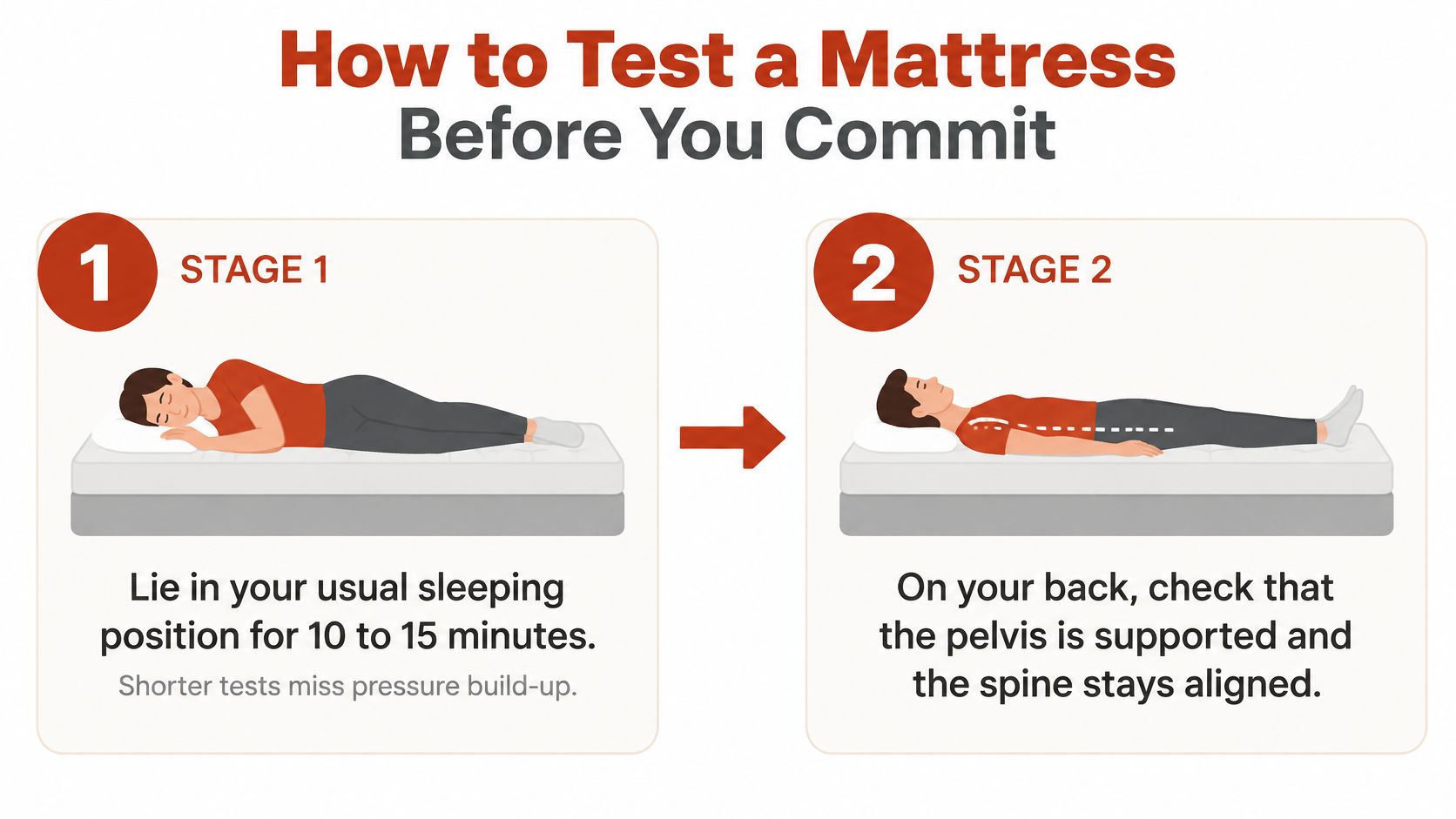
Start Stage 1 by screening for a subjectively medium-firm surface, since a systematic review of controlled trials indexed on PubMed found that medium-firm mattresses generally best supported comfort, sleep quality, and spinal alignment, without establishing a simple linear rule where firmer always means better. Before beginning Stage 2, name the dominant sleeping posture and heaviest contact zones (such as the shoulder and hip for side sleepers, or the pelvis for back sleepers), because those zones decide which alignment check carries the most weight.
- Lie in the usual sleep posture for 10 to 15 minutes. Shorter tests miss how foam warms, compresses, and builds localized pressure around bony joints.
- Run the back-sleeping check. While lying flat, notice whether the pelvis drops visibly below the rib cage or whether a hand slides easily under a gap at the lower back.
- Run the side-sleeping check. Confirm that the shoulder and outer hip sink far enough into the comfort layer to keep the neck and spine roughly level from ear to tailbone.
- Eliminate obvious misfits immediately. Walk away from any model if sharp pressure builds at the shoulder or hip, the lumbar area feels hollow and unsupported, or rolling from side to back takes unusual effort.
- Test with a partner on the bed. Both sleepers should lie down simultaneously and change positions to check how strongly movement transfers across the surface, since a bed that passes a solo test can fail when two people share it.
- Confirm the exchange mechanics before paying. Verify the minimum trial duration, return or restocking fees, pickup conditions, whether a mattress protector is required, and whether the seller permits a firmness exchange.
- Track real nights during the home trial. Keep brief morning notes on sleep quality, waking stiffness, and daytime energy across several weeks instead of relying on first-night impressions.
Why a Multi-Week Home Trial Beats a Showroom Test
Body temperature, joint pressure, and subtle spinal strain accumulate across repeated nights in ways a brief store visit can't replicate. A 2011 peer-reviewed study from RTI Press recruited 128 healthy adults in the Raleigh-Durham, North Carolina area and used a Latin-square randomized design in which participants slept at home on seven test mattresses for approximately four weeks per mattress. Measured via actigraphy and sleep diaries, firmness significantly affected 9 of 11 key sleep measures, and a related report recorded an average 0.19-point (or 3.5%) improvement in sleep quality between each sleeper's best and second-best beds (p<0.0001), yet individuals varied widely in which mattress delivered their best rest.
Because personal response varies so sharply, a generous in-home trial functions as an essential risk-control feature rather than a marketing bonus.
If morning stiffness or joint pain persists after the adjustment period, treat it as a fit failure and reassess the mattress and pillow height together instead of automatically jumping to a firmer bed. An overly firm surface blocks shoulder accommodation and can worsen neck, shoulder, or hip discomfort.
Read Return and Warranty Terms Before Paying
A tempting mattress price can hide the cost of a wrong choice. Return windows and warranty rules work like the fine print on insurance: they matter most when the bed feels wrong or develops a defect. Many shoppers read a "90-night trial" as a free refund at any point, or treat a "10-year warranty" as a promise to replace any mattress that feels softer. Brand documents describe a narrower set of protections.
Under Sealy's published return policy, eligible Sealy models have a 90-night trial, with a 30-night minimum before a return request. Sealy states that if the concern cannot be resolved, it will take the mattress back and refund the purchase price minus the return-shipping fee. The same policy lists Cocoon by Sealy mattresses separately with a 100-night trial. These are seller-published terms for particular product lines, not industry-wide rules, so the value lies in what they protect and what they deduct.
Warranty terms work differently. They cover defined defects, not every change in comfort. Serta's official warranty page specifies a 10-year limited warranty with two indentation thresholds: sagging must measure more than 0.75 inches on smooth-top models and more than 1.5 inches on quilted mattresses. It also lists coverage for foam that splits or cracks and certain cover defects such as unraveled stitching, subject to the document's terms and exclusions. The shape of the mattress matters, like measuring a dent in a cushion by its construction rather than by touch alone.
Comparing Seller Protection Against Seller Conditions
Published terms show what each seller states. Serta's warranty page does not list trial length, adjustment period, or refund basis, so shoppers need the seller's return page for those terms.
| Term | Sealy published terms | Serta published terms |
|---|---|---|
| Trial length | 90 nights, 100 nights for Cocoon by Sealy | Not listed on warranty page |
| Adjustment requirement | Try for 30 nights before requesting a return | Not listed on warranty page |
| Refund basis | Purchase price minus return shipping fee | Not listed on warranty page |
| Warranty length | Not listed on return-policy page | 10-year limited warranty |
| Sag threshold | Not listed on return-policy page | More than 0.75 in smooth-top, more than 1.5 in quilted |
The practical lesson is that firmness and sagging are separate questions. A quilted mattress with a one-inch body impression may feel uncomfortable each morning while still sitting below the stated warranty threshold. A required adjustment period gives the body time to adapt, while a shipping deduction lowers the refund. Read the trial as a test period with conditions and the warranty as defect coverage with measurements.
Documentation habit: Save a screenshot or note of the exact mattress model name, the policy URL, and the date checked before placing an order, because sellers change trial terms, shipping fees, and exclusions.
Confirm Your Shortlist and Budget
Rather than trying to compare dozens of brands at once, narrow the decision to two mattresses that fit the sleeper's posture, material needs, room dimensions, and written protection terms, then start a home trial with the stronger candidate.
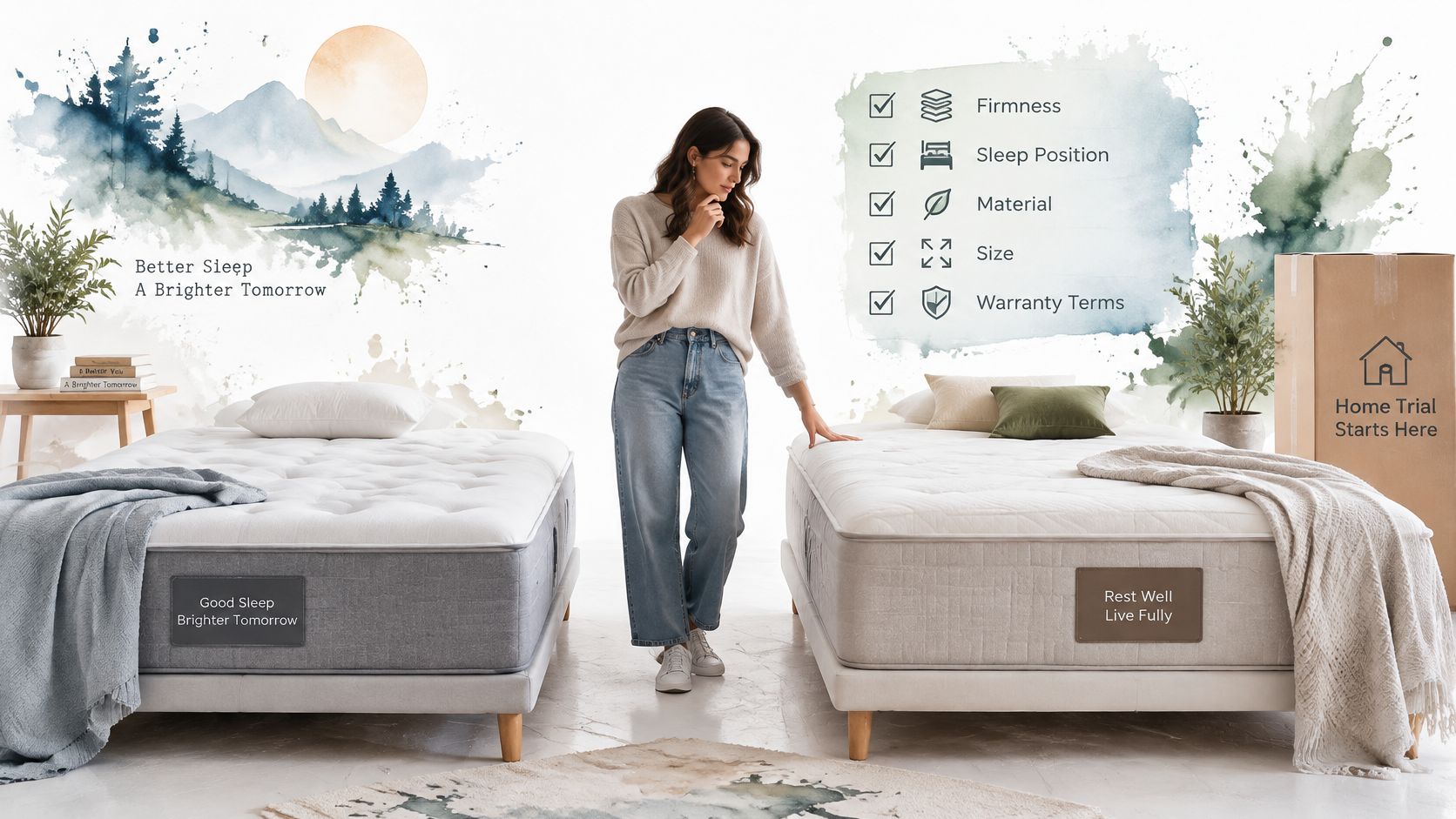
Run both shortlisted models through a five-point final check in order before entering payment details:
- Firmness aligned to sleep position and weight: Confirm the surface matches the primary sleeping posture and adjusts for lighter or heavier body weight rather than relying on a generic label.
- Material matched to pressure zones: Pick the comfort layer construction (latex, memory foam, polyurethane foam, innerspring, or hybrid) that relieves shoulder or hip pressure without letting the waist collapse.
- Size verified for room and partner: Double-check bedroom clearance, delivery stairwells, and shared sleep space.
- Trial and exchange terms written out: Confirm the minimum adjustment period, return-shipping fees, pickup rules, and protector requirements on the seller's live page.
- Warranty sag threshold recorded: Note the exact indentation depth required for that mattress construction (smooth-top versus quilted) along with exclusions.
Setting an All-In Mattress Budget
Set a firm spending ceiling for the complete bed setup rather than focusing solely on the headline mattress tag. Delivery fees, old-mattress haul-away, a compatible foundation, a waterproof mattress protector (often required to keep warranty coverage valid), and sales tax can add substantially to the checkout total.
For broad market context on what buyers pay, the UK National Bed Federation's 2025 survey of 1,000 recent bed or mattress buyers reported that average mattress spending rose 8.4% to £645, up from £595 in 2024. Treat that figure as a UK market signal rather than a fixed US price target, since mattress sizing, materials, and retail structures differ by region.
HearSmart operates as an independent guide to what to buy, accepting no paid placements and scoring products with one consistent formula across documented specs and published prices: performance 40%, ease of use 25%, and value 35%. Shoppers timing a purchase or comparing current markdowns can check HearSmart's guide to the best mattress sales and deals alongside HearSmart's mattress best lists and statistics pages. Because manufacturers change prices, bundles, and policy terms frequently, HearSmart advises readers to verify the exact live price and return rules directly on the maker's website before buying.
Narrow your options to two mattresses that pass the alignment, material, size, and warranty checks above, then confirm the live price, shipping deduction, and sag threshold directly on the manufacturer's site before ordering. Once your top choice arrives, book the start of your in-home trial on a calendar and set a reminder well ahead of the return deadline so you have time to evaluate morning stiffness and request an exchange or refund if the fit falls short.
Cite this page
HearSmart. How to Choose a Mattress: Firmness, Materials and Size. Updated November 27, 2026. https://hearsmart.org/how-to-choose-a-mattress
Spotted an error in this guide? Email editorial@hearsmart.org