Review · Money
 Public review
An investing app with $0 commissions on US-listed stocks and ETFs in regular and extended hours, plus options order flow rebates.
By the HearSmart research desk · Updated November 24, 2026
The short answer
Public is a US online broker with $0 commissions on stocks, ETFs and their options, a $0.06 to $0.18 rebate per stock or ETF options contract and margin from 5.15%, as checked in November 2026. Core service is free; Public Reserve costs $20 a month or $200 a year and raises the cash account from 3.30% to 3.75% APY. It suits options traders, margin borrowers and savers who want cash, bonds and stocks in one app; mutual fund buyers and anyone who wants phone support should look at Fidelity or Schwab.
- Performance (40%)
- 8.0
- Ease of use (25%)
- 8.8
- Value (35%)
- 8.6
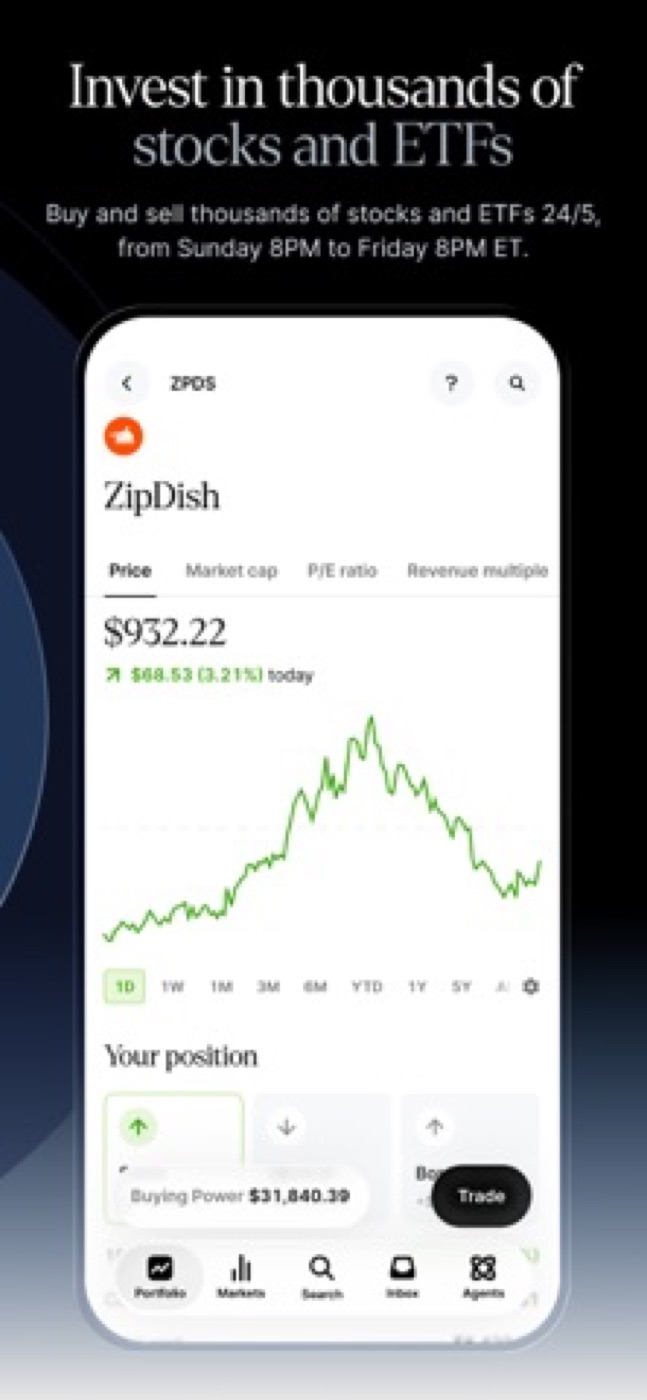
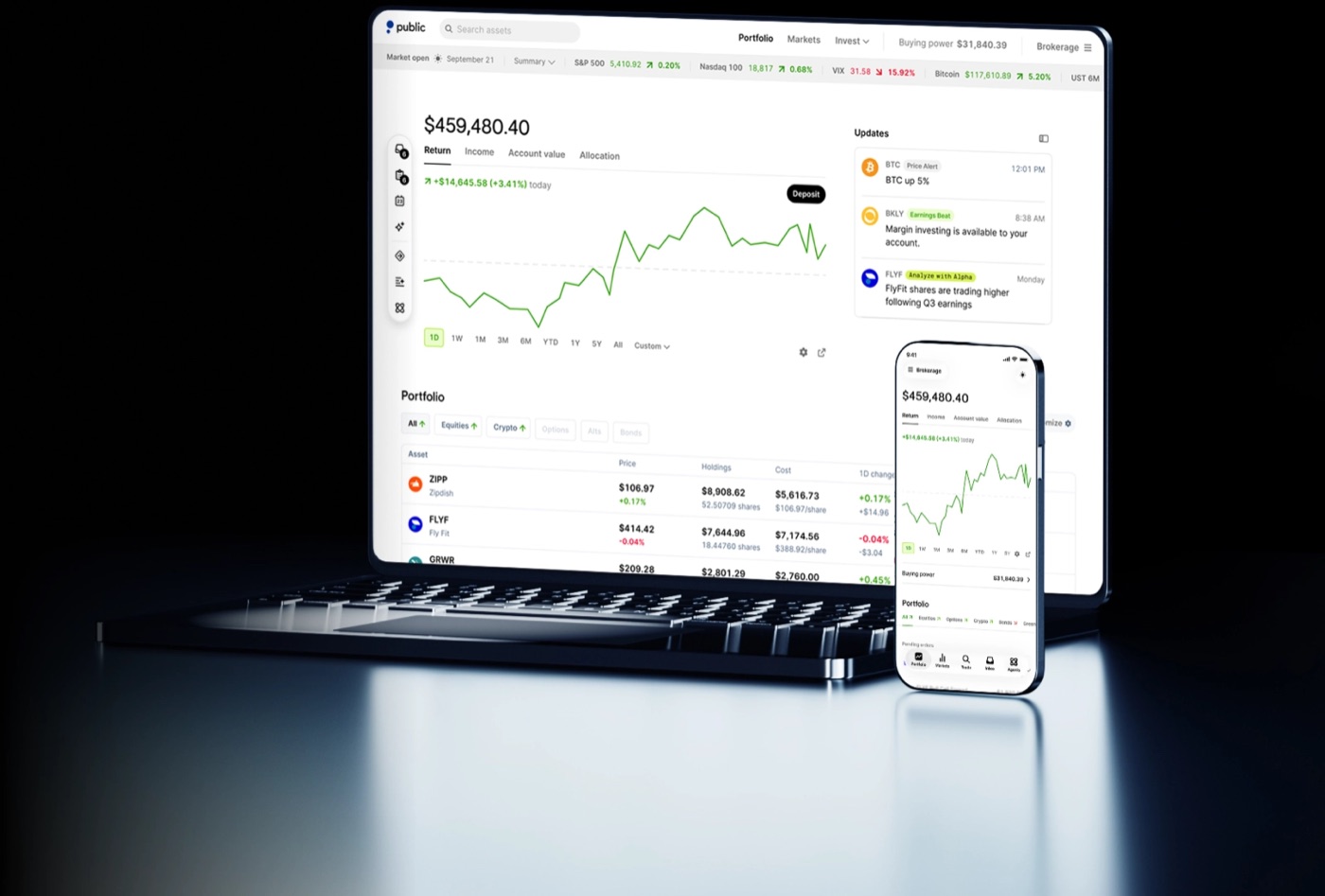
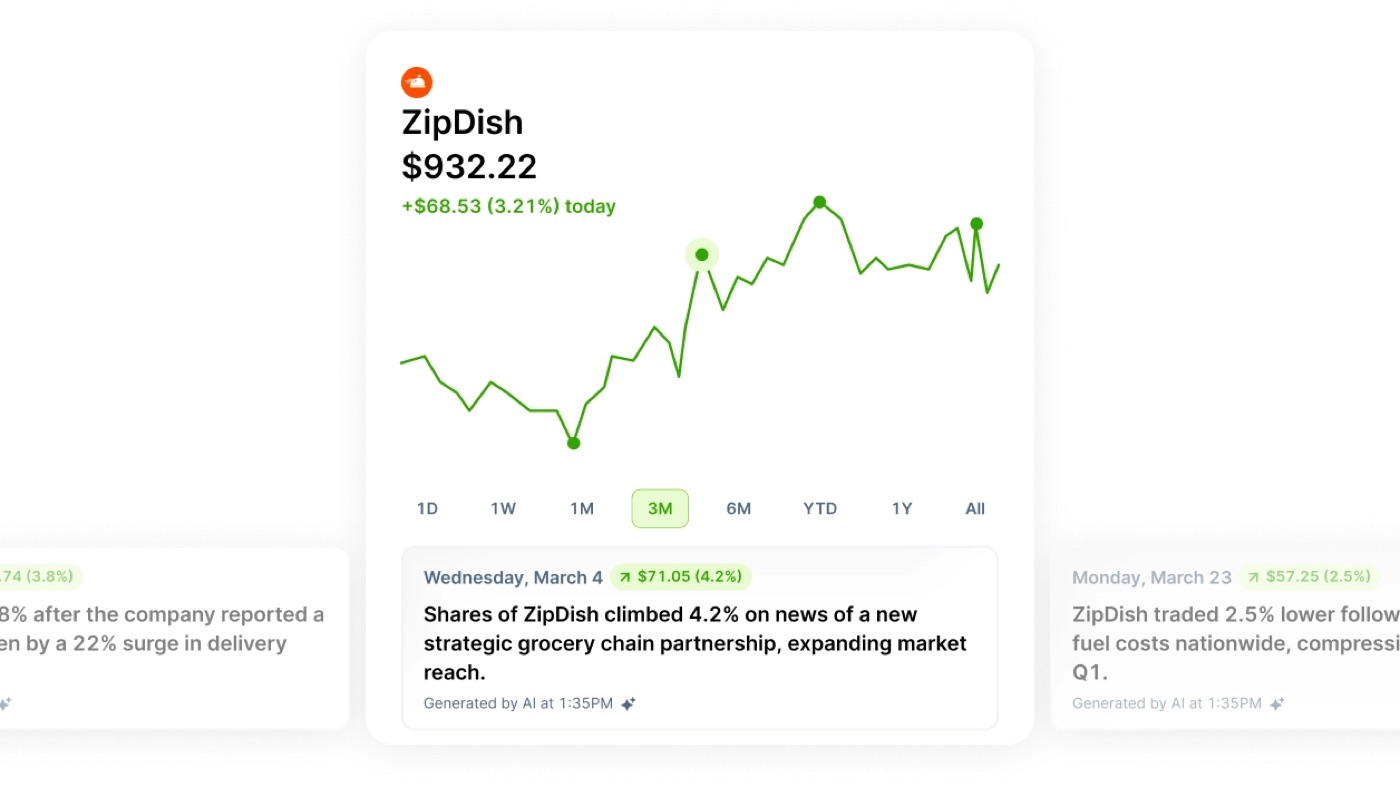
What it looks like
Our verdict
Choose Public if you trade stock and ETF options in volume, borrow on margin, or want 3.30% APY on cash without a subscription. Choose Fidelity or Charles Schwab if you need mutual funds, custodial accounts or a phone line, and expect to pay $100 to transfer out of Public. The deciding fact is the options price: the contract itself is free and earns back at least $0.06, while Fidelity and Schwab list $0.65. Skip Reserve unless you will use its matches, because on cash alone the $200 annual fee needs a balance of about $44,400 to pay for itself.
Overview
Public is the app and web platform of Open to the Public Investing, Inc., a FINRA and SIPC member that clears through Apex. One login covers stocks, ETFs, options, corporate bonds and Treasuries, crypto through Zero Hash, prediction markets through Kalshi, a high-yield cash account and IRAs. The company's home page now calls it an investing platform for the agentic age, after the launch of AI Agents that run rules a customer writes in plain English.
The plan line-up changed in September 2026. Public Premium was replaced by Public Reserve at $20 a month or $200 a year. Extended-hours trading, financials, earnings call material, custom price alerts and Investment Plans became free for everyone, and the old waiver that gave Premium to accounts of $50,000 or more was removed. Reserve is a financial bundle instead: a 4% match on IRA contributions, deposit matches on managed accounts and a higher cash rate. Reviews that still describe a $10 Premium plan, a $2.99 after-hours fee or a $75 transfer fee predate the fee schedule dated October 13, 2026.
Against other brokers on this site, the price gap is widest in options and margin. Fidelity and Charles Schwab charge $0.65 per options contract and 12.075% on margin below $25,000. Robinhood is the close rival, with $0 options commissions and 5.25% margin up to $50,000, against 5.15% at Public. On cash, Public pays 3.30% APY with no subscription, while Robinhood's 3.60% requires Gold at $5 a month or $50 a year. Public's 3.75% requires the much dearer Reserve.
The rebate needs a careful reading. It is a share of the payment Public receives for options order flow, 16% to 50% depending on tier and security. New customers start at $0.06, the top $0.18 rate needs 10,000 or more contracts a month, and contracts on SPY, QQQ and IWM stay at $0.06 until the top tier pays $0.10. Regulatory pass-through charges apply as well, capped at $0.05 per contract on orders under 10 contracts. Index options earn no rebate and cost $0.35 each plus exchange fees, according to the fee schedule, although the options product page still shows a $0.35 to $0.50 range.
Breadth of accounts and depth of tools are the weak points. NerdWallet lists no mutual funds and no custodial accounts. StockBrokers.com scores Public 3.0 and ranks it 12th for 2026, up from 13th, criticizing quotes that do not stream and a mobile options chain that omits Greeks and bid-ask spreads. Its paywall criticism may be out of date, since it describes the Premium plan that Reserve replaced. Trust accounts are marked as coming soon on Public's site.
Two points on oversight and execution belong in the decision. FINRA fined Open to the Public Investing $350,000 in May 2025 over its supervision of paid social media influencers, InvestmentNews reported. NerdWallet, in a review updated in February 2026, gave execution quality of 94% at Public, against a 97.51% average for the brokers it reviews as of October 2025.
How it scored
Public is a clean app with a few details that suit active investors. Its fee schedule lists $0 commissions on US-listed stocks and ETFs both during regular hours and in extended sessions from 4:00 AM to 9:30 AM and 4:00 PM to 8:00 PM ET, and OTC stocks also trade at $0. Stock and ETF options cost nothing, and customers in the Options Rebate Program receive $0.06 to $0.18 per contract depending on the underlying and their volume. Unusually, you can choose how equity orders are routed: wholesale routing is free, while smart and lit exchange routing cost $0.003 per share. Index options cost $0.35 per contract plus exchange fees. Margin starts at 5.15% on balances up to $50,000 and falls on larger loans. Bonds and Treasuries sit in the same app. The optional Public Reserve membership costs $20 a month or $200 a year, which most traders can skip.
Who it is for
Investors who trade around the open and close and want options rebates.
Good fit if
- Stock and ETF options traders who want no contract fee and a rebate of $0.06 or more
- Margin borrowers: 5.15% up to $50,000 and 4.75% on balances between $100,001 and $1 million
- Savers who want 3.30% APY next to a brokerage account with no subscription and no minimum
- Bond buyers with small amounts: fractional corporate bonds, or a ten-bond account from $1,000
- Traders who automate, through a commission-free API or Agents, including inside IRAs
Skip it if
- Mutual fund investors: NerdWallet lists none at Public, so Fidelity or Charles Schwab fits better
- Parents who want a custodial account: Public's help center says it has none; Robinhood and Charles Schwab do
- People who want to call someone: Public has chat and email only, while Charles Schwab has phone lines and branches
- Active chart and Greeks users: Charles Schwab's thinkorswim is a free platform built for active traders
Specifications
| US stock and ETF commission | $0 in regular and extended hours (4:00 a.m. to 8:00 p.m. Eastern) | source |
|---|---|---|
| Stock and ETF options | $0 per contract, with a $0.06 to $0.18 rebate; regulatory fees capped at $0.05 per contract on orders under 10 | source |
| Index options | $0.35 per contract plus exchange fees; no rebate | source |
| Order routing | Wholesale $0; smart order or lit exchanges only $0.003 per share | source |
| Margin rate | 5.15% up to $50,000; 5.00% to $100,000; 4.75% to $1 million; 4.20% over $50 million (September 17, 2026) | source |
| Cash account APY | 3.30% free; 3.75% with Reserve (as of September 17, 2026) | source |
| Cash account insurance | Up to $5 million FDIC through partner banks | source |
| Account minimum | $0, per NerdWallet | source |
| Bond trades | Per $100 of par: Treasuries $0.10 to $0.25, corporates $0.35 to $0.50 | source |
| Bond Account | 6.32% average yield to worst before fees (October 29, 2026); ten bonds, $1,000 to start | source |
| IRA match | 1% of contributions free; 4% with Reserve, up to the IRS annual limit | source |
| Crypto fee | $0.49 on orders up to $10, rising to 1.25% above $500; 0.10% to 0.60% via API | source |
| Event contracts | $0.02 per contract: $0.01 commission and $0.01 exchange fee | source |
| Transfer out (ACATS) | $100 for each outgoing account transfer | source |
| Inactivity fee | $3.99 a month below $70 in total value with no activity for 6 months | source |
| Support | In-app chat and email; no phone support | source |
Price
$0 commissions on US-listed stocks and ETFs; optional Public Reserve membership $20 per month or $200 per year.
Monthly membership $20 per month Annual membership $200 per year
Quoted from the vendor pricing page on November 10, 2026.
Plans and pricing
| Plan | Price | What is included | Source |
|---|---|---|---|
| Core account | $0No account maintenance fee | $0 stock, ETF and stock or ETF options commissions; 3.30% APY High-Yield Cash Account; 1% IRA contribution match; Extended hours, earnings material and price alerts | Checked Nov 24, 2026 |
| Public Reserve (monthly) | $20 per monthCharged on joining, then every 30 days | 3.75% APY on the whole cash account balance; 4% IRA contribution match; 1% match on up to $250,000 a year in Generated Assets; 0.5% match on up to $250,000 a year in Direct Index and Treasury accounts combined; Crypto IRA custodial fee waived | Checked Nov 24, 2026 |
| Public Reserve (annual) | $200 per yearOnce a year, $40 less than twelve monthly charges | Same benefits as monthly Reserve; Priority customer support | Checked Nov 24, 2026 |
| Generated Assets account | 0.49% per yearDeducted monthly; $1,000 minimum | Custom index built from a text prompt; Automatic rebalancing | Checked Nov 24, 2026 |
| Direct Index account | 0.19% per yearDeducted monthly; $1,000 minimum | Holds an index's stocks directly; Tax-loss harvesting | Checked Nov 24, 2026 |
| Treasury Account | 0.29% per year on the first $25,000Tiered to 0.09% above $5 million; bond markups extra | Managed US Treasuries; 0.5% deposit match with Reserve | Checked Nov 24, 2026 |
Key features
Options rebates by tier
Tier 1 pays $0.06 up to 999 contracts a month, Tier 2 $0.10 up to 4,999, Tier 3 $0.14 up to 9,999 and Tier 4 $0.18 from 10,000. SPY, QQQ, IWM and API trades pay $0.06, or $0.10 in Tier 4. Dollar figures are estimates, because the terms define the rebate as a percentage of order flow revenue.
High-Yield Cash Account
Cash is moved to partner banks and pays 3.30% APY, or 3.75% for Reserve members, with no minimum and up to $5 million of FDIC cover. The account is separate and opened by choice: Public announced the end of its older cash sweep program in December 2023.
AI Agents
Agents monitor markets and place trades when conditions a customer sets are met. They need no subscription, work in margin accounts and IRAs, and follow an approved plan the same way each time. The June 2026 help page says backtesting was not yet available.
Bond Account and bond trading
The Bond Account buys ten investment-grade and high-yield bonds, pays interest 20 times a year and reinvests once payouts reach $100. Its advertised yield is before Public's markup on each bond, and fractional bonds cannot be moved to another broker.
Transfer match
Since September 14, 2026, accounts moved in earn an uncapped 1% match paid in up to 60 equal monthly installments. Withdrawing transferred money cuts the remaining payments. Public also refunds up to $100 of the old broker's fee on transfers of $5,000 or more.
IRAs
Traditional and Roth IRAs can hold stocks, ETFs, bonds and options with the same rebates. Free users get a 1% contribution match; Reserve members get 4%, paid over 12 months and subject to a five-year hold.
Order routing choice
Customers can send stock orders to wholesalers for $0, or pay $0.003 per share for smart routing or lit exchanges. The choice does not apply to OTC stocks, Investment Plans or managed accounts.
Strengths and weaknesses
What we like
- Stock and ETF options cost $0 per contract and earn a $0.06 to $0.18 rebate, against $0.65 at Fidelity and Schwab
- Margin at 5.15% up to $50,000, against 5.25% at Robinhood and 12.075% for small balances at Fidelity and Schwab
- 3.30% APY on cash with no subscription, no minimum and up to $5 million of FDIC cover
- Extended-hours and OTC stock trades are now $0 for all customers
- 1% IRA contribution match without a paid plan, and 1% on incoming transfers with no cap
- Bonds in fractional form, with Treasury fees of $0.10 to $0.25 per $100 of par
- AI Agents and API trading carry no subscription charge, and API crypto fees start at 0.60%
What could be better
- $100 to transfer out; Fidelity lists $0 in StockBrokers.com data and Schwab charges nothing on partial transfers
- No phone support: chat and email only
- No mutual funds and no custodial accounts
- Crypto is costly in the app: $1.69 on a $50.01 order is about 3.4%, and orders above $500 pay 1.25%
- Reserve at $200 a year needs about $44,400 in cash to break even on the 0.45-point APY gain alone
- Transfer match is slow: $50,000 moved in earns $500, or about $8.33 a month for five years
Key facts
- Stock and ETF commission: $0, including extended hours
- Options: $0, rebate $0.06 to $0.18 per contract
- Index options: $0.35 per contract
- Margin rate: 5.15% up to $50,000
- Paid plan: Public Reserve, $20 per month
Where it ranks
Public is No. 8 in our Best Stock Trading Apps verdict.
Alternatives to consider
- Robinhood: Closest on price, with 5.25% margin and a $5 Gold plan that pays 3.60% APY and a 3% IRA match, but no options rebate
- Fidelity: Mutual funds, retirement planning and a money market default for cash, with options at $0.65 per contract
- Charles Schwab: thinkorswim, branches and phone support; options cost $0.65 and idle brokerage cash pays 0.01%
- E*TRADE from Morgan Stanley: $0 mutual fund commissions and options at $0.50 with 30 or more trades a quarter
Questions readers ask
Is Public worth it?
Public is worth it if you trade options or borrow on margin: contracts are $0 with a rebate of at least $0.06, and margin starts at 5.15%. It is a weaker choice for mutual funds, custodial accounts or phone support, none of which it offers.
Is Public free to use?
Yes, the core account has $0 stock and ETF commissions, $0 maintenance and no minimum balance to open. Charges to watch are $100 to transfer out, a wire at $25, instant withdrawals at up to 3.5% and $3.99 a month on inactive accounts below $70.
Public vs Robinhood: which is better?
Public is cheaper for options and margin, with a $0.06 to $0.18 rebate and a 5.15% base rate against Robinhood's 5.25%. Robinhood is cheaper for boosted cash: Gold costs $50 a year for 3.60% APY, while Public pays 3.30% free or 3.75% with the $200 Reserve plan.
Is Public Reserve worth $20 a month?
Reserve pays off on an IRA alone only near the limit: 4% on $7,500 is $300, which is $225 more than the free 1% match and $25 above the $200 annual price. On cash alone, the break-even is about $44,400 on annual billing and $53,300 on monthly billing.
How do Public's options rebates work?
Public pays back 16% to 50% of the order flow revenue from each stock or ETF options contract, shown as $0.06 to $0.18. Customers approved for options are enrolled, and the rate depends on volume in the current and prior month. Index options do not qualify.
Is Public safe?
Public Investing is a FINRA and SIPC member, so securities are covered to $500,000, including $250,000 for cash, if the broker fails. The cash account has up to $5 million of FDIC cover through partner banks. Crypto has neither protection, event contracts are outside SIPC, and market losses are never covered.
What happened to Public Premium?
Public replaced Premium with Public Reserve in September 2026. Most former Premium features are now free, and the free Premium benefit for accounts of $50,000 or more ended.
How much does it cost to transfer out of Public?
Each outgoing account transfer costs $100, and ACATS moves typically take 7 to 10 business days. Fractional shares cannot be transferred, so they have to be sold first.
Sources we checked
- Public fee schedule, October 13, 2026, checked November 24, 2026
- Public home page and disclosures, checked November 24, 2026
- Public High-Yield Cash Account, checked November 24, 2026
- Public margin rates, checked November 24, 2026
- Public options trading, checked November 24, 2026
- Options Order Flow Rebate Program terms, checked November 24, 2026
- Public IRAs, checked November 24, 2026
- Public Bond Account, checked November 24, 2026
- ACATS and IRA Match Program terms, checked November 24, 2026
- What is changing from Premium to Reserve?, checked November 24, 2026
- Benefits of Public Reserve, checked November 24, 2026
- Reserve rollout for free users, checked November 24, 2026
- Free Premium by account balance, checked November 24, 2026
- How much can I earn back with Reserve?, checked November 24, 2026
- Transferring out of Public, checked November 24, 2026
- 1% match on ACATS and IRA transfers, checked November 24, 2026
- Generated Assets fees and minimums, checked November 24, 2026
- Direct Indexing fees and minimums, checked November 24, 2026
- Custodial accounts at Public, checked November 24, 2026
- Contact Member Support, checked November 24, 2026
- Prediction Markets fees, checked November 24, 2026
- Agents: The Basics, checked November 24, 2026
- Agents: Money, Risk, and Rules, checked November 24, 2026
- Agents: Sharing, Pricing, and Limits, checked November 24, 2026
- What happened to the Cash Sweep Program?, checked November 24, 2026
- NerdWallet: Public.com review, February 6, 2026, checked November 24, 2026
- StockBrokers.com: Public.com review, checked November 24, 2026
- InvestmentNews: FINRA fine, May 28, 2025, checked November 24, 2026
- Fidelity commissions and margin rates, checked November 24, 2026
- StockBrokers.com: Fidelity review, checked November 24, 2026
- Schwab pricing guide, checked November 24, 2026
- Schwab margin rates, checked November 24, 2026
- Schwab cash investments, checked November 24, 2026
- Robinhood margin rates, checked November 24, 2026
- Robinhood high-yield cash program, checked November 24, 2026
- E*TRADE pricing and rates, checked November 24, 2026
Deep review last updated November 24, 2026. We recheck prices and specs against these pages; send corrections to the address below.
Alternatives we scored
Cite this page
HearSmart. Public review. Updated November 24, 2026. https://hearsmart.org/review/public
Visit public.com · Questions or corrections: editorial@hearsmart.org