Guide · General
Secured vs Unsecured Credit Cards: Which Fits You in 2026
Compare secured vs unsecured credit cards on deposits, approval, fees and credit building, with sourced figures and guidance on which card fits your situation.
By the HearSmart research desk · Updated November 13, 2026 · 14 min read
In 2024, 80.8% of consumers who had previously held a credit card said they were at least somewhat interested in obtaining a secured card, according to PYMNTS Intelligence research reported by eMarketer. Demand that broad usually signals a product people understand. Here it signals the opposite. A large share of existing cardholders are weighing an account whose deposit buys access, and access is the only thing it buys.
The deposit doesn't make borrowing cheaper. It makes approval possible for someone whose file is empty, thin or damaged, because the issuer holds cash that covers a default. Everything else about the account, the interest rate, the annual fee, the size of the line, is an issuer decision layered on top of that structure.
That split explains why the secured vs unsecured credit cards question has no single answer. The structure decides who gets in. The terms decide what it costs. What follows separates the two, prices each offer against the limit it grants and runs the utilization arithmetic that determines whether a small line helps a credit file or hurts it.
Table of Contents
- Secured and Unsecured Credit Cards at a Glance
- How Deposits and Approval Set Your Credit Limit
- What Each Card Costs in Fees and Interest
- Why Utilization Matters More Than Card Type
- How to Move From a Secured to an Unsecured Card
- Which Card Fits and What to Verify First
Secured and Unsecured Credit Cards at a Glance
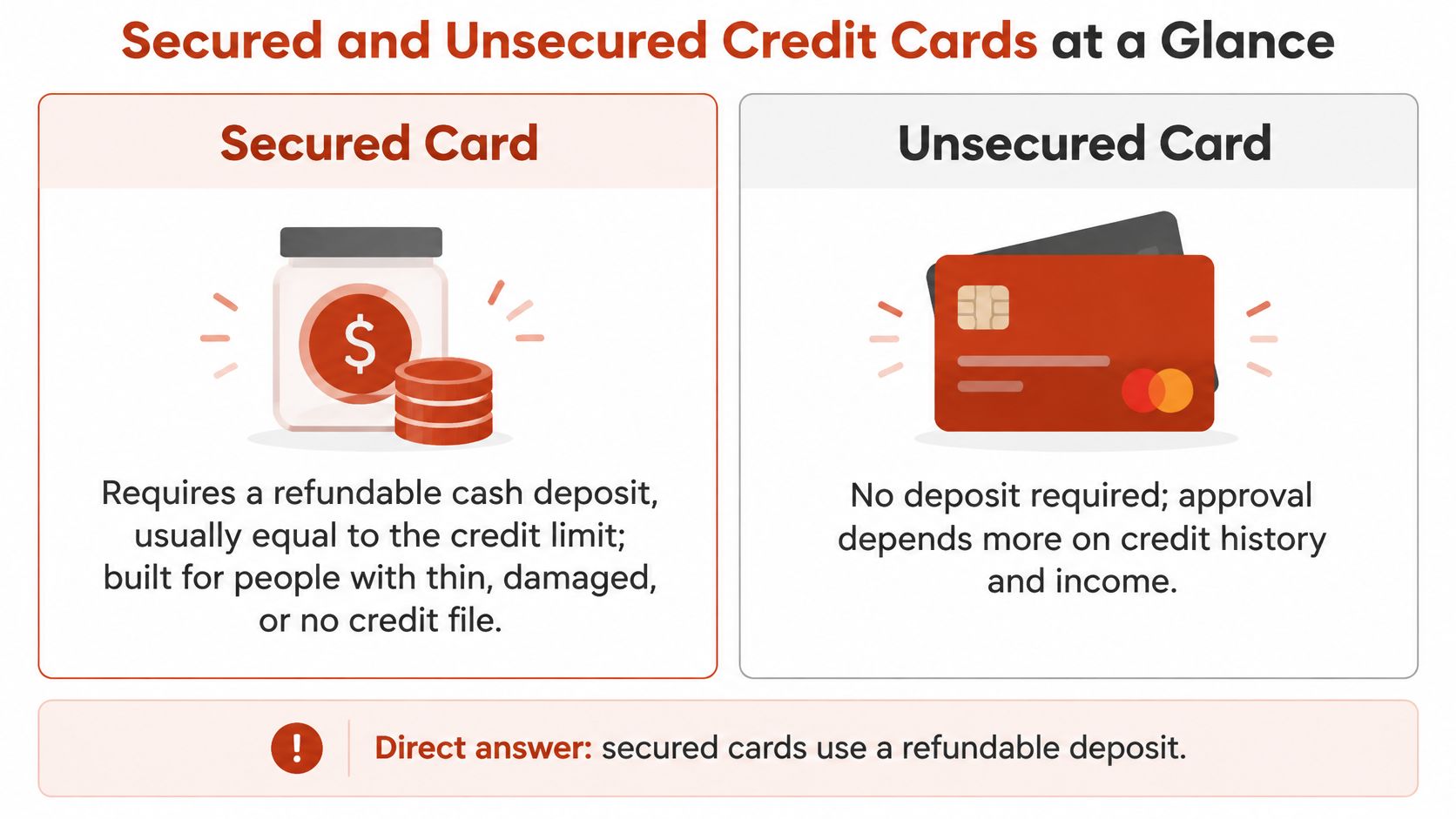
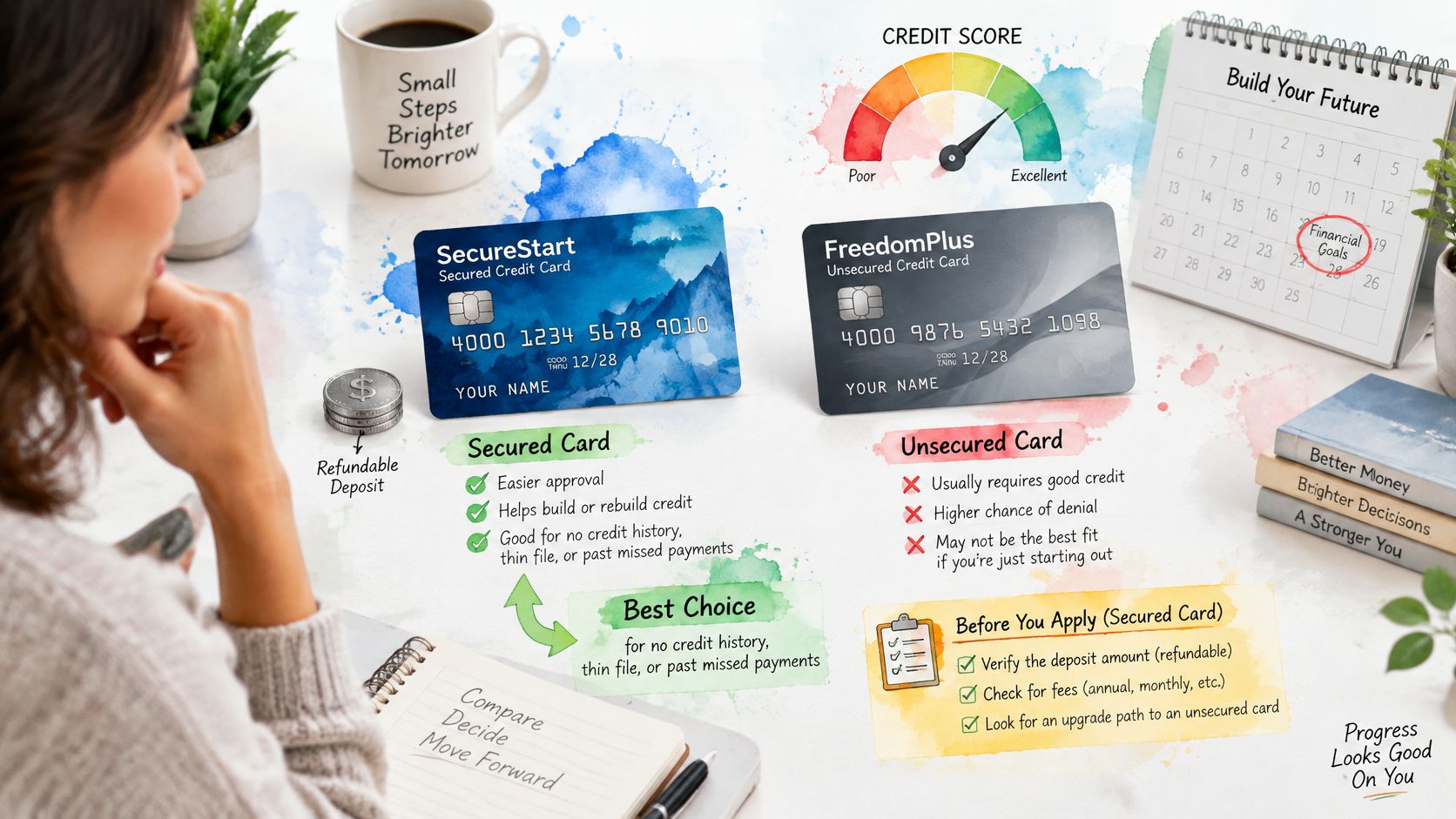
A secured credit card requires a refundable cash deposit, usually equal to the credit limit, and it exists for applicants with thin, damaged or no credit file. An unsecured card comes with no deposit; the issuer approves or declines on credit history, income and assessed repayment risk, as the Federal Reserve's overview of credit-building products sets out. Both are revolving credit, and both can report payment activity to the credit bureaus. The structural difference is collateral and access, not how the account behaves month to month.
Table 1 sets out where the two products diverge.
| Feature | Secured card | Unsecured card |
|---|---|---|
| Cash deposit | Required, usually equal to the credit limit | None |
| Credit limit basis | Deposit amount, for example a $200 deposit typically gives a $200 limit | Underwriting on credit history, income and existing debt |
| Typical applicant | Thin, damaged or no credit file | Established credit history |
| Share of new holders with no credit score at opening | About half (Federal Reserve, 2024) | Uncommon, because underwriting starts with a scored file |
| Average other open cards | 0.43 (Federal Reserve, 2024) | 2.58 (Federal Reserve, 2024) |
| Payment activity reported to credit bureaus | Yes | Yes |
| What supports the account | Refundable cash deposit held as collateral | Issuer underwriting, no collateral |
Reporting is the part applicants underweight. A secured account that reports to the bureaus behaves exactly like an unsecured one inside a credit file. The balance, the limit and the payment history land in the same fields and feed the same scoring models.
The Federal Reserve's 2024 analysis shows how strongly the secured product functions as a first step. About half of new secured-card borrowers had no credit score when the account opened, and secured borrowers averaged 0.43 other open cards against 2.58 for unsecured borrowers. A secured card is typically the only card in the wallet rather than an addition to an established one.
That is what the deposit buys: a first reporting account. It does not buy a low rate. Collateral opens the door, and the price of walking through it is set by the issuer's fee schedule and APR.
How Deposits and Approval Set Your Credit Limit
The cleanest way to see how a deposit becomes a limit is to follow one account. The Federal Deposit Insurance Corporation's consumer guide, updated in 2025, uses a card that opens with a $400 limit and a deposit of about $400 as its typical illustration. Experian's comparison of the two card types applies the same rule in smaller numbers, noting that a $200 deposit typically produces a $200 limit. The deposit is collateral, not prepaid spending. The cardholder still makes monthly payments, and the bank may draw on the deposit to cover a required payment that goes unpaid.
An unsecured limit is built the other way around. Underwriting weighs credit history, income, existing debt and the issuer's own risk model, then assigns a line that no cash secures. That can produce a larger limit, but it depends entirely on the file the applicant brings.
The trade-off is liquidity, not credit quality
A $500 deposit ties up $500 that could have covered a car repair or a dental bill. The account doesn't return that money while it stays open, and a low initial line can pinch ordinary spending on top of it. The applicant is effectively buying an approval decision with cash that stays locked until the account closes in good standing or converts to unsecured credit.
Four questions settle whether a specific deposit is workable, and each has to be answered from the issuer's own terms rather than assumed. What are the minimum and maximum deposits the issuer publishes? Under what conditions is the deposit refunded? Does the issuer pay any interest on the money while it holds it? Can the limit rise later without a new deposit?
Decision rule: if funding the deposit would empty the emergency buffer, the secured card is the wrong tool even when approval is close to certain. A card that creates a cash shortfall trades one credit problem for a worse one.
The smarter sequencing for most applicants is to keep the deposit inside money they would not need for at least a year, then treat the limit as a fixed number to plan spending around rather than a ceiling to test. That framing matters more in the next step, where the size of the line changes the arithmetic of every purchase.
What Each Card Costs in Fees and Interest
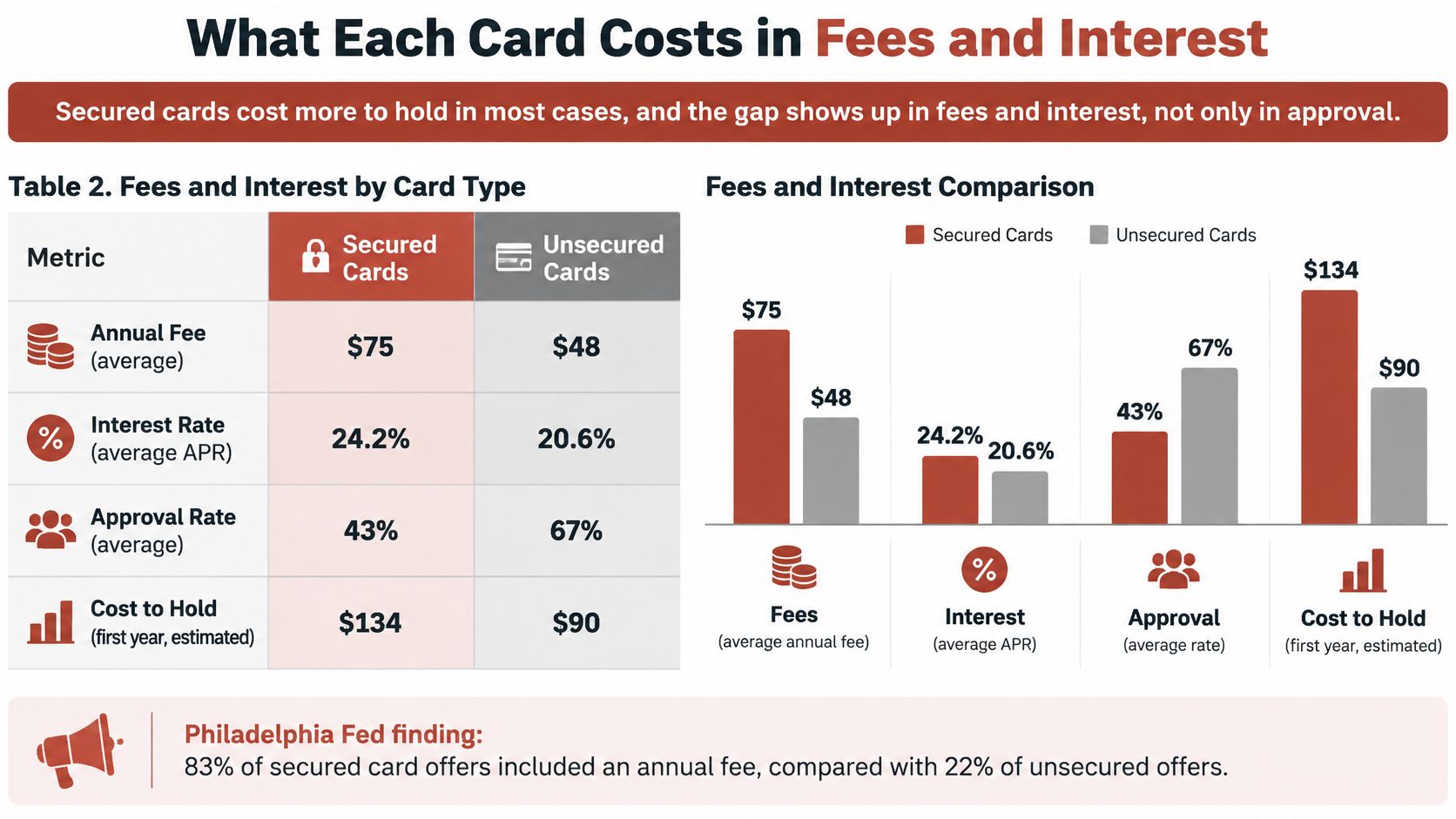
Secured cards cost more to hold in most cases, and the gap shows up in fees and interest, not only in approval. Table 2 puts the two markets side by side on the measures that show up on a statement.
| Measure | Secured card | Unsecured card | Source and year |
|---|---|---|---|
| Cards carrying an annual fee | 83% | 10% | Philadelphia Fed secured-card market analysis |
| Annual fee range | $18 to $125, most common $29 | No range reported; fees appear on 10% of cards | Philadelphia Fed secured-card market analysis |
| APR below 20% | 35.4% | 55.8% | Federal Reserve, 2024 |
| Rewards available | 12% | 47% | Federal Reserve, 2024 |
| Delinquency rate on accounts | 10.3% | 4.9% | Philadelphia Fed secured-card market analysis |
| Median income at account opening | $35,000 | $50,000 | Philadelphia Fed secured-card market analysis |
| Unauthorized-use liability | Generally limited to $50 | Generally limited to $50 | FTC, 2021 |
The Philadelphia Fed's secured-card market update found that 83% of secured cards carried an annual fee, against 10% of unsecured cards, with secured fees running from $18 to $125 and $29 the most common amount. The Federal Reserve's 2024 data shows the same tilt in pricing, with 55.8% of unsecured-card borrowers holding an interest rate below 20% compared with 35.4% of secured-card borrowers.
Putting a fee against the line it reduces
A $29 annual fee on a $200 limit consumes 14.5% of the line in the year it posts. On the average new secured limit the same fee is still around 8%, and that average has been shrinking: the Federal Reserve found the average credit limit on new secured accounts fell nearly 25% between 2013 and 2022, from $482 to $362. A fixed fee against a shrinking line is a rising percentage cost, and it takes usable credit away before a single purchase is made.
The Federal Trade Commission's comparison of secured cards lists the cost items to check in full:
- Annual percentage rate: charged on any balance carried past the grace period.
- Annual fee: common on secured offers and charged whether or not the card is used.
- Activation fee: a one-time charge at account opening on some products.
- Monthly maintenance fee: a recurring charge that erodes the line month after month.
The FTC published that comparison in 2021 and notes that these charges reduce usable credit even when the deposit equals the nominal limit. It also confirms that a secured card keeps the same federal protections as any other credit card, with liability for unauthorized use generally limited to $50. Fee schedules change, so the issuer's current disclosure is the document that counts.
Delinquency and income belong in the picture as description rather than diagnosis. The Philadelphia Fed reported delinquency on 10.3% of secured accounts against 4.9% of unsecured accounts, and median individual income at account opening of $35,000 against $50,000. Those figures describe who holds each product. They don't excuse a $125 fee, so the comparison should rest on terms the applicant can read.
Scale is the last piece of context. The Federal Reserve counted roughly 3.7 million secured general-purpose and private-label cards at the largest financial institutions, holding $817 million in balances. Small next to the unsecured market, and large enough that fee differences matter to millions of households. Cardholders carrying a balance at a high secured APR should price the exit as well as the entry, and the best balance transfer credit cards ranking scores transfer offers on fees and window length.
The workable rule is to compare first-year total cost, not the approval notice: annual fee plus activation fee plus monthly maintenance fees, divided by the credit limit, then add interest on any balance carried at the stated APR.
Why Utilization Matters More Than Card Type
Card type doesn't build credit. The reported balance divided by the credit limit does. Utilization is the one credit-building variable a cardholder controls every month, and it is calculated the same way whether the account is secured or not.
| Credit limit | Statement balance | Reported utilization | What the ratio means |
|---|---|---|---|
| $300 secured | $90 | 30% | At the edge of the roughly 30% guideline |
| $1,000 unsecured | $90 | 9% | Same balance, far lower ratio |
| $300 secured | $150 | 50% | One larger purchase pushes the ratio well above guideline |
| $1,000 unsecured | $150 | 15% | Same purchase, ratio stays moderate |
Experian's guidance on using secured cards to build credit advises keeping utilization below about 30%, with lower generally better, and identifies payment history and amounts owed as major FICO Score components. The table above is the whole argument in four rows. Identical spending produces a 30% ratio on a small secured line and a 9% ratio on a larger unsecured one.
Why one ordinary purchase moves the number
A cardholder who treats a $300 limit like a normal card will cross the 30% mark on a single grocery run and a tank of fuel. Nothing about the behavior is irresponsible, and the reported ratio still looks like strain to a scoring model. Small limits are operationally demanding in a way that has nothing to do with discipline.
The number to plan around: the statement balance is usually what gets reported, not the total a cardholder spent during the month.
Three responses work. Pay before the statement closes so the reported balance stays low while the purchase still counts as activity. Request a limit increase when the issuer allows one without a new deposit. Or start with a card whose opening line is large enough that ordinary spending stays under the guideline.
Paying in full by the due date avoids interest where the terms provide a grace period, but it doesn't stop a balance from being reported. Timing and amount are separate levers, and the statement date is the one that decides what lands in the file. A monitoring service that shows the reported balance each month makes the ratio visible before a lender sees it, and the best credit monitoring services ranking compares how often each one refreshes.
An unsecured card offers more headroom. It offers no immunity. A maxed-out unsecured line or a single payment 30 days late does the same damage to a score as the secured equivalent. Card type sets the room available to build with. Repayment behavior decides the result.
How to Move From a Secured to an Unsecured Card
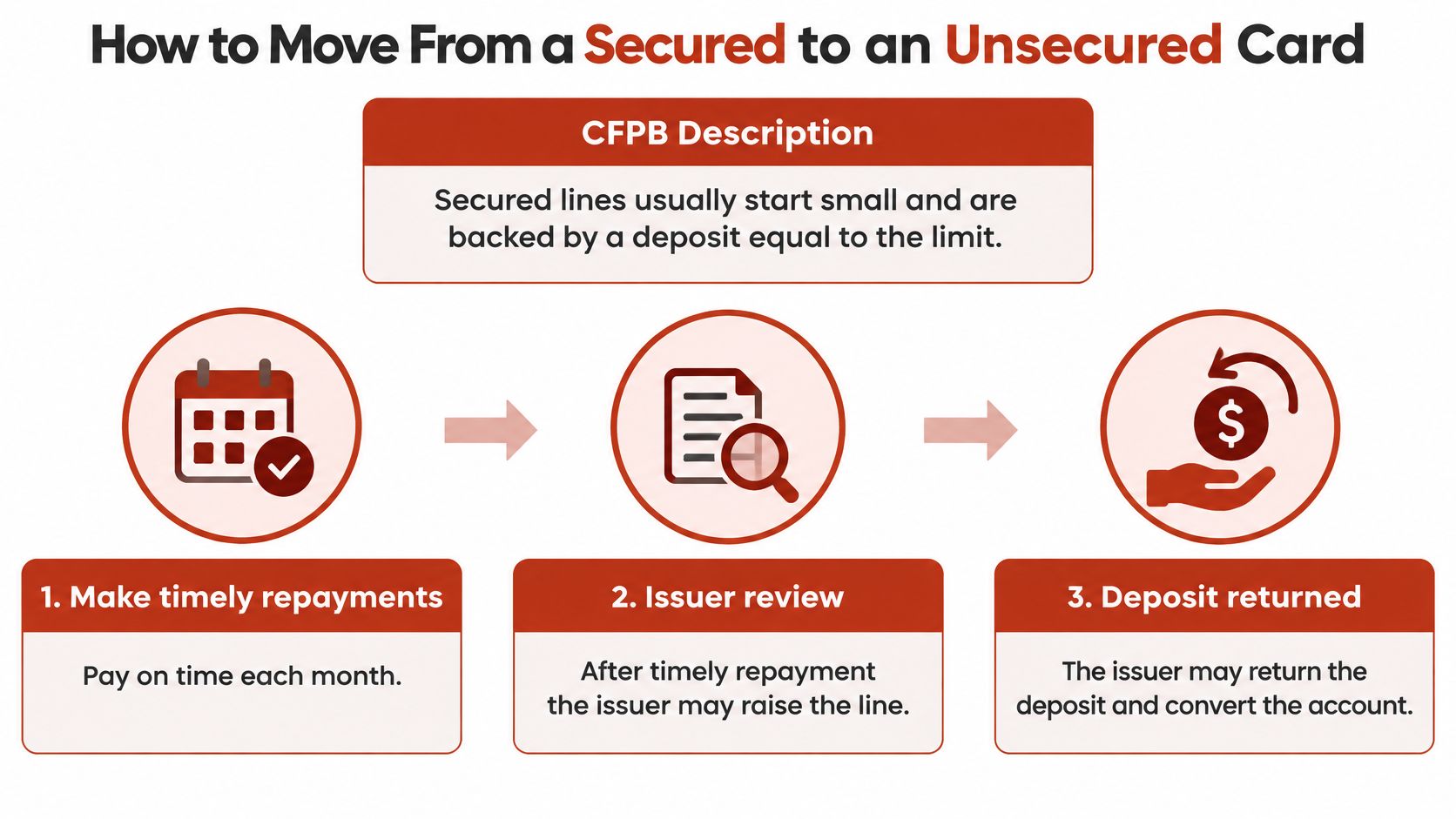
The Consumer Financial Protection Bureau's credit-rebuilding guide describes secured lines as products that usually start small and are backed by a deposit equal to the credit limit. After the cardholder demonstrates timely repayment, the issuer may raise the line and may return the deposit. Those are two separate milestones. Credit-line growth depends on issuer policy and payment history. Deposit release is not automatic and can hinge on account status or conversion to a different product. The CFPB names no universal number of on-time payments and no guaranteed upgrade date, so any fixed graduation timeline is a policy statement from one issuer, not a rule.
The sequence that works
- Confirm the reporting relationship in writing. An account that reports to nobody builds nothing, so ask which bureaus receive the file and which date is used. Get the answer from the issuer rather than a marketing page.
- Automate at least the minimum payment. A single 30-day late mark outlasts any fee this account can charge. Set the autopay date at least three days before the due date so a weekend doesn't create a missed payment.
- Keep the reported balance well under the limit. Aim below about 30% of the line, and lower if the limit is small. Ask whether the issuer reports the statement balance or a balance captured on a fixed date, because that detail decides how early a payment has to land.
- Learn the issuer's review cycle. Limit increases and graduation usually follow a scheduled review rather than a request. The card agreement or a written message to support will state the interval.
- Ask what graduation requires, in writing. The CFPB's guidance makes clear that deposit release can depend on conversion or account closure, so the answer will differ by issuer. Confirm whether the deposit comes back on conversion or only on closure.
- Compare any unsecured offer against the current card's full cost. A higher line isn't automatically cheaper. Put the new APR, annual fee and maintenance fees next to the secured card's numbers before accepting anything, because an upgrade can move someone from a $29 fee onto a much higher rate.
- Close the old account last. Closing before the new line is open and reporting can change the profile at exactly the wrong moment. Wait until the deposit refund has posted and the replacement account shows up.
What success looks like is unglamorous and specific: the deposit refunded, the limit raised, and no annual fee attached to the converted account. If an issuer offers a conversion that keeps a $125 annual fee, the cardholder has changed the wrapper and not the cost.
Which Card Fits and What to Verify First
The split comes down to the file and the cash, not the marketing. A secured card fits the applicant whose file is the obstacle. An unsecured card fits the applicant whose file already clears underwriting and who wants a bigger line or rewards.
| Circumstance | Better fit | Why |
|---|---|---|
| No credit history or a first card | Secured | Deposit-backed approval is designed for applicants without an established file |
| Thin or damaged file, approval uncertain | Secured | Collateral makes approval more accessible than underwriting alone |
| Established credit, wants rewards | Unsecured | Rewards on 47% of unsecured accounts against 12% of secured (Federal Reserve, 2024) |
| Needs a larger spending line | Unsecured | Average new secured limit was $362 in 2022 (Federal Reserve) |
| Cannot spare a deposit without touching an emergency buffer | Unsecured if approved, otherwise wait | The deposit ties up cash that the account does not return while it is open |
| Wants a card that can convert later | Secured, only with written graduation terms | Graduation is not automatic and depends on issuer policy |
Where the two-year arithmetic lands
APR alone doesn't settle the comparison, and a worked example shows why. Take a secured card with no annual fee against an unsecured offer charging $39 a year with a rate several points higher. Over two years the secured card's fee cost is zero, and the cost of its deposit is the interest that cash could have earned elsewhere, which is small at ordinary savings rates. The unsecured card costs $78 in fees plus the rate difference on any carried balance.
The reverse happens just as easily. A secured card charging the $29 most common annual fee costs $58 over two years, which is 16% of a $362 limit. Two years of fees on a small line can exceed what a no-fee secured card would have cost to hold. That is why the fee schedule decides which wrapper is cheaper, not the word secured.
For an established file chasing cash back, the unsecured side is a better product. The Wells Fargo Active Cash Card holds a score of 9.2 in HearSmart's Best Cash Back Credit Cards ranking, which is the kind of comparison an applicant with good credit should be running instead of hunting for a secured account.
For a student building a file from zero, the deposit is often smaller than the limit it provides, and the best credit cards for students ranking lists offers with their deposit and fee terms so the first-year cost is visible before applying.
The verification list before any application
Pull the issuer's terms and record seven things: the deposit amount with its minimum and maximum, the refund conditions on both closure and conversion, the bureaus reported to, the reporting date, the APR, every fee, and the graduation policy in the issuer's own words.
Then compute first-year cost for two or three offers on one page and rank them. Price and fee terms change, so quote only what the issuer publishes on the day it's checked, and write that date beside the number. An offer quoted from memory six months ago isn't a comparison, it's a guess.
The single rule that resolves most cases: a card is worth its deposit only if the deposit is money you can leave untouched, the account reports to all three bureaus and the first-year cost as a share of the limit is lower than the alternative offer on the table.
Start with the two numbers that decide the outcome. Add up the annual fee, the activation fee and twelve monthly maintenance fees, divide by the credit limit, and write the percentage next to the APR. Do that for the secured card in front of you and for the unsecured offer you'd take if approved, then check whether the issuer reports to all three bureaus and whether graduation terms are in writing. HearSmart publishes its secured and unsecured card rankings with the deposit, fee and APR for each offer recorded on the date checked, so the comparison starts from the issuer's own figures rather than a headline rate.
Spotted an error in this guide? Email editorial@hearsmart.org