Guide · General
What Is High Yield Savings Account: Rates and Returns 2026
What is high yield savings account - Learn exactly what a high yield savings account is, how it earns interest, and how to choose one that pays more than a
By the HearSmart research desk · Updated November 23, 2026 · 12 min read
A high-yield savings account is an FDIC-insured deposit account, when it is held at an insured bank, that pays a variable annual percentage yield (APY) usually higher than a conventional savings account. The coverage behind that balance stops at $250,000 per depositor, per insured bank, for each ownership category, and the rate on top of it carries no floor at all.
So why do two savers who open the same advertised rate end the year with different returns? Because three parts of the account move independently, and only one of them is the number in the headline. The yield is variable and set by the bank. The deposit insurance is fixed by ownership category. The access rules, meaning transfer limits, processing times and fees, are written by each bank rather than by federal law.
Answering what is a high-yield savings account properly means separating those three, because a decision that treats them as one bundle usually gets one of them wrong. A rate chaser who ignores the fee schedule can lose more than the extra yield pays. A saver who reads "high yield" as "guaranteed" can park more than the coverage limit in one place. A household that never checks transfer times can find bill money stuck in transit.
The HearSmart research desk works through the account in the order confusion usually appears: what the product is, what the yield really returns after rate changes and tax, what insurance covers, how withdrawals and fees work, which goals fit, and what to verify before the first deposit.
Table of Contents
- What a High-Yield Savings Account Is
- How APY Taxes and Rate Changes Set Your Real Return
- How Deposit Insurance Protects Your Balance
- How Withdrawals, Transfers and Fees Work
- Which Goals Fit a High-Yield Savings Account
- Verify and Decide Before You Open an Account
What a High-Yield Savings Account Is
A high-yield savings account (HYSA) is an interest-bearing deposit account that usually pays a higher annual percentage yield than a conventional savings account, with the bank setting the rate and free to change it at any time. Anyone asking what is a high-yield savings account in 2026 gets a shorter answer than expected. Three properties define it, and the headline rate isn't one of them.
Three properties that define the product
It is a deposit, not an investment. The balance is money the bank owes you, not a share of anything. It doesn't rise on a good earnings report or fall on a bad one. It earns whatever rate the bank is paying that week. The FDIC's deposit insurance basics guide sets the standard maximum at $250,000 per depositor, per insured bank, for each ownership category, and records that no depositor has lost insured funds in an insured-bank failure since coverage began on January 1, 1934.
The rate is variable. Nothing in the account agreement promises today's APY survives the next rate change. Banks move it when funding conditions and central-bank policy move, and they don't need the saver's permission to do it.
It is liquid, within the bank's rules. Money can normally be transferred to a linked account, but the bank decides how many transfers, how quickly and at what cost. That gap between "accessible" and "instant" is where most first-time savers get surprised.
How much cash a typical household holds is a separate question, and the HearSmart personal savings statistics page collects the published figures on it.
How a high-yield savings account compares with standard savings and checking
| Feature | High-yield savings | Standard savings | Checking |
|---|---|---|---|
| Rate behaviour | Variable, set by the bank and can change | Variable, usually lower than high-yield | Usually none or very low |
| Deposit insurance | FDIC coverage at an FDIC-insured bank, up to $250,000 per depositor, per insured bank, per ownership category | Same, if held at an insured bank | Same, if held at an insured bank |
| Access | Transfers to linked accounts; limits and timing set by the bank | Same as high-yield | Debit card, ATM and bill payments |
| Typical use | Emergency fund and goals within a few years | Everyday cash reserve | Bills and daily spending |
Think of it as the same coins in a larger jar. The dollars in a high-yield account are the dollars that would otherwise sit in a standard savings account, protected the same way at the same kind of bank. The jar pays more for holding them.
The one-line version: a high-yield savings account fits money you'll need within a few years and can't afford to lose value today.
It is usually the wrong home for money you won't touch for a decade, because a deposit rate isn't built to outrun inflation across that horizon.
How APY Taxes and Rate Changes Set Your Real Return
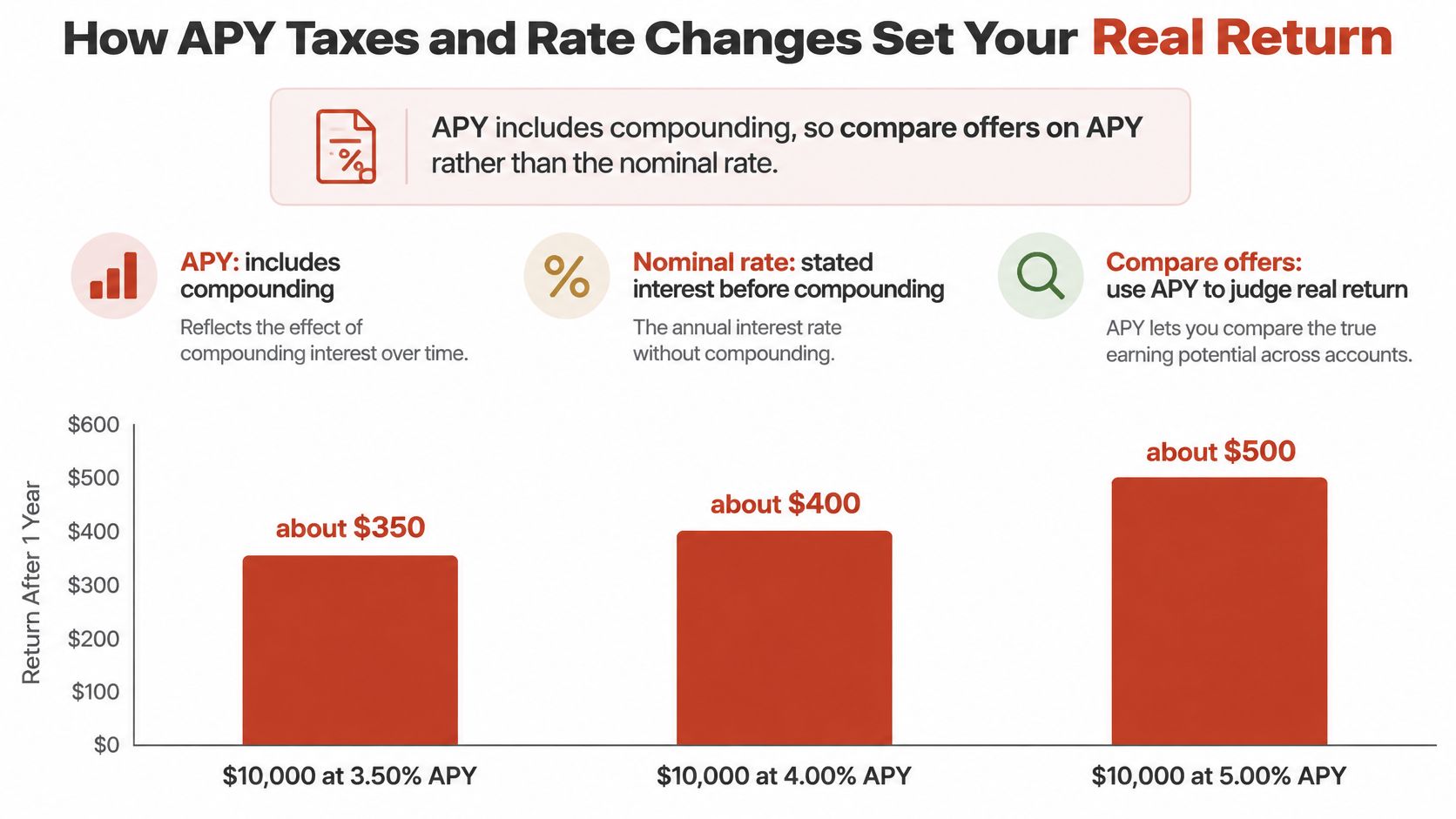
APY is the only rate worth comparing. It folds the compounding schedule into a single number, so an account advertising a 4.00% nominal rate and one advertising a 4.00% APY don't pay the same thing. Compounding is why: interest credited to the balance starts earning interest itself in the next period, and APY accounts for that.
The arithmetic is short enough to do on a phone. Balance multiplied by APY gives the approximate interest for one year, before tax and fees.
Interest earned on $10,000 at three APY levels over one year
| Annual percentage yield (APY) | Approximate interest on $10,000 in one year | Basis of calculation |
|---|---|---|
| 3.50% | $350 | Balance multiplied by APY, before tax and fees, 2026 example |
| 4.00% | $400 | Balance multiplied by APY, before tax and fees, 2026 example |
| 5.00% | $500 | Balance multiplied by APY, before tax and fees, 2026 example |
Why a quoted rate can drop mid-year
The APY on the account page is a snapshot of a decision the bank can reverse. When the central bank cuts, deposit pricing usually follows. Rate coverage from U.S. News on the savings rate outlook reported that the Federal Reserve reduced its benchmark rate three times in late 2025, ending that year at a 3.50% to 3.75% target range, with savings yields declining alongside it. A saver who locked in a mental 5.00% in the summer may be earning closer to the 3.50% row by the following spring, on the same balance, without moving a dollar.
The gap between advertised and actual yields is wide across the market. In 2024, 22% of U.S. savers reported earning an APY of at least 4% on short-term savings while 67% earned less than 4%, according to Bankrate's online savings survey. That's a commercial survey of savers rather than a regulatory dataset, and it still shows the distance between the best offer on a comparison page and what many savers hold.
Practical rule: write the date next to any APY you record. A rate without a date is a memory, not a fact.
What tax and inflation take
Interest is generally taxable as ordinary income whether or not it stays in the account, and a 1099-INT is typically issued once annual interest reaches $10, as Experian's guide to high-yield savings accounts explains. Say a saver's marginal rate is 24% and the balance is $10,000 at 4.00%. The account pays about $400, the tax bill is roughly $96, and about $304 remains. The rate the bank advertises was never the rate the saver keeps.
Inflation does the rest. When prices rise faster than the APY, the balance buys less even though the number on the statement grew. No deposit insurance covers that, and no bank promises a real return.
Three checks settle most of the doubt:
- The current APY and the date it was published. Compare only figures from the same week.
- Whether the rate is promotional. Ask what it becomes after the introductory period, and when.
- The minimum balance required to earn it. A high rate on a tier you can't reach pays nothing extra.
How Deposit Insurance Protects Your Balance
"High yield" sounds like "high guarantee" to a first-time saver. It isn't, and the difference sits inside a rule rarely read.
Deposit insurance is automatic for qualifying deposits at an FDIC-insured bank, with no separate policy to buy. The FDIC's answer on what deposit insurance covers confirms that coverage applies to savings accounts at insured banks and savings associations, protects principal plus accrued interest through the date the bank closes, and applies up to the standard limit. Credit unions run the equivalent system through the NCUA.

The ownership category is the part that catches people. Two savings accounts at the same bank, both in your name alone, share one limit rather than getting one each. A joint account and an individual account are different categories, so they can add coverage. So can accounts at a second insured institution.
Here's where the interest matters. Say a saver holds $245,000 at 4.00% APY. Over a year that earns about $9,800, taking the balance to roughly $254,800. That's about $4,800 above the limit, because accrued interest counts toward the ceiling rather than sitting outside it. Interest is insured, and interest is also what pushes a careful saver over the line.
What deposit insurance does not do
- It doesn't lock the APY. The bank can cut the rate the week after the account opens, and coverage has nothing to say about it.
- It doesn't protect purchasing power. A balance can be fully insured and still buy less next year, and it doesn't cover the tax owed on the interest either, as the FDIC's guide to understanding deposit insurance sets out.
- It doesn't cover everything that looks like a savings account. Brokerage cash accounts, money-market funds and securities sold beside bank products sit outside deposit insurance. The FDIC covers deposit accounts, not investment products.
The question to ask a provider: which institution holds the deposit, and is it FDIC-insured? If the answer is a fintech brand rather than a bank, keep asking until a bank name appears.
How Withdrawals, Transfers and Fees Work
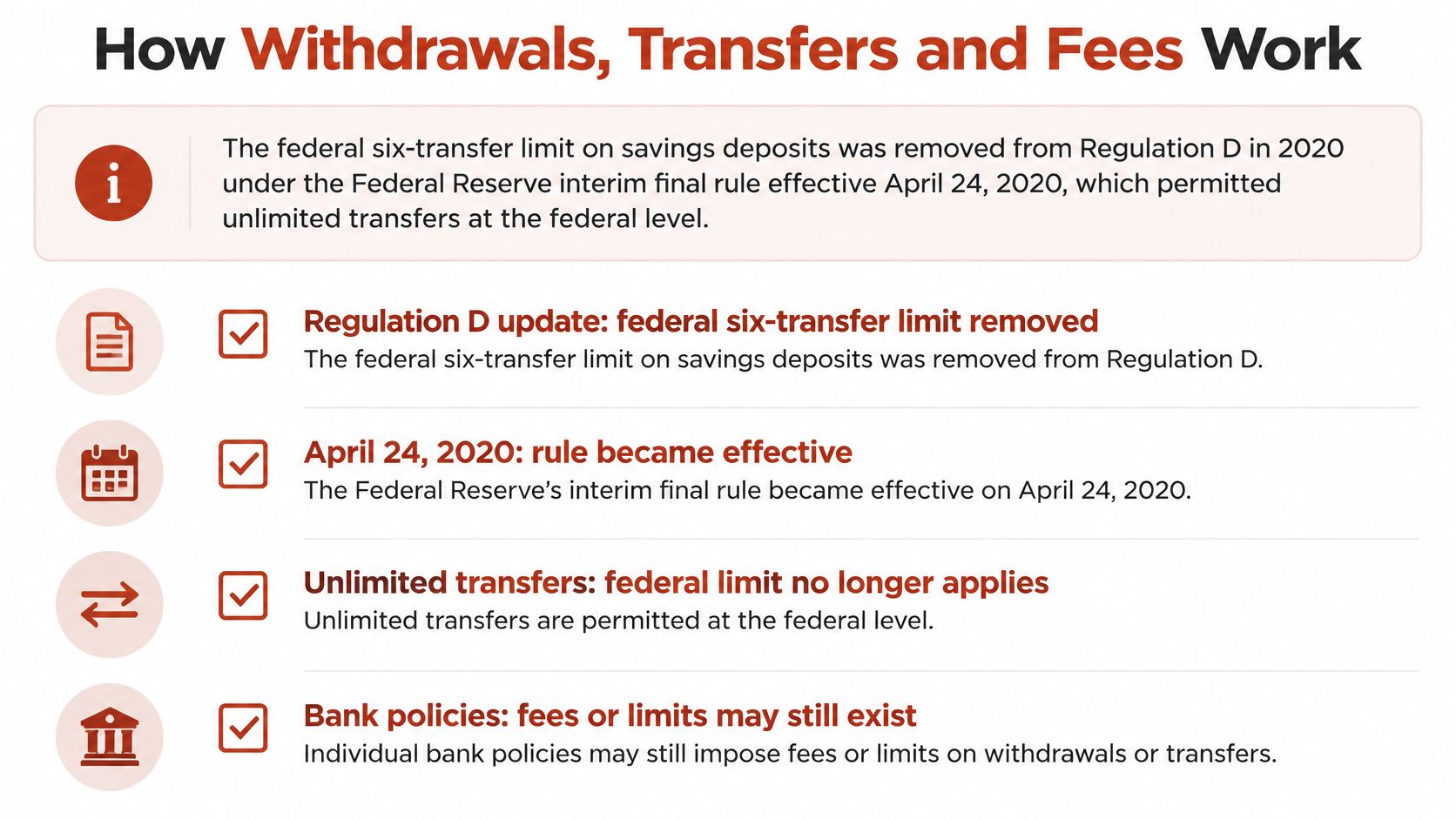
The rule that many account holders still repeat, that a savings account allows six transfers a month, is no longer a federal rule. The Federal Reserve's interim final rule, effective April 24, 2020, permitted depository institutions to allow unlimited convenient transfers and withdrawals from savings deposits, and the related FDIC guidance let institutions suspend enforcement of the six-transfer limit without requiring them to, as the archived FDIC guidance on Regulation D records. Removing the federal cap did not oblige any bank to remove its own. Access rules now live in the account agreement, and they vary.
Six items to read in the account agreement
- The monthly transfer or withdrawal limit, if the bank keeps one. Some do, and the number is usually in a fee schedule rather than the headline page.
- Processing times for transfers to linked accounts. Same-bank transfers often clear the same day; an external transfer can take several business days.
- The monthly maintenance fee and the balance that waives it. Both numbers matter, because a waived fee is only waived if the balance stays above the line.
- Fees for excess transfers or paper withdrawals. A branch withdrawal or a mailed check can carry a charge that an electronic transfer doesn't.
- Restrictions on linked external accounts. Some banks limit how many outside accounts you can connect, or hold the first deposit for verification.
- Whether the account links to checking at the same institution. It isn't a small detail. It decides whether bill money moves in minutes or days.
The fee trap, in numbers. A $5,000 balance at 4.00% earns about $200 in a year. A $12 monthly fee costs $144. Net interest is about $56, which is roughly a quarter of what the advertised rate implied. The APY was accurate. The account still didn't pay it.
Keep a cash buffer in checking for bills due this week rather than scheduling a transfer and hoping it lands. HearSmart's ranking of the best checking accounts covers the bill-paying side of that pairing.
Read the disclosure, not the landing page. Note the version date on the document you reviewed. Terms change, and a fee schedule without a date on it tells you nothing about this month.
Which Goals Fit a High-Yield Savings Account
Three households, three different answers, and the deciding factor in each is a date rather than a rate.
The renter with a reserve. Say a renter keeps a $12,000 emergency fund, about four months of expenses, in a high-yield account at 4.00%. That's roughly $480 in a year before tax, earned on money that has to be available in a bad week. Part of the first month's bills stays in checking so a transfer delay never turns into a late payment.
The car buyer with 18 months. A household saving $20,000 for a car with a known purchase date can keep the money liquid or move it into a certificate of deposit that pays a fixed rate for that term. The CD wins if the date is certain and the early withdrawal penalty is acceptable. The savings account wins if the date might move.
The weekly sweep. A saver whose pay lands in checking transfers the surplus to the high-yield account every Friday and leaves only bill money behind. Interest accrues on the savings balance, spending stays in the account with the debit card, and neither job interferes with the other.
Which savings goals suit a high-yield savings account
| Goal | Fits a high-yield savings account? | Better alternative |
|---|---|---|
| Emergency fund of three to six months of expenses | Yes, liquid and insured within limits | Keep the first month of bills in checking |
| Known spending within one to three years | Often yes, if the APY remains competitive | Certificate of deposit for a fixed term and rate |
| Money invested for ten years or more | No, its variable rate may trail inflation over long periods | Diversified investments that carry market risk |
| Daily spending and bills | No, keep it in checking | Checking account |
The trade-off is consistent. A certificate of deposit buys rate certainty by giving up access, and it usually charges a penalty for leaving early. A high-yield savings account keeps the access and gives up the certainty. Neither is better in the abstract.
The test that settles most debates: name the date you need the money. If no date comes to mind, the money belongs where you can reach it this week.
Verify and Decide Before You Open an Account
Four checks remain once the rate, the fees and the insurance limit are understood, and each one takes a few minutes.
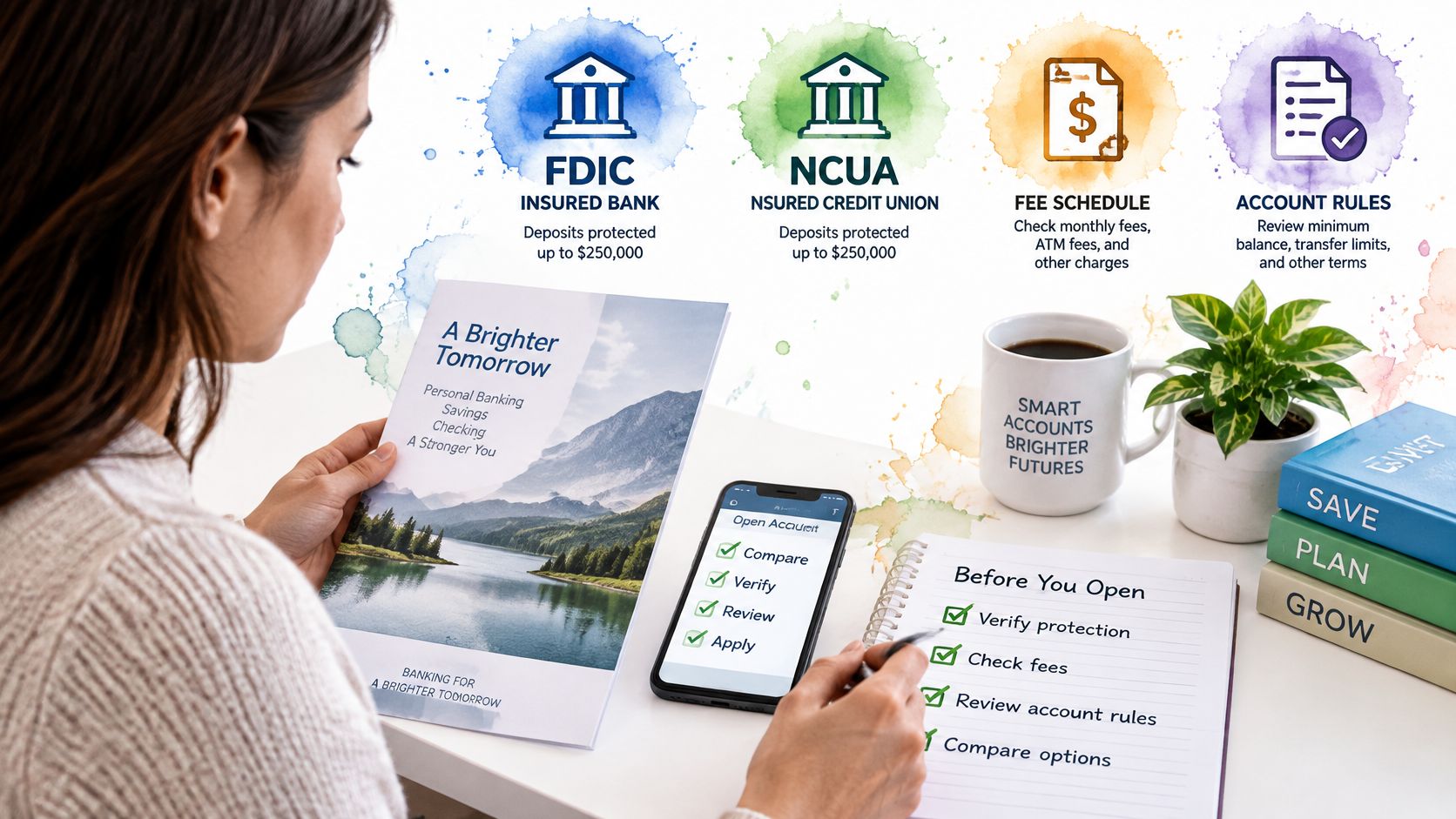
Four checks before the first deposit
- Confirm the institution's insurance status. Look up the bank in the FDIC's BankFind tool, or the credit union in the NCUA's search, and check the name on the account agreement matches the name in the lookup. A brand name on the app isn't the same as the insured institution's legal name.
- Confirm the product is a deposit account. Read the account type line. Brokerage cash, a money-market fund or a bundled investment product can sit behind the same login and carry different protections.
- Record the rate with its date and its expiry. Note whether the APY is promotional and what replaces it, then set a reminder to recheck in 90 days.
- Total the balances by ownership category. Add every deposit account you hold at that institution under the same category, including accrued interest, and compare that sum against the coverage ceiling from the insurance section rather than against each account separately.
Then decide, plainly. A high-yield savings account suits money needed within a few years that must stay insured and reachable. Money with a longer horizon belongs in a product built for growth, such as diversified investments, which carry market risk and offer no deposit insurance. Money needed this week belongs in checking.
HearSmart's best high-yield savings ranking lists published APYs with the date each rate was checked, which is the only honest way to present a variable figure. Any rate on that page can change the day after the check, so treat the date as part of the number. The HearSmart method scores each account on documented features and published prices rather than on hands-on testing, and every page shows when it was last updated.
Revisit the fee schedule, the transfer rules and the tax treatment before signing rather than after. Those three decide what the account pays.
Start with one number: the date you last confirmed your APY. If it's more than a month old, open the bank's rate page today, write the figure and the date side by side, and take that pair to the HearSmart high-yield savings rankings to see how it compares with the accounts currently paying more. Then do the second half of the job: list every goal you're saving for beside the date you need the money, move the ones with a date within a few years into the insured account, and leave the rest where market risk belongs. One page, two lists, and the account choice stops being a guess.
Spotted an error in this guide? Email editorial@hearsmart.org