Guide · General
Bagged vs Bagless Vacuum: Which Fits Your Home in 2026
Bagged vs bagless vacuum compared on filtration, upkeep, running costs and allergy exposure, with a verdict by household type for 2026.
By the HearSmart research desk · Updated November 24, 2026 · 13 min read
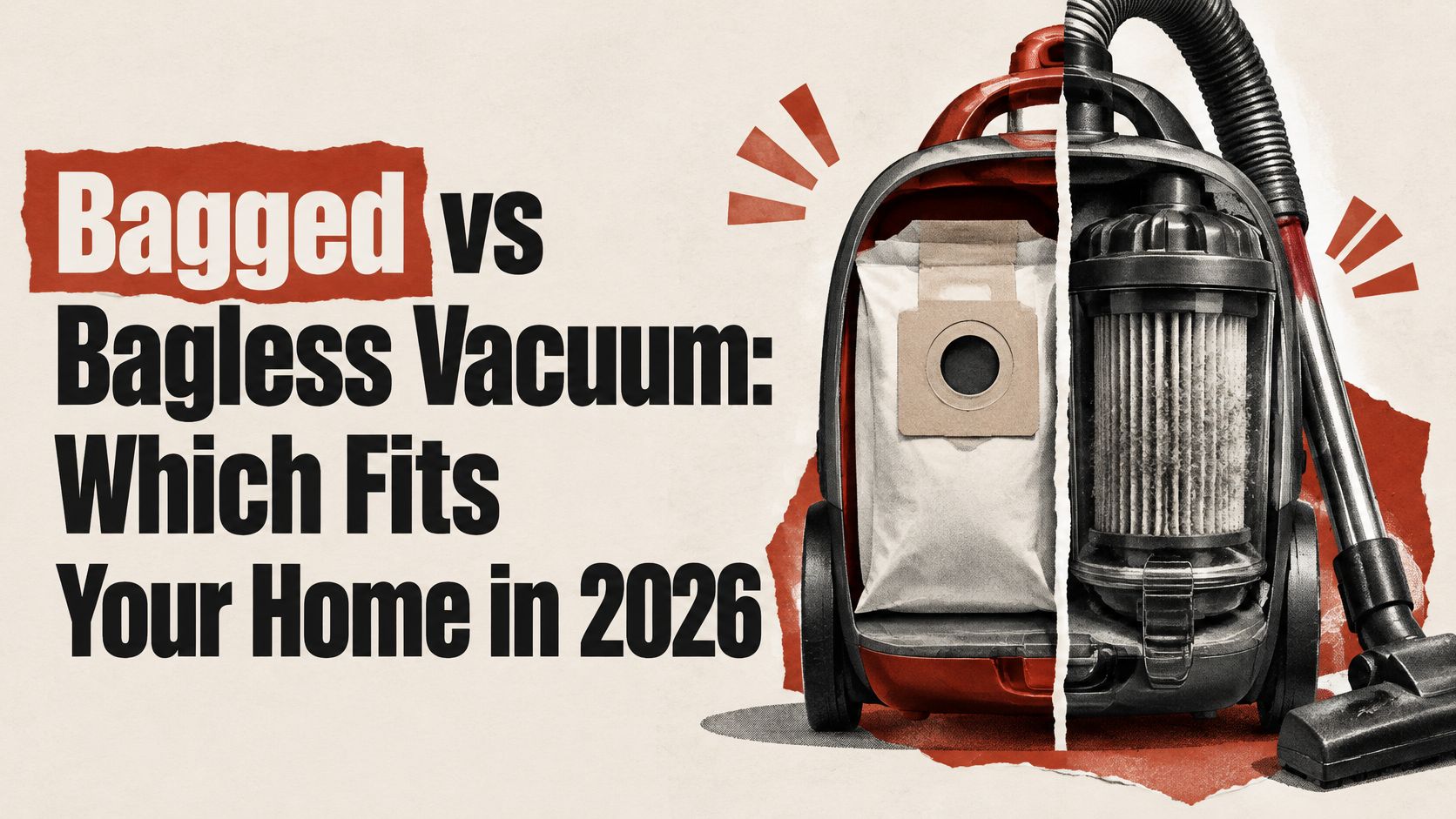
A bagged vacuum isn't automatically cleaner for indoor air, and a bagless model isn't automatically cheaper to own. Neither format wins on every measure: published emissions testing and engineering reviews point to sealing, filtration and maintenance as the deciding factors. For allergy-sensitive households, the strongest reason to choose bagged is often what happens when the collected dust leaves the machine, not how the machine picks it up.
Table of Contents
- Bagged and Bagless Vacuums Side by Side
- How Suction Changes as the Bag or Bin Fills
- Filtration, Emissions and Allergy Exposure
- Maintenance Work and Ongoing Running Costs
- How Bagless Became the Mainstream Format
- Which Format Fits Your Household
- Confirm Your Format Before You Buy
Bagged and Bagless Vacuums Side by Side
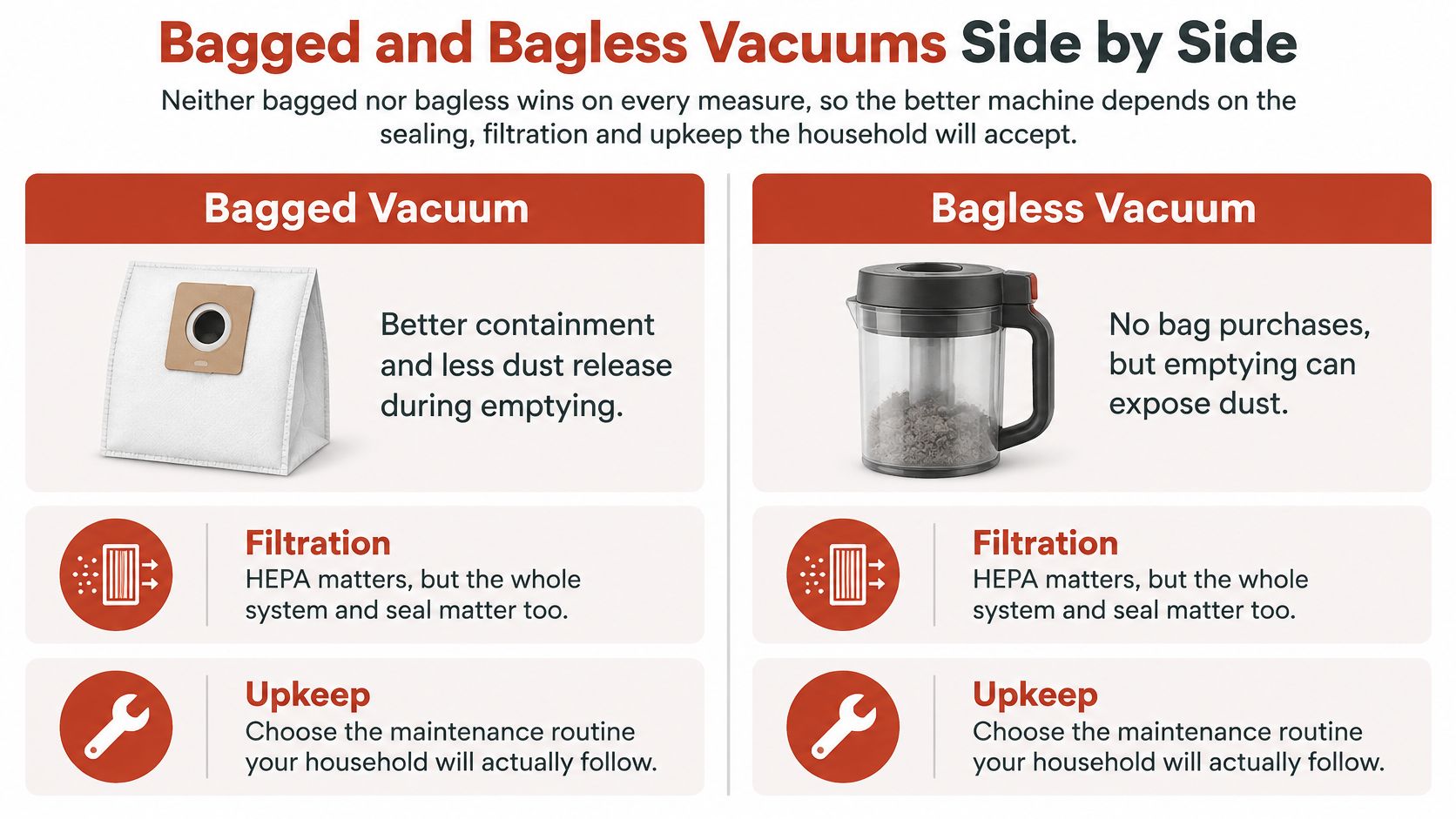
The useful bagged vs bagless vacuum comparison starts with the household's tolerance for dust handling and upkeep. A bagged machine stores debris in a disposable bag; a bagless machine collects it in a removable bin and uses reusable filters. Neither arrangement guarantees better floor cleaning.
The European vacuum-cleaner review dated 2018 found that properly designed machines of both formats can deliver comparable cleaning performance, while identifying differences in airflow, maintenance and disposal exposure. Because that review describes established engineering trade-offs rather than every current product, buyers should check the specific model's current specification sheet.
Bagged and bagless vacuums compared on core criteria
| Criterion | Bagged vacuum | Bagless vacuum |
|---|---|---|
| Dust container | Disposable bag that holds most collected dust | Removable bin or canister emptied by the user |
| Filtration path | Bag and exhaust filter | Cyclonic or bin separation with reusable filters |
| Suction as dirt builds | Typically highest when the bag is new, then declines as the bag fills | Performance declines less as the bin fills |
| Best suited to | Households that want less direct contact with dust at disposal | Households that want no bag purchases and accept filter washing |
The container determines the disposal routine. With a bagged machine, the user removes the dust together with its container; with a bagless machine, the user transfers loose debris into household waste.
The filtration path determines where particles must be stopped. The container is only part of that path, so a bag or transparent bin shouldn't substitute for documentation of the complete filtration system.
The trade-off behind the label
Suction behavior reflects how dust meets the airflow path. Bagless separation avoids a progressively dust-filled bag, but that advantage doesn't make its filters immune to clogging.
Household fit reflects the work someone will perform. Buying bags may be preferable to washing filters for one household, while another would rather clean a reusable component than keep compatible consumables in stock.
The review's maintenance findings matter because bagless ownership doesn't eliminate work. Filters can clog after repeated use, and washable filters require cleaning and drying; emptying outdoors reduces the need to handle loose collected material inside the home. Bagged ownership instead adds continuing purchases and discarded bags.
Quick-pick rule: Choose bagged for less direct contact with dust during disposal. Choose bagless to avoid recurring bag purchases, provided filter washing is an acceptable routine.
This isn't a choice between an old technology and a universally superior replacement. It's a choice between different ways of separating, storing and discarding the same household debris.
How Suction Changes as the Bag or Bin Fills
Dust changes suction by changing the route air must travel. In a bagged machine, air passes through the bag material, so permeability and dust loading matter. Cyclonic bagless designs avoid that particular bag restriction, although their filters and passages still need attention. The useful question is not which format starts strongest, but how long each one keeps a workable air path under normal loading.
An RTINGS airflow investigation recorded 43.1 cubic feet per minute with a dirtbag installed versus 116.3 CFM with the bag removed on the same vacuum. That comparison shows how strongly a bag can affect measured airflow. It also shows why a bag-removed number has limited practical value. Removing the bag removes its intended collection function, so the result describes resistance in the air path, not safe dust capture or better whole-machine cleaning.
Airflow isn't floor pickup
A high airflow reading at the hose or motor leaves several questions unanswered. The nozzle must make suitable contact with the surface, the brush must loosen debris, and the airflow must carry that debris through the machine's filtration path. A maximum-suction claim may describe a favorable test condition rather than cleaning performance after dust has accumulated.
That distinction matters most when a household expects one number to summarize cleaning. Airflow measures movement through a path. Floor pickup depends on how well the machine disturbs debris, seals against the surface and keeps the path open while working. Two vacuums with similar airflow claims can behave differently once one has a loaded bag, a dusty filter or a obstructed floor head.
A useful comparison worksheet should record:
- Empty-condition airflow: Note the test location, installed accessories and whether all normal filters were fitted.
- Partly loaded airflow: Compare results under the same setup after dust has accumulated, where independent testing provides that measurement.
- Floor-cleaning evidence: Look for pickup testing on the household's actual surface type rather than treating airflow as a complete score.
- Filtration documentation: Check whether the maker describes sealed-system or filtration testing alongside its suction claim.
Most shoppers lack instruments for reliable airflow checks. Independent tests that disclose their setup are more useful than improvised comparisons between unrelated manufacturer specifications. For any format, replace the bag or empty the bin before it reaches its limit, clean filters on the manual's schedule, and inspect the nozzle after each session. A blocked floor head can undermine a well-designed machine regardless of its container.
Filtration, Emissions and Allergy Exposure
Emissions during vacuuming and exposure during disposal are separate problems. A HEPA label describes a filter feature, while allergy exposure also depends on machine sealing, exhaust filtration and what happens when the bag or bin is opened.
In the peer-reviewed 2020 comparison of vacuum designs, operating PM10 emissions were 207 ± 99.0 µg/min for the bagged vacuum and 75.4 ± 7.89 µg/min for the washable-filter bagless model; the HEPA-equipped robot produced no observed increase in particulate mass or number. The following table reports those tested machines, not category-wide averages.
Measured PM10 emissions during operation, by vacuum design
| Design tested | PM10 emission during operation | Study year |
|---|---|---|
| Bagged vacuum | 207 ± 99.0 µg/min | 2020 |
| Washable-filter bagless vacuum | 75.4 ± 7.89 µg/min | 2020 |
| HEPA-equipped robot vacuum | No observed increase in particulate mass or number | 2020 |
Those results challenge a blanket bagged-is-cleaner verdict. They also show why a single format label is a weak proxy for real emissions. They don't establish that all bagless models outperform all bagged machines, or that an absence of observed increase means absolutely no emissions under every condition. The measured values apply to the tested designs and the conditions used in that comparison.
The complete air path matters
The EPA's HEPA-vacuum guidance says HEPA vacuums used for lead-safe cleaning must pass drawn-in air through the filter without leakage. That complete-machine requirement matters more than a filter name on a product page. The same guidance warns that adding a replacement HEPA filter to a basic shop vacuum may not meet the intended requirement.
For household buyers, the point is direct: a capable filter can't capture air that escapes around it. Look for a sealed air path, clear filtration documentation and an explanation of how the machine handles dust after pickup. Those details separate a well-integrated design from a strong filter spec attached to a leaky system.
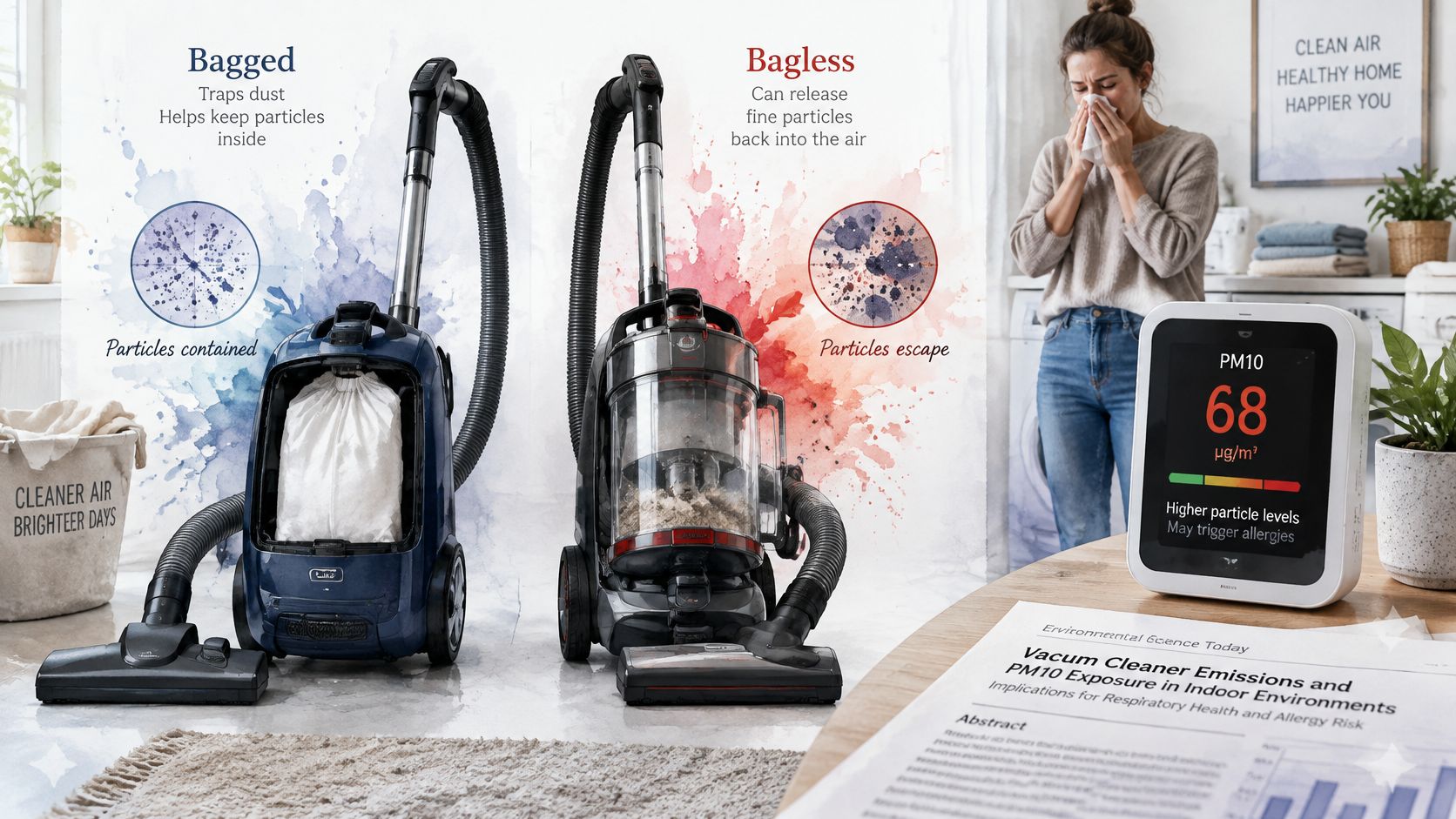
The illustration depicts a possible disposal contrast, not a universal ranking of operating emissions. A bagless bin can release dust at emptying even when operating emissions look modest. A bagged design can reduce that contact if the bag is sealed well and removed without shaking loose dust.
Maintenance creates a separate exposure event
RTINGS' air-quality and filtration analysis found that bagged machines generally maintained cleaner air overall, while bagless models needed multiple filtration stages to perform comparably during operation. Emptying remained an important exposure point. Consumer Reports' guidance, discussed in that evidence, likewise favors considering self-sealing bags for people with asthma or allergies.
A broader Environmental Science & Technology study published in 2012 tested 21 vacuum cleaners and found markedly different particle and bacterial emissions among machines. Dust bags were only part of the explanation alongside exhaust filtration, construction, dust loading and age. That pattern helps explain why two models with similar container formats can behave differently in practice.
Laboratory operating emissions aren't a direct measure of someone's long-term household exposure. Nor do they capture every dust cloud created by opening a bin or cleaning a filter. For allergy-sensitive homes, the disposal step often deserves as much attention as the bagged or bagless label.
For airborne-dust management beyond the vacuum, the dust air-purifier buying guide provides a separate comparison. The vacuum specification to verify remains a sealed system, multi-stage filtration and a documented disposal method.
Maintenance Work and Ongoing Running Costs
The maintenance bill includes both purchases and labor. Bagless removes the bag purchase, but not the need to maintain the collection and filtration components.
Upkeep tasks for bagged and bagless vacuums
| Task | Bagged vacuum | Bagless vacuum |
|---|---|---|
| Emptying | Replace the bag when the manufacturer indicates it is full | Empty the bin, preferably outdoors, per the manufacturer |
| Filter care | Replace filters on the schedule in the manual | Wash and fully dry washable reusable filters regularly |
| Consumable purchases | Recurring bag purchases | No bag purchases; filter replacement when required |
| Main ownership cost | Consumables and waste | Filter care and dust exposure during emptying |
The EPA ENERGY STAR vacuum-cleaner market report published in 2011 explains the mechanical split: a disposable bag filters dirt from the moving airstream, while a bagless machine uses a removable container and reusable filtration. It also identifies a separate exhaust-filtration stage for particles that escape primary separation.
That distinction prevents a common budgeting mistake. Replacing the bag doesn't necessarily replace every filter in a bagged vacuum, and washing a bagless filter doesn't mean it will never need replacement.
Compare a full year of consumables
A useful estimate comes from the exact model, compatible parts and the household's likely dust load. A universal annual bag-cost figure would conceal those differences.
- Estimate annual bag changes. Use the manual's capacity and replacement guidance, then adjust the estimate using the household's observed fill rate. If the manual doesn't provide a replacement interval, don't invent one.
- Calculate the bag cost. Divide the seller's pack price by the number of bags, then multiply by expected replacements. Record the seller and date checked.
- Add scheduled filters. Include each replacement filter specified by the manufacturer, rather than assuming exhaust filtration is permanent.
- Build the bagless comparison. Enter no bag expenditure, then add required filter replacements and any other documented consumables.
The resulting total is a consumables estimate, not the complete ownership cost. Purchase price, electricity, repairs and the time needed for care remain separate considerations.
Prices in the ranking are the US prices shown on each maker's own store at the time HearSmart checked them. They can change, so a saved comparison should retain its checking date.
Budgeting caution: No bag purchases doesn't mean no running costs. A washable component still requires the owner's time and may eventually need replacement.
Environmental claims need similar discipline. Disposable bags create a recurring waste stream, while reusable bins require repeated handling and filter care. Avoiding bags alone doesn't establish a lower lifecycle environmental impact without evidence about the complete products, their replacement parts and service lives.
How Bagless Became the Mainstream Format
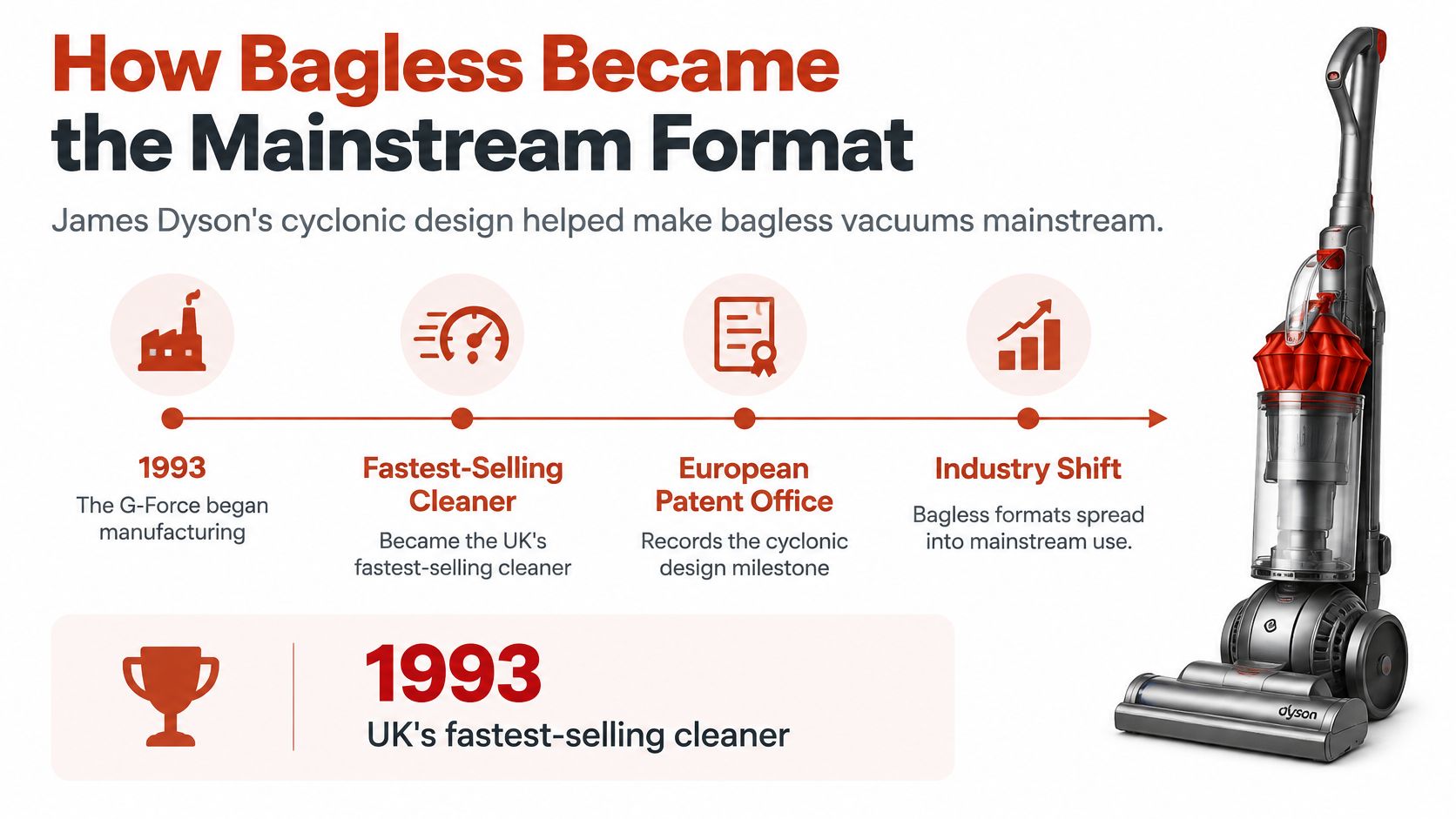
James Dyson's cyclonic design made bagless collection a visible alternative to conventional disposable bags. The European Patent Office's account records manufacturing of the G-Force beginning in 1993 and describes it as the United Kingdom's fastest-selling cleaner. What followed was a format shift rather than a single brand's story: bagless collection moved from a patented engineering solution to the design buyers came to expect across much of the category.
The features that drove that adoption deserve a second look. A clear bin showing accumulated debris and the end of bag purchases gave shoppers a concrete reason to switch. Neither addresses the emptying step, where collected dust is handled again and particles can re-enter the room. Mainstream status was earned at the bin window, not at disposal.
Popularity changes with the category
Commercial market estimates put bagless ahead across household vacuums overall, but narrower categories don't split the same way. These figures come from market-research publishers rather than official government statistics, and each publisher defines its category and sales measure differently, so the rows shouldn't be treated as interchangeable.
Bagged and bagless share by vacuum category
| Market and scope | Year | Bagless share | Bagged share |
|---|---|---|---|
| Global household vacuum cleaners, Reed Intelligence | 2025 | Approximately 70% | Approximately 30% |
| Global compact vacuums, DataIntelo | 2025 | 65.1% | 34.9% |
| Global cordless canister vacuums, DataIntelo | 2025 | 58.2% | 41.8% |
| Global canister-vacuum sales, DataIntelo | 2024 | Approximately 58% | Approximately 42%, calculated remainder |
| Global cylinder-vacuum revenue, DataIntelo | 2025 | 41.6%, calculated remainder | 58.4% |
The two calculated remainders assume each publisher divides the stated category entirely between bagged and bagless designs. They aren't separately reported findings.
The cylinder result is the useful corrective here. A household can encounter a category where bagged models account for the larger revenue share even while bagless dominates the broader market estimate. Buyers considering cylinder machines should examine that product category rather than assume the overall household split describes the choices on the shelf.
Market share isn't a cleaning-performance score. It describes purchasing patterns within a defined segment, not filtration quality, disposal exposure or suitability for a particular home. A format can lead sales while still requiring the owner to handle collected dust directly when the bin opens. Popularity measures what households bought, not what they breathe at the point of emptying.
Which Format Fits Your Household
Most homes can use either format successfully. The practical difference emerges when the household weighs respiratory sensitivity, recurring purchases and the maintenance routine someone will reliably keep.
Best-fit format by household situation
| Household situation | Better fit | Reason |
|---|---|---|
| Asthma or allergy sufferers | Bagged with sealed disposal or self-sealing bags | Emptying a bagless bin can release particles back into the air |
| Households that want no bag purchases | Bagless | No recurring bag cost, with filter washing and drying as the trade-off |
| Low-waste households | Bagless, if filter care is practical | Avoids disposable bags, but repeated bin emptying and filter washing have their own exposure trade-offs |
| Homes with light dust on mostly clean floors | Either, if well designed | Properly designed machines of both types can perform comparably |
The allergy recommendation is a risk-management preference, not a medical guarantee. A bagged machine still needs appropriate sealing and filtration, and a household shouldn't assume every replacement bag closes securely when removed.
For low-waste buyers, bagless is a reasonable starting point rather than an automatic environmental winner. The better choice is the machine whose required care and replacement components fit the household's intended use.
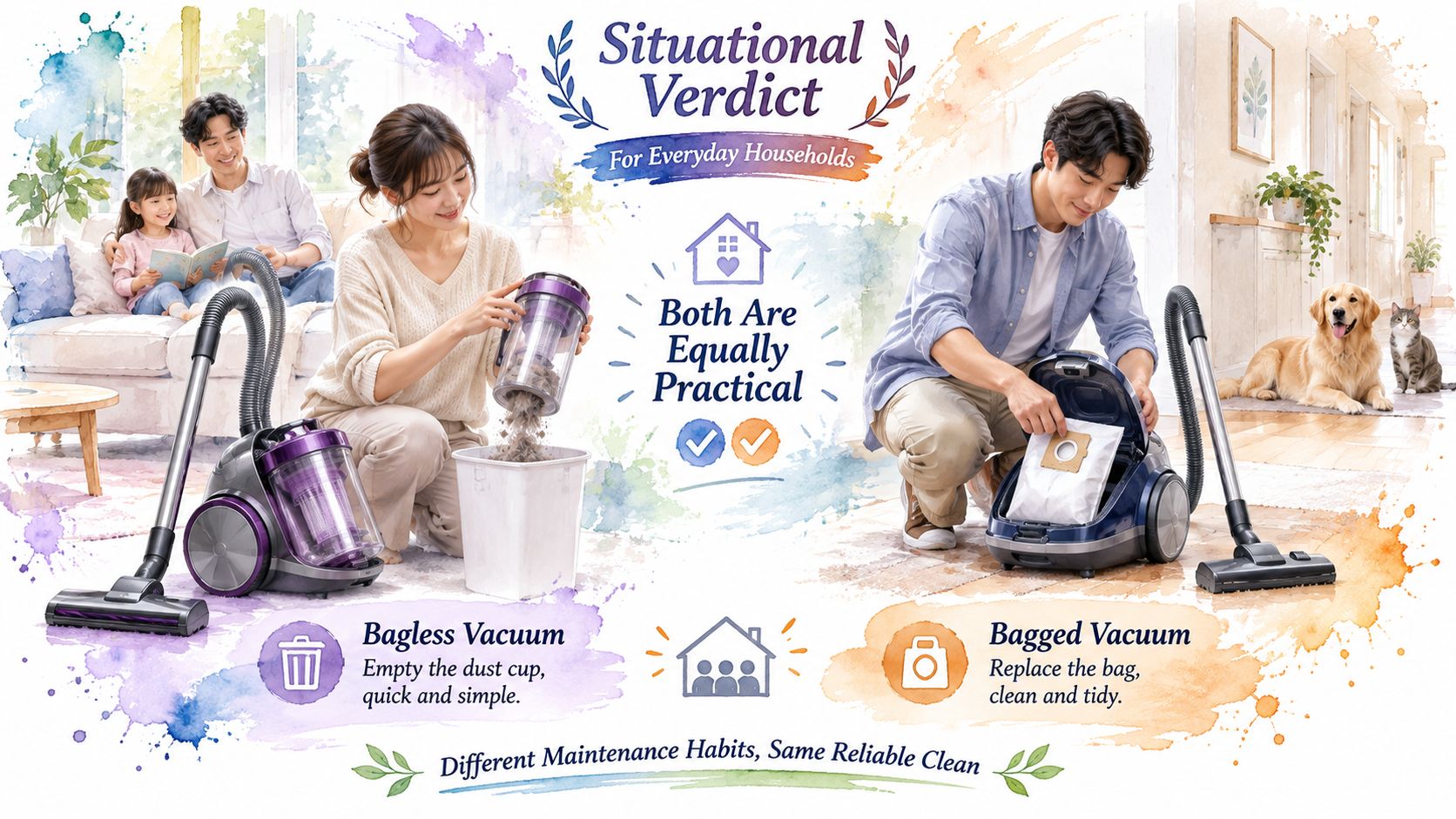
Similar floors, different decisions
Consider a hypothetical family with a child who has asthma. The family chooses a sealed bagged model with a self-closing disposal arrangement, and an adult takes the bag outdoors for disposal. The purchase prioritizes limiting contact with collected material rather than avoiding consumable spending.
A second household has no respiratory concerns and dislikes ordering replacement bags. It chooses bagless and schedules monthly filter washing only if that model's manual specifies that interval, allowing the filter to dry completely before reinstallation. A different manual may require a different routine or prohibit washing a particular filter.
Neither household has selected the universally better format. Each has selected a workable responsibility.
Robot shoppers should apply the same reasoning to the entire collection route, including the dock where fitted. The budget robot-vacuum comparison can help narrow the device shortlist, but the disposal instructions still need a separate check.
For sensitive users, the disposal step can matter more than the format label when deciding between otherwise suitable machines. That doesn't mean disposal always dominates measured exposure; it means a good operating-emissions result shouldn't excuse a dust-handling process the household can't tolerate.
Confirm Your Format Before You Buy
The final decision should begin with the maintenance process, not a headline suction figure. A machine is a poor match if its owner is unlikely to perform the care needed to keep it working as designed.
A short checklist can expose that mismatch before purchase:
- Respiratory sensitivity: Does anyone in the home have asthma or allergies that make dust disposal especially important?
- Acceptable upkeep: Will someone wash and fully dry the permitted filters, or would the household rather purchase replacement bags?
- Documented construction: Does the model describe a sealed system, its filtration stages and how collected debris is removed?
An unanswered question is a reason to inspect the manual, not to assume that a product photograph or HEPA badge supplies the answer. The bag compartment, filter housing and bin-release instructions deserve attention alongside the floor head and accessories.
Turn the answers into a shortlist
- Select a small group of suitable models. Start with the preferred disposal format, then compare the floor-cleaning features relevant to the home.
- Read each specification sheet and manual. Record sealing claims, filtration stages, washable components, drying instructions and the disposal method.
- Check the seller's own listed price. Record the checking date and compatible replacement-part costs, since prices can change.
- Use the appropriate product comparison. Robot buyers can consult the best robot vacuums ranking, while shoppers considering a portable stick design can use the cordless vacuum comparison.
Before paying, the household should be able to describe the full maintenance sequence in plain language: where the debris goes, who removes it, which parts need cleaning and when the machine can return to service. If that sequence sounds impractical, another design deserves consideration.
The strongest purchase isn't necessarily the model with the fewest consumables or the most prominent filtration claim. It's the model whose documented care requirements match the household's priorities without relying on optimistic maintenance habits.
Choose the format whose maintenance the household will do every month, while following the model's specific schedule rather than imposing a universal washing interval.
Use HearSmart's relevant ranking to build a shortlist today, then open each finalist's manual and seller page. Confirm the seals, disposal process and replacement-part costs before choosing the bagged or bagless vacuum that fits the household's real routine.
Spotted an error in this guide? Email editorial@hearsmart.org