Guide · General
Best Electric Dryer 2026: How to Pick by Efficiency
Compare the best electric dryer types by capacity, venting, efficiency, ease of use and price, with sourced 2026 benchmarks.
By the HearSmart research desk · Updated November 19, 2026 · 12 min read
About 83% of U.S. households had both a clothes washer and a clothes dryer in 2024, according to the U.S. Energy Information Administration's 2024 Residential Energy Consumption Survey. An appliance that common stops being a novelty purchase. It becomes an installation decision, because the machine has to fit a room, a circuit and often a duct, then run for a decade.
That's why one flat "best electric dryer" pick serves almost nobody. The label covers machines that differ in capacity, voltage, venting path and heat source, and each of those decides which models a household can plug in at all.
The comparison that holds up starts with class. Running cost and upkeep come second, and both are judged on the federal test method rather than a showroom impression.
Table of Contents
- Quick Picks by Electric Dryer Type
- How Electric Dryer Efficiency Ratings Are Measured
- Capacity, Venting and Upkeep Side by Side
- Running Cost, Payback and the Heat-Pump Trade-Off
- Drying Features and Ease of Use
- Matching the Dryer to Your Home Setup
- Confirm the Specs Before You Buy
Quick Picks by Electric Dryer Type
No single electric dryer is best for every home. The class comes first, set by three facts about the building: how much laundry the household dries in a week, which circuit the laundry area has, and whether an exhaust duct exists and what condition it's in.
Get the class wrong and a well-reviewed machine becomes a bad purchase. A full-size 240-volt vented dryer can't go into a closet wired for 120 volts, and no efficiency rating rescues a ducted model in a sealed apartment nook with nowhere to vent.
The table sets the classes side by side on published thresholds. Each figure is a threshold for the class, not a rating for any single model, and "no separate threshold" means exactly that.
| Dryer type | DOE 2022 proposed CEF | Venting | Best for |
|---|---|---|---|
| Standard electric, 4.4 cu ft or larger | 3.93 lb/kWh | External vent | Full-size loads and larger families |
| Compact electric, 120 volt | 4.33 lb/kWh | Vented | Small homes with 120-volt outlets |
| Compact electric, 240 volt, vented | 3.27 lb/kWh under the standard in force | External vent | Apartments with an existing vent |
| Compact electric, 240 volt, ventless | 2.55 lb/kWh | No external vent | Homes where venting is not possible |
| Heat-pump electric | No separate threshold published | No external vent | Buyers focused on running cost |
Where the numbers come from. DOE's 2022 rulemaking notice lists 3.93 lb/kWh for a standard electric model of at least 4.4 cubic feet, 4.33 lb/kWh for a compact 120-volt model under that size, and 2.55 lb/kWh for a compact ventless 240-volt dryer (DOE dryer energy conservation standards notice, 2022). Set against the rules in force, the proposal would lift the floor for standard-capacity vented electric models from 3.73 lb/kWh to 3.93, while compact vented models sit at 3.61 lb/kWh on 120 volts and 3.27 lb/kWh on 240 volts (DOE consumer clothes dryers program page).
Practical rule: choose the class that matches the vent, the circuit and the load size, then compare models only inside that class. A strong CEF in a class the room can't support buys nothing.
Heat-pump electric is the one class with no separate published threshold in the federal rulemaking, and it's also where running cost shifts most. That gets its own arithmetic.
Every HearSmart ranking opens with a spec sheet table that lists each product's starting price, whether it can be bought directly or needs a conversation with sales, and one key spec for the category. For a dryer, that spec is class plus CEF.
How Electric Dryer Efficiency Ratings Are Measured
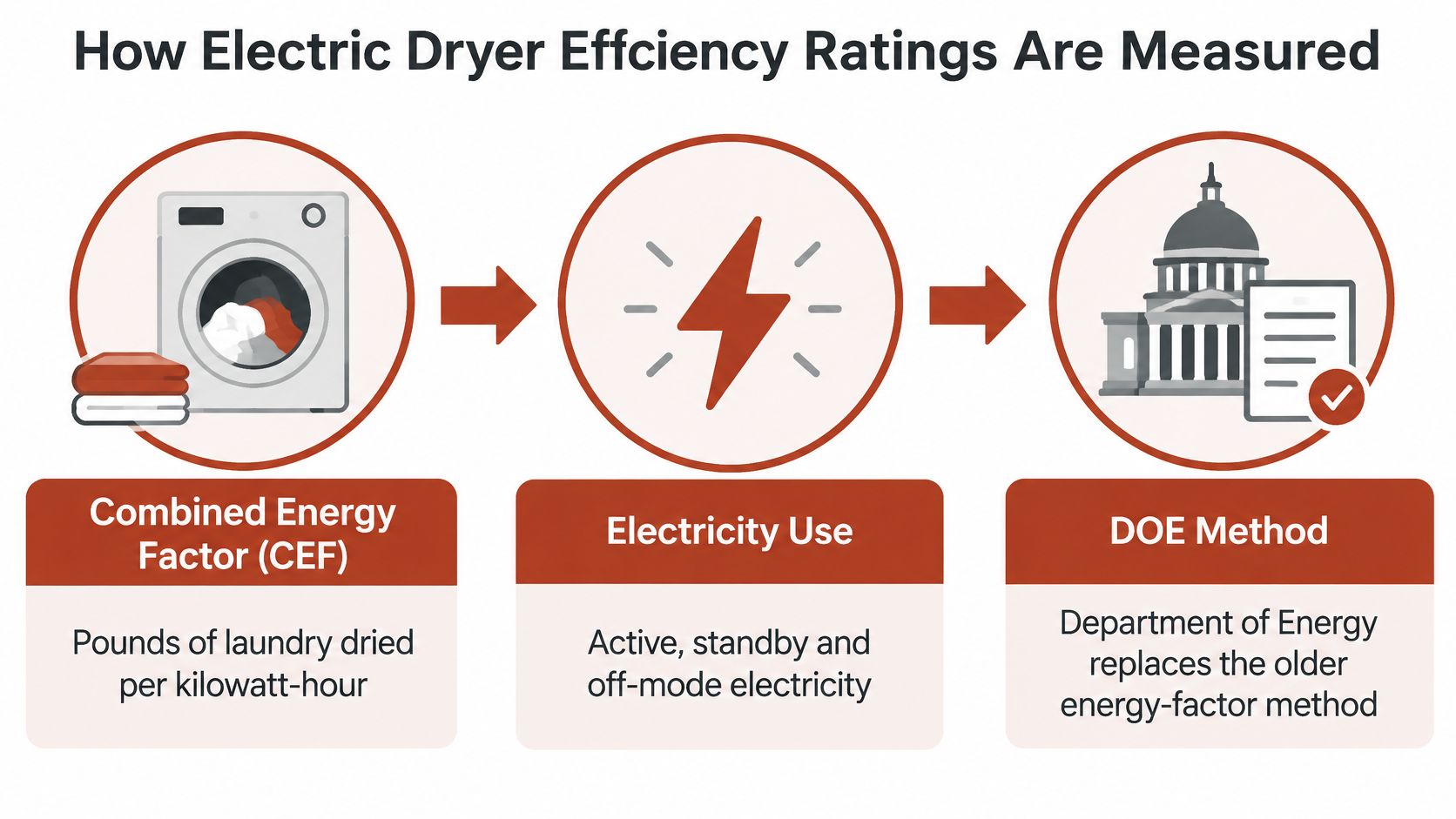
Combined energy factor (CEF) is pounds of laundry dried per kilowatt-hour, and it counts the electricity a dryer draws while running plus what it pulls in standby and off modes. Higher is better. The Department of Energy replaced the older energy-factor approach with CEF so that a machine's idle draw would count against it instead of disappearing from the label.
The reason the number travels between products at all is the test behind it. A controlled load, a fixed starting moisture and a defined dryness endpoint are what let a compact ventless unit and a full-size vented unit be compared on the same scale at all.
The Test Procedure, Step by Step
Each step in the DOE clothes dryer test procedure materials exists to remove a variable a manufacturer could otherwise exploit.
- Saturate the test load in water at 60 degrees Fahrenheit, plus or minus 5 degrees. A fixed starting condition is what makes two models comparable in the first place.
- Spin the load until moisture reaches 54.0% to 61.0% of bone-dry weight. Every run then begins from the same wetness, so a model can't look efficient by receiving drier clothes.
- Run the dryer until the load reaches 2.5% to 5.0% moisture. That sets a defined endpoint instead of "until it feels done".
- Stop the cycle before cool-down begins. The endpoint stays fixed across every model tested.
- Measure the full programmed cycle, cool-down included. Energy used after the heat cuts off is still energy.
- Repeat any run that finishes above 2% moisture. DOE treats that result as invalid, so published figures rest on runs that met the endpoint.
Three Dates That Separate the Rules
Dryer efficiency numbers carry three separate milestones, and confusing them is how buyers end up comparing figures produced under different methods. The amended test procedure took effect on February 18, 2025, testing with the revised method became mandatory for manufacturers on July 16, 2025, and compliance with the amended energy-conservation standards is required from March 1, 2028 (DOE 2024 final rule materials).
A CEF figure without a test method and a production date is a number without a baseline.
On a spec sheet, look for both before lining up two models. An older label and a newer one can each be accurate and still fail to describe the same machine.
Capacity, Venting and Upkeep Side by Side
Capacity sorts dryers into standard and compact, and venting splits each of those again. Three designs cover the field: a vented electric dryer that pushes moist air outside, a ventless electric dryer that condenses moisture internally, and a heat-pump electric dryer that does the same job with a refrigeration cycle.
| Criterion | Vented electric | Ventless electric | Heat-pump electric |
|---|---|---|---|
| Venting | External duct required | No external duct | No external vent, confirm on spec sheet |
| Cycle time, ENERGY STAR test | Under 80 minutes, standard models | Under 80 minutes, standard models | Longer cycles typical, confirm on spec sheet |
| Field performance on real clothing | Falls below its lab CEF | Split between condenser and heat-pump designs | Holds efficiency as loads grow |
| Upkeep | Lint trap and vent cleaned yearly, more often in shared rooms | Lint trap plus condenser cleaning | Lint trap plus heat exchanger and drain care |
Venting is the row that rules options out. A vented machine needs a duct to the outside; the other two designs don't, which is why they dominate apartments and converted closets where a duct run was never built.
Cycle time is where published figures get over-read. ENERGY STAR's certification test requires a cycle below 80 minutes for standard models (ENERGY STAR clothes dryers key product criteria), but that test time isn't a household promise. Load size, starting moisture and fabric all stretch or shorten a real cycle.
Contrarian read: where the duct is long, crushed or shared, a vented dryer's speed advantage is theoretical. A slower ventless unit that never fights a bad duct can be the better machine in that house.
Efficiency behaves differently outside the lab, and the gap grows with load size. Conventional electric drying loses ground on big loads while heat-pump drying holds up, which matters for households that wash bedding and towels in one drum.
Upkeep is the row most rankings skip, and it carries the highest stakes. A 2025 New York State fire-safety bulletin reports approximately 15,000 structure fires, 15 deaths and 400 injuries annually from clothes dryers, and identifies failure to clean as the leading contributing factor (New York State Division of Homeland Security and Emergency Services dryer vent bulletin, 2025). The same guidance calls for cleaning lint traps and vents yearly, more often in busy shared laundry rooms, and notes that manufacturers may recommend professional internal cleaning.
Filter placement, door swing and service access are where those tasks get easier or harder, and they belong on the same spec sheet as the CEF figure.
Running Cost, Payback and the Heat-Pump Trade-Off
Independent DOE test data on standard electric dryers show a spread from 2.71 to 3.51 CEF, with the best performers reaching 3.48 to 3.51 lb/kWh, and ENERGY STAR's analysis estimated those top dryers used more than 20% less energy than the least efficient model tested (ENERGY STAR clothes dryers data and analysis). Divide the ends of that range and the weakest machine used close to 30% more electricity per pound dried than the best. The same analysis bases annual-use estimates on 283 cycles per year, which is the multiplier that turns a CEF figure into a yearly comparison.
CEF is built for product comparison, not bill forecasting. The procedure normalizes results to a standard test load at roughly 2% final moisture and applies a field-use factor for over-drying, so a household that runs small, damp loads will land somewhere else entirely.
Turning CEF Into a Yearly Number
- Find the annual kWh gap between two models using the 283-cycle basis, rather than guessing at loads per week.
- Multiply by the local electricity rate. That is the yearly saving, in the reader's own currency.
- Compare with the price premium. Payback is the premium divided by the annual saving, and nothing else.
An illustration, not a quote from any seller: a 100 kWh annual difference at $0.30 per kWh is $30 a year. Against a $300 price gap that's a ten-year payback; against $150 it's five. The arithmetic is the same for every household, but only one of those answers belongs to a given buyer.
The Fork That Matters Is Resistance Versus Heat-Pump
Comparing electric with gas misses the more consequential split inside electric drying. A 2025 ENERGY STAR proposal found its planned criteria would be 10% to 73% more efficient than the current U.S. minimum standard depending on product class, while only about 13% of current electric base models met the proposed levels (ENERGY STAR Draft 1 Version 2.0 clothes dryers specification, 2025).
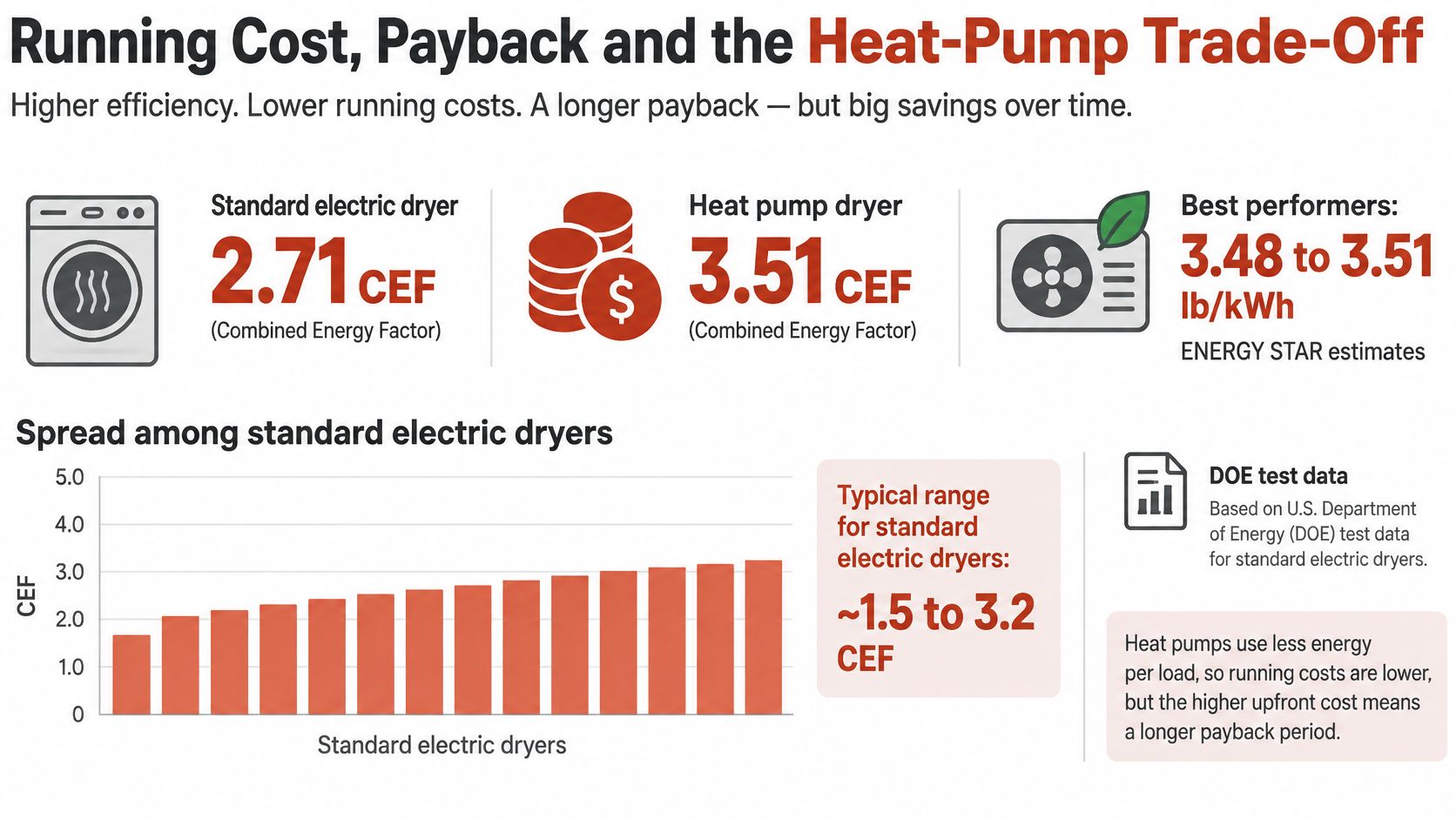
The same proposal points to a Pacific Northwest field study that found conventional electric dryers typically dried fewer than 3 pounds of real clothing per kilowatt-hour, against more than 6 pounds for heat-pump dryers. It also recorded that heat-pump models performed better as loads grew, while conventional models became less efficient.
Payback is where that gap turns into a decision. ENERGY STAR's analysis estimated payback for most eligible classes at between zero and 4.9 years, with qualifying rebates potentially reducing it to zero. Gather five inputs before dividing anything: purchase price, electricity rate, typical load size, cycles per year, and any rebate the household can claim. Venting and climate sit behind those, because a heat-pump unit that needs a drain or a condensate routine adds a task the vented model didn't have.
The two ventless designs aren't interchangeable, either. A heat pump versus condenser dryer comparison explains why one is a refrigeration cycle and the other is a heated condenser, and why the difference shows up in drying time and cleaning.
Rebates and standards are U.S.-specific. The physics of the energy comparison isn't.
Prices need the same discipline as the efficiency figures. Prices in a HearSmart ranking are the US prices shown on each maker's own store at the time the desk checked them, and they change.
Drying Features and Ease of Use
Features separate models that already fit the same class. They don't override the class, and none of them is established as an efficiency gain.
- Drum capacity. Take the cubic-foot figure from the spec sheet and check it against the boundary that separates standard from compact sizing.
- Drying control. Note whether the maker describes timed cycles, moisture sensing or both, and how the cycle is selected on the panel.
- Noise. Use the manufacturer's published rating where one exists. Where none is published, record it as unknown rather than inferring quiet operation from the drum size.
- Lint filter and vent access. Where the filter sits and how easily it clears matters, because the yearly cleaning routine is the task that keeps the machine safe.
- Controls and door swing. A door hinged the wrong way for the room becomes a daily annoyance in a narrow laundry closet.
- Warranty and service. Record the stated term and who services the unit, since heat-pump models add components a general technician may not carry.
Treat all six as tie-breakers between shortlisted models, not as reasons to change class.
Matching the Dryer to Your Home Setup
Most households fit more than one class, so the useful move is to rank constraints in order: venting, electrical service, floor space, then running cost. The scenarios below show where that order lands.
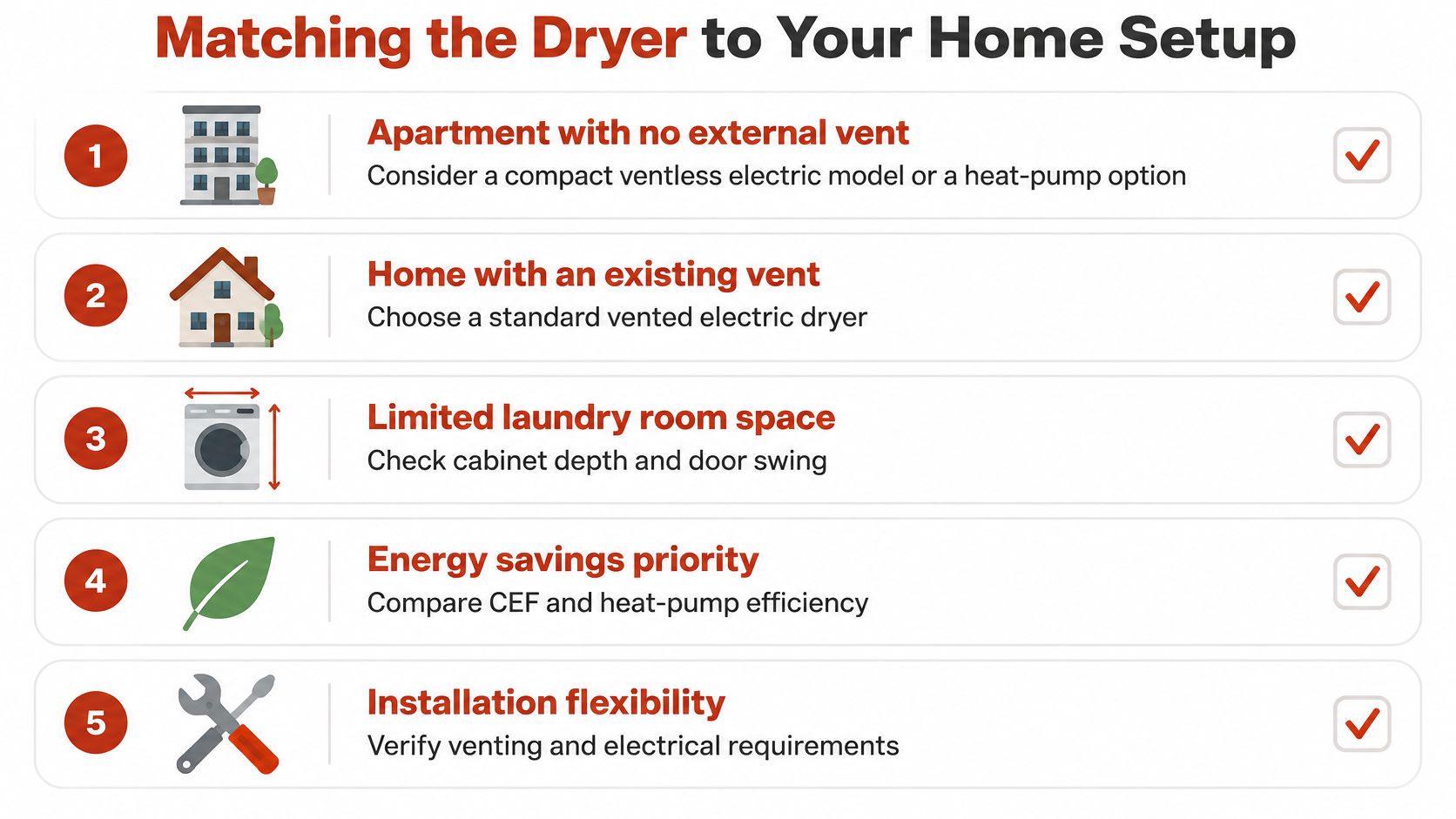
An apartment with no external vent. A compact ventless electric model or a heat-pump model solves the duct problem outright. Check the voltage available at the outlet and measure the alcove before comparing anything else, because a 240-volt ventless unit won't run on a 120-volt circuit.
A family of five doing large weekly loads. Standard-capacity electric drying is the fit here, and the one check that matters is the CEF against the threshold for that class. Large households run the machine often enough that the efficiency gap compounds across a year.
A small home with 120-volt outlets. A compact 120-volt model avoids new wiring, and the check is whether the unit's published CEF clears the compact 120-volt benchmark rather than the full-size one. Comparing it against a standard-capacity figure produces a false verdict in both directions.
A shared laundry room or dormitory. Maintenance comes first, and lint trap access and a cleaning schedule beat any feature list. Blocked airflow is what turns a dryer into a fire risk, and shared machines accumulate lint faster than a household unit.
A house with long or restricted duct runs. A ventless or heat-pump design sidesteps the airflow problem entirely. The cheapest vented model is the weakest choice here, because a long run with bends cuts airflow and stretches cycle time while the machine works harder.
One household may match two scenarios. When that happens, venting wins first, then the circuit, then the footprint, then the running cost, because each earlier constraint is more expensive to change later.
Confirm the Specs Before You Buy
- Match the class and capacity to the quick-pick table, and write down which of the five classes the room can accommodate.
- Check voltage and vent path against the physical installation, including whether a duct exists and how many bends it takes.
- Compare lb/kWh figures only within the class and voltage group. A compact figure and a full-size figure describe different machines doing different work.
- Confirm the test method and production date on the label, since the measurement rules changed for testing from mid-2025.
- Check the compliance horizon. Confirm which standard the unit is certified against, because amended rules will govern new production well before a dryer bought today reaches the end of its service life.
- List the upkeep, including yearly lint trap and vent cleaning, filter access, and any condenser or heat exchanger service.
- Record the seller's price and the date checked. Maker stores change prices, and an undated figure can't be verified later.
HearSmart ranks gadgets, home gear, money products, apps, travel and everyday services on one published formula, so the dryer shortlist sits alongside documented rankings rather than paid placement (HearSmart's best lists). Use those pages after the checks above, not instead of them.
Start with the room, not the ranking. Measure the laundry space, read the breaker label, and confirm whether a duct exists and what condition it's in. Then take the two or three models that fit that class and put them through the running-cost arithmetic: the kWh gap, the local rate, the price premium and the cleaning routine. HearSmart's best lists carry the spec sheets and the prices with the date checked, which gives the shortlist a documented starting point before the first store visit.
Spotted an error in this guide? Email editorial@hearsmart.org