Guide · General
Heat Pump vs Condenser Dryer: Which Costs Less to Own
Heat pump vs condenser dryer compared on energy per cycle, drying time, installation, maintenance and lifetime cost, with sourced EU figures for 2026.
By the HearSmart research desk · Updated November 16, 2026 · 13 min read
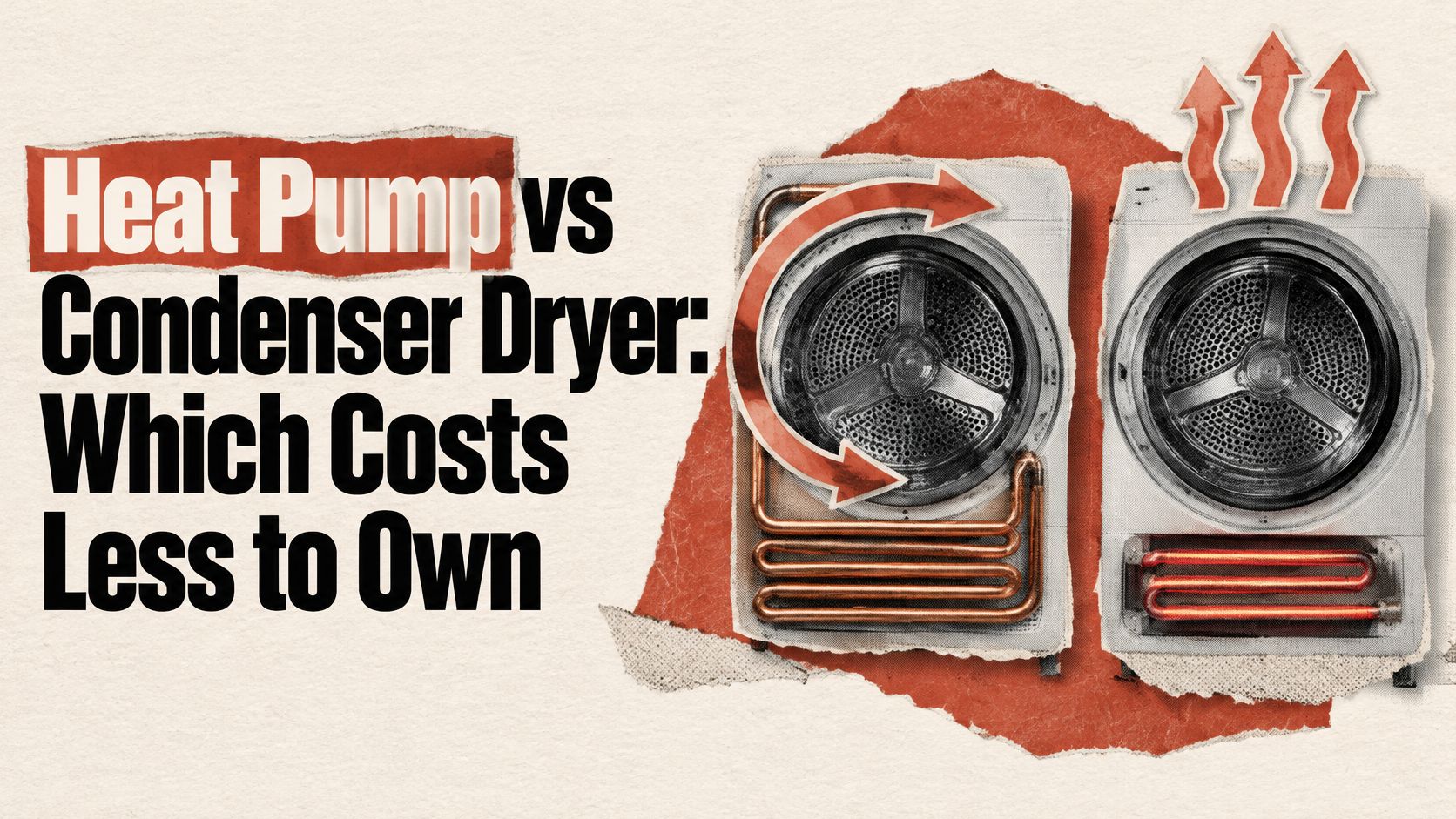
A heat-pump dryer usually costs less to run, but it doesn't automatically cost less to own. The European Commission's 2020 averages were about 1.0 kWh per cycle for heat-pump dryers versus 2.7 kWh for electrically heated condenser dryers, approximately 63% less electricity, according to its tumble-dryer efficiency assessment. Whether that saving outweighs the purchase premium depends on household usage, electricity prices, repair access and how much slower drying disrupts the laundry routine.
Table of Contents
- Heat Pump and Condenser Dryers at a Glance
- How the Two Dryers Remove Moisture and What They Need
- Energy Use and Drying Time Per Cycle
- Lifetime Cost and the Break-Even Point
- EU Rules That Limit Which Dryers Can Be Sold
- Which Dryer to Buy for Your Household
Heat Pump and Condenser Dryers at a Glance
The first distinction in any heat pump vs condenser dryer comparison is terminology. A heat-pump machine is also a condenser dryer: condenser describes moisture removal; heat pump describes heat recovery. Retailers commonly use “condenser dryer” as shorthand for the electrically heated version, which is the comparison used below.
Heat-pump and electric condenser dryers compared by criteria
| Criterion | Heat-pump dryer | Electric condenser dryer |
|---|---|---|
| Heating method | Refrigeration cycle recovers heat from moist air | Electric heating element generates heat during drying |
| Energy per cycle, EU 7 kg eco benchmark | 0.85 kWh | 2.73 kWh |
| Cycle time, same benchmark | 134 minutes | 76 minutes |
| Venting | No outdoor vent; process is largely closed-loop | No outdoor vent; condensed water goes to a tank or drain |
| Maintenance focus | Filters, heat exchanger and qualified service for the refrigerant circuit | Lint filter, condenser unit and water tank or drain |
| Main cost driver over life | Lower electricity use against any purchase premium and repair complexity | Any purchase-price saving against higher electricity use |
| Purchase price | Set by each seller; record the listed price and check date | Set by each seller; record the listed price and check date |
The energy and duration entries are the standardized benchmark values in the 2023 regulation, reproduced in the consolidated EU ecodesign text dated 2025. They aren't promises about every programme or every machine.
What the comparison establishes
The heating method explains the operating trade-off. Recovering heat reduces electricity demand, while the benchmark heat-pump programme keeps the machine occupied longer.
The remaining rows describe ownership rather than efficiency alone. Both machines need suitable installation and routine cleaning, but the heat-pump design adds refrigeration components that matter when arranging repairs.
Buying rule: A lower energy bill isn't the same as a lower total ownership cost.
HearSmart compares documented features and published prices and doesn't conduct hands-on product testing. No purchase-price estimate is used here: sellers set prices, those prices can change, and a meaningful comparison needs dated listings for the actual machines being considered.
How the Two Dryers Remove Moisture and What They Need
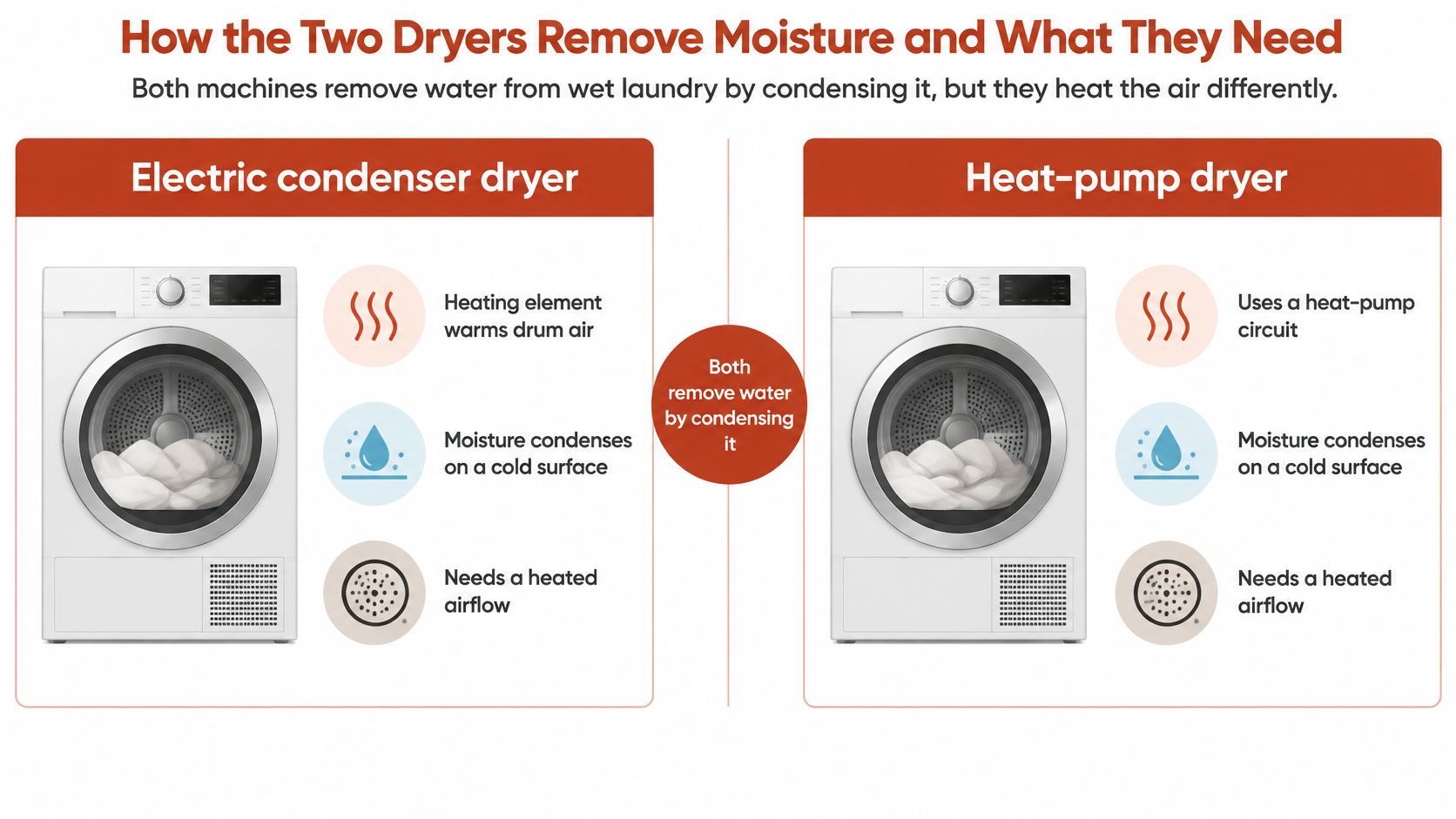
Both technologies remove moisture from laundry, collect the resulting water and circulate drying air. The important difference is what happens to the heat after the air has absorbed moisture.
The EU's 2023 tumble-dryer energy-labelling regulation defines condenser dryers by their removal of moisture from drying air. That definition explains why a product specification can correctly describe a machine as both heat pump and condenser.
Where the heat goes
An electric condenser dryer uses a resistance element to warm the process air. That air passes through wet laundry, picks up moisture and reaches a condenser where cooling allows water to separate from the air. The heater supplies the thermal energy needed to keep drying.
A heat-pump dryer adds a refrigeration circuit. Moist process air passes over a cold heat exchanger, where moisture condenses and the refrigerant absorbs heat. Another heat exchanger returns recovered heat to the drying air.
The heat-pump system therefore reuses thermal energy rather than relying on an electric element to supply it continuously. Its process normally operates at lower drying temperatures, although programme suitability still matters. A lower-temperature machine doesn't make every garment tumble-dryer safe.
Neither type needs an exhaust hose through an outside wall. That doesn't mean either can be installed anywhere: the manual's room-temperature limits, ventilation clearances, electrical requirements and stacking instructions still govern placement.
Identify the hardware before comparing labels
Product titles can be ambiguous. A retailer's category name is less useful than the technical specification and installation manual.
- Find the heating method. Look for an explicit heat-pump description rather than assuming “condenser” means resistance heating.
- Check the refrigeration information. A heat-pump model should identify its refrigerant in its product information or appliance marking. Refrigerant type and charge are model-specific, not category-wide specifications.
- Confirm water collection. Establish whether the intended installation uses a removable tank or a drain connection, and whether the required hose or fittings are included.
- Read the electrical requirements. Use the rated power and circuit instructions in the installation manual. A familiar-looking plug isn't a substitute for checking local requirements.
For example, a buyer comparing the Miele TXD160WP with another heat-pump machine should inspect each model's own documentation. A refrigerant specification from one appliance shouldn't be transferred to another model merely because both use heat-pump technology.
Maintenance that an owner can realistically perform
Airflow maintenance is part of the purchase decision, not an optional task after delivery. Before ordering, a buyer should inspect the manual's cleaning diagrams and establish whether the relevant filters and heat-exchanger surfaces are accessible.
For an electric condenser dryer, routine care generally means cleaning the lint filter after each load, keeping the water path clear and cleaning the condenser as the manufacturer directs. A removable condenser should be cleaned only by the method permitted in the manual, then refitted correctly.
A heat-pump dryer also needs clean filters and an unobstructed heat exchanger. Some designs use additional filters or automated cleaning systems, but owners shouldn't interpret those features as permission to ignore the maintenance schedule.
| Owner check | What to establish before purchase |
|---|---|
| Filter access | Filters can be removed, cleaned and refitted without awkward disassembly |
| Heat-exchanger cleaning | The manual clearly distinguishes owner cleaning from service work |
| Drain routing | The hose can follow the permitted route without crushing or kinking |
| Warranty conditions | Cleaning duties and exclusions are understandable |
| Repair access | A local service business supports the exact model and refrigeration system |
The sealed refrigerant circuit isn't an owner-cleaning component. Puncturing tubing, opening refrigerant connections or attempting a recharge belongs outside routine maintenance and normally requires qualified service.
A dryer also shouldn't be treated as the solution to an unrelated damp-room problem. Where humidity persists without laundry drying, the best dehumidifiers comparison addresses a different appliance category; ventilation, leaks and room conditions still need attention.
The practical question is whether the household can maintain the machine it buys. An efficient appliance with inaccessible cleaning points or unavailable service can be a poor ownership choice even when its label looks attractive.
Energy Use and Drying Time Per Cycle
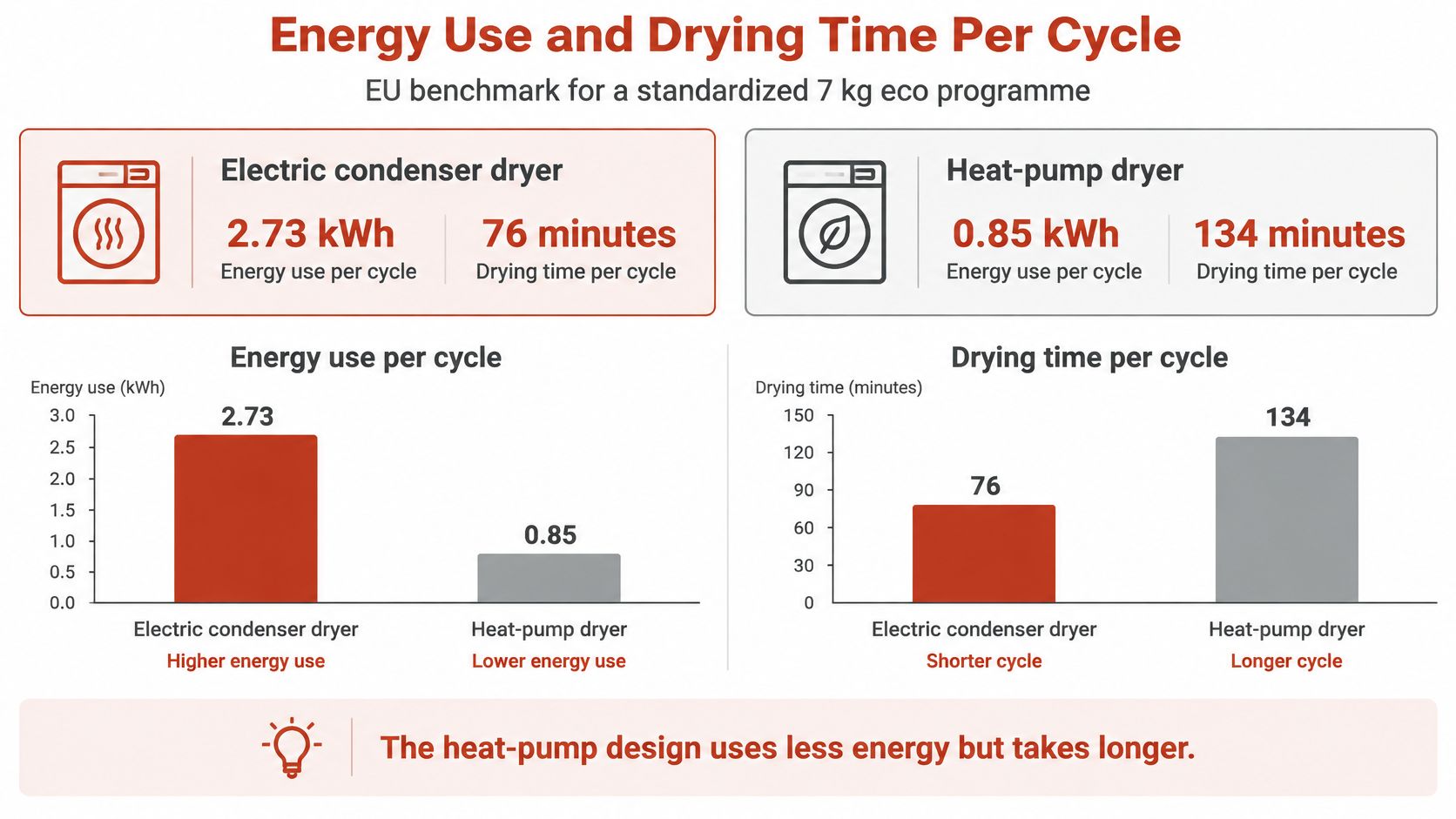
The standardized comparison gives a clear trade-off. For the 7 kg eco-programme benchmark, the electric condenser uses 2.73 kWh and takes 76 minutes, while the heat-pump dryer uses 0.85 kWh and takes 134 minutes, under Regulation (EU) 2023/2533, consolidated in 2025. Calculated from those values, the heat-pump design uses approximately 69% less electricity but takes roughly 76% longer.
Annual electricity use by number of cycles per year
The following calculations multiply the cited 2023 regulatory benchmark values by illustrative annual cycle counts. They are calculated scenarios, not measurements in occupied homes.
| Cycles per year | Heat-pump electricity use, kWh/year | Electric condenser electricity use, kWh/year | Difference, kWh/year |
|---|---|---|---|
| 100 | 85 | 273 | 188 |
| 200 | 170 | 546 | 376 |
| 300 | 255 | 819 | 564 |
Frequent users have more opportunities to recover a purchase premium because each comparable load adds another electricity saving. Light users receive the same benchmark advantage per load, but accumulate it more slowly.
Elapsed time and electricity consumption measure different things. A machine can run longer while drawing less energy overall, so programme duration alone can't establish operating cost.
For households processing successive loads, however, duration has a practical cost. The dryer may become the bottleneck between washing and putting laundry away, especially when towels, bedding and clothing must all be ready the same day.
A longer programme matters financially only when the household gives that delay a real consequence, such as needing another drying arrangement or losing access to a cheaper electricity window.
What the benchmark cannot predict
Actual results change with drum capacity, load size, residual moisture, dryness target, programme, filter condition and room temperature. Comparing a quick programme on one machine with an eco programme on another won't reproduce a standardized comparison.
Independent engineering evidence supports the efficiency mechanism without providing a household bill estimate. A 2024 peer-reviewed review by Deymi-Dashtebayaz and colleagues reported heat-pump dryer coefficients of performance of 3.5 to 4.5 in the Journal of Thermal Analysis and Calorimetry.
The same 2024 review reported specific energy consumption of 0.5 to 0.7 kWh per kilogram of evaporated moisture, according to the published review PDF. That denominator is removed water, not kilograms of laundry, so it shouldn't be substituted into a consumer energy-label calculation.
A household should annualize its actual weekly load count, including seasonal changes, rather than assume the middle scenario applies. The broader home and smart-home statistics collection provides context for household technology decisions, but the exact appliance label remains the relevant input for this purchase.
Lifetime Cost and the Break-Even Point
Break-even measures how long electricity savings take to repay a purchase premium. It doesn't establish that a machine will remain economical through every repair, tariff change or change in household usage.
The starting point is the exact model's consumption figure. The EU EPREL record for an Electrolux heat-pump condenser dryer, published or updated in 2024 or later, lists 8 kg capacity and weighted consumption of 0.85 kWh per drying cycle. That is a model-specific weighted figure, not proof that its results equal a different-capacity regulatory benchmark under every load condition.
Calculate the purchase-premium payback
The basic calculation is:
Break-even years = heat-pump purchase premium ÷ annual electricity-cost saving
Annual electricity-cost saving = annual kWh difference × applicable electricity price per kWh
The annual difference from a suitable scenario can be multiplied by the household's billed electricity rate. The purchase-price difference is then divided by that annual cash saving.
| Input | Evidence to record | Common mistake |
|---|---|---|
| Purchase premium | Both seller listings, with dates checked | Comparing a discounted model with an unrelated list price |
| Energy difference | Exact-model labels using comparable measures | Mixing weighted and full-load consumption |
| Electricity price | The household's applicable tariff | Treating a standing charge as avoidable consumption cost |
| Ownership period | Intended replacement horizon and available manufacturer documentation | Treating warranty length as guaranteed service life |
| Repair allowance | Warranty coverage, local quotes and a stated assumption | Assuming every future repair will be free |
A warranty describes coverage, not necessarily expected lifespan. If the manufacturer doesn't publish a supported service-life estimate, the household should use its intended ownership period and test whether the result remains acceptable over a shorter period.
Include repairs and tariff timing
An ownership calculation should also include incremental repair costs: the repair spending expected for the heat-pump option beyond that expected for the electric condenser. Charging all possible repairs to only one machine would bias the comparison.
A repair allowance covering the whole ownership period must be spread across that period before being deducted from annual savings. Alternatively, total expected electricity savings can be compared with the purchase premium and total additional repair allowance together.
Cost check: If the repair-adjusted annual saving isn't positive, there's no financial payback under those assumptions.
Time-of-use tariffs need a more careful calculation than multiplying by a headline rate. A programme that crosses from a cheap period into an expensive period may have a different effective electricity price from a shorter programme completed entirely within the cheap window.
The useful conclusion isn't a universal payback date. It's whether the purchase remains sensible when the household tests lower usage, less favourable tariffs and a plausible repair allowance.
EU Rules That Limit Which Dryers Can Be Sold
For EU buyers, this comparison is no longer only about preferences and operating costs. Market-access rules also limit the choice of newly placed appliances.
The EU summary of ecodesign and energy-labelling requirements states that Regulation (EU) 2023/2533 began applying on 1 July 2025. The accompanying label changed on that date from A+++ to D to A to G under Regulation (EU) 2023/2534.
What the rules change
The framework covers more than electricity used during drying. It addresses low-power consumption, condensation efficiency, resource efficiency and product information alongside the core energy requirements.
The European Commission's July 2025 explanation of the new measures says that only tumble dryers based on heat-pump technology would be allowed on the EU market under the new requirements. The relevant distinction is new placement on the market, not whether an existing appliance may continue operating.
- Existing owners: The sales rules don't create an instruction to discard a working dryer.
- Buyers comparing stock: The seller should be able to identify the model, applicable label and regulatory status.
- Buyers outside the EU: Local rules determine what may be sold; the EU framework isn't a worldwide ban.
- Buyers comparing label letters: An old label letter and a rescaled letter aren't directly interchangeable measures of performance.
Repair information belongs in the purchase check
Resource-efficiency requirements also make parts and repair information relevant to ownership. Buyers should establish which parts are available to consumers, which require professional access and whether a local service business supports the model.
Refrigerant identification is another useful check for heat-pump appliances. It helps a qualified repairer identify the system, but doesn't establish that a repair will be affordable or available locally.
The practical consequence is that regulatory compliance and good ownership value are separate tests. A compliant machine can still have awkward filter access, unsuitable dimensions or an inconvenient local service arrangement.
EU shoppers should check the appliance's current energy label and exact EPREL record before ordering. A retailer's promotional efficiency wording shouldn't substitute for those documents, particularly when comparing older stock with newly introduced models.
Which Dryer to Buy for Your Household
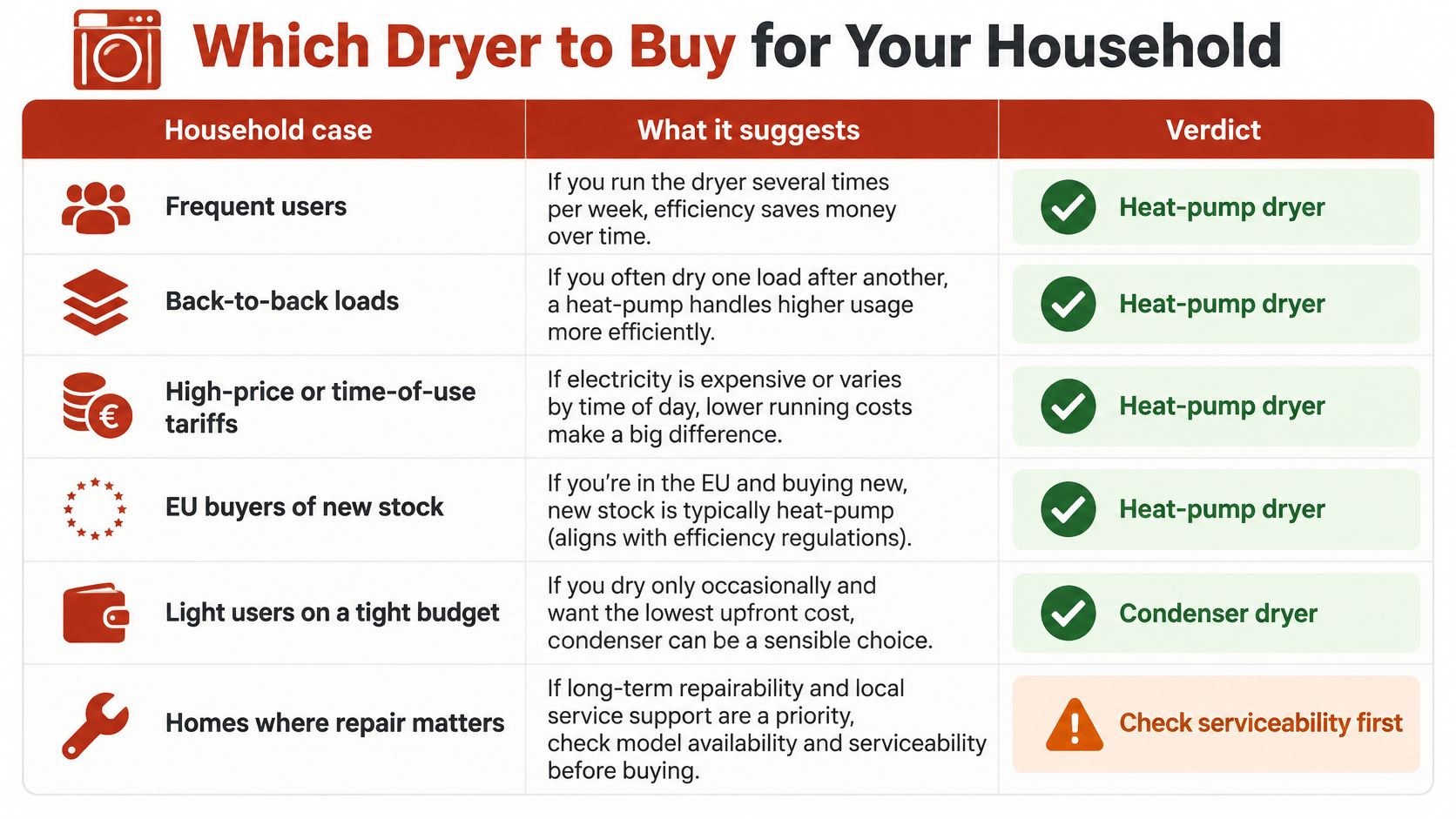
The better choice follows the household's constraint: energy spending, laundry throughput, initial budget or repair access. A heat-pump dryer has the stronger efficiency case, but that doesn't remove the need to compare specific machines.
Which dryer fits each household case
| Household case | Better fit | Deciding evidence or rule |
|---|---|---|
| Frequent dryer use | Heat-pump dryer | More loads accumulate more electricity savings |
| Back-to-back loads on the same day | Electric condenser dryer, where legally available | Shorter benchmark drying duration supports faster throughput |
| High-price or time-of-use electricity tariff | Heat-pump dryer, subject to scheduling | Value the energy saving at the rates applying during operation |
| New placement on the EU market | Heat-pump dryer | Current ecodesign requirements determine qualifying technology |
| Light use on a tight budget | Electric condenser dryer, if its actual listing is cheaper and sale is permitted | A premium may not be recovered during the intended ownership period |
| Limited local access to qualified refrigerant service | Electric condenser dryer where available, or a better-supported heat-pump model | Serviceability can outweigh an efficiency advantage |
The throughput verdict deserves particular care. A household can prefer heat-pump efficiency while still finding that a slower machine doesn't fit its laundry schedule. Conversely, unattended drying during an otherwise unused part of the day may make programme duration relatively unimportant.
A short purchase decision
- Count actual use. Annualize the household's weekly loads, allowing for seasonal drying.
- Estimate the energy difference. Use comparable exact-model consumption figures and the household's annual load count.
- Apply the tariff. Calculate savings using the electricity prices that will apply during drying.
- Test ownership cost. Use the break-even formula, include an incremental repair allowance and compare payback with the intended ownership period.
- Verify the documents. Confirm the exact model's energy label, EPREL entry where applicable, installation manual and warranty.
- Confirm service access. Establish who can repair the appliance locally before placing the order.
Buy the fit, not the category
Frequent users and households paying high electricity rates have the strongest reason to choose heat-pump technology. Light users may reasonably prioritize a lower documented purchase price, provided the electric condenser model is legally available and its higher running cost remains acceptable.
Where repair access is poor, the answer isn't necessarily to reject every heat-pump dryer. It may be to choose a different manufacturer or model with accessible filters, clear service documentation and established local support.
Purchase timing can help with the upfront budget, but a discount doesn't change an appliance's energy consumption or repair needs. HearSmart's guide to the best time of year to buy a refrigerator addresses a separate appliance purchase; dryer buyers still need dated dryer listings rather than assumed sale-season savings.
Before ordering, the household should complete the decision steps using its own load count and tariff, save the seller's dated price, and confirm the consumption figure on the exact model's label. The final check should be a local service enquiry, so the purchase rests on an appliance that can be installed, maintained and repaired, not just a favourable energy figure.
Spotted an error in this guide? Email editorial@hearsmart.org