9 Best Caption Glasses of 2026
By the HearSmart research desk · Updated November 27, 2026 · Next review January 11, 2027 · 9 products compared
 Ranked firstAirCapsHard of hearing people who follow conversations in noisy restaurants8.8
The short version
AirCaps, the product formerly sold as TranscribeGlass, ranks first: AirCaps lists 97% accuracy, 300ms latency and four beamforming microphones, keeps unlimited captions free in 9 languages, and supports prescriptions from -16 to +16. The XRAI AR2 is a close second for people who want captions to keep working without internet, since its offline engines run on the phone and the $699 price includes 3,600 Pro minutes with no subscription. Captify Pro is the pick for strong prescriptions, down to -20.00, and its free Standard plan covers unlimited offline captions. If you want no phone at all, XanderGlasses II is the only option here: a $2,999 kit with its own processing device and up to 15 hours of captioning. On a tight budget, Hearview Lite and Captify Light cost $399 with free captioning.
Short answer
Most caption glasses need a paired phone, and AirCaps is the best caption glasses for most deaf and hard of hearing people in 2026 because its maker documents 97% caption accuracy and 300ms latency from $659; XanderGlasses II is the only pick here that captions with no phone, Wi-Fi or app, for a one-time $2,999. Hearview Lite and Captify Light are the cheapest at $399 with free captioning, while people who want captions offline and no subscription should look at the XRAI AR2 at $699, with prices checked as of November 2026.
This list is for people who are deaf or hard of hearing and want speech turned into text in front of their eyes during conversations, meetings and shows. We compared documented features and published US prices for 9 caption glasses sold today, using each maker's own product pages, FAQs and plan pages. We looked at five things: the caption accuracy and latency the maker publishes, battery life, whether a phone or internet connection is needed, prescription support, and what captioning costs after you buy the frames. Accuracy figures are the makers' own claims, not our test results. Scores weigh performance at 40%, ease of use at 25% and value at 35%. Prices are US prices checked on November 27, 2026, and several include Black Friday discounts that may end soon.
At a glance
| Rank | Product | Best for | Price | Score |
|---|---|---|---|---|
| 1 | AirCaps | Hard of hearing people who follow conversations in noisy restaurants | $659 for the glasses; captions free in 9 languages, Pro plan $20 per month | 8.8 |
| 2 | Captify Pro | Strong prescription wearers who want both-eye captions | $699 (sale from $849) when checked; Standard captioning plan $0 per month | 8.7 |
| 3 | XRAI AR2 | Deaf users who want captions offline with no subscription | $699 one-time purchase, includes 3,600 Pro minutes and unlimited offline captioning | 8.7 |
| 4 | Hearview Lite | Budget buyers who want captions with no monthly fee | $399 sale price (regular $499), one-time purchase with no subscription | 8.6 |
| 5 | XanderGlasses II | People with severe to profound hearing loss who want captions with no phone | $2,999 one-time for the complete US kit, no subscription | 8.2 |
| 6 | Captify Light | First-time buyers who want the lightest frame | $399 sale price (regular $499) when checked; works with the free app | 8.1 |
| 7 | Even G2 | Professionals who want captions in glasses that look like regular eyewear | From $599 at the Even Realities store when checked | 8.1 |
| 8 | Hearview MYVU Air | Budget buyers who want captions in both eyes and long battery | $419 sale price (regular $599) when checked | 8.1 |
| 9 | Rokid Glasses | Travelers who want translated subtitles plus a camera and AI assistant | $619 sale price (regular $739) when checked | 7.5 |
Figures worth knowing
- 20%1.57 billion people worldwide had some degree of hearing loss in 2019, about 20% of the global population, according to the Global Burden of Disease study.Source: The Lancet
- 430 million430 million people, over 5% of the world's population, need rehabilitation for disabling hearing loss, including 34 million children, WHO estimates.Source: World Health Organization
- 2.5 billionNearly 2.5 billion people are projected to have some degree of hearing loss by 2050, and more than 700 million will need hearing rehabilitation, WHO projects.Source: World Health Organization
- $1 trillionUnaddressed hearing loss costs the world almost $1 trillion a year, WHO estimates.Source: World Health Organization
- 28.8 millionAbout 28.8 million US adults could benefit from using hearing aids, according to NIDCD calculations from national hearing exam data.Source: National Institute on Deafness and Other Communication Disorders
How we make the call
Every entry gets a 0 to 10 rating on the three criteria below, and the order follows the weighted total. The ratings rest on the documented features and published prices on each maker's own pages, never hands-on testing.
- 40%Performance
- 25%Ease of use
- 35%Value
No. 1, top ranked
AirCapsCaptioning glasses from the team formerly known as TranscribeGlass, with four microphones, a free caption tier and an optional Pro plan.
8.8of 10Best for Hard of hearing people who follow conversations in noisy restaurants
- Performance
- 9.3
- Ease of use
- 8.6
- Value
- 8.3
Price
$659 for the glasses; captions free in 9 languages, Pro plan $20 per month
Quoted from the AirCaps pricing page on November 27, 2026:
$659 — HSA/FSA Eligible. Free US shipping. 15-day risk-free returns. 1-year warranty.
AirCaps is the new name for TranscribeGlass, and the company says it was built specifically for the Deaf and Hard of Hearing community. The headline figures are the strongest published on this list: 97% caption accuracy, 300ms latency and a four-microphone beamforming array meant to isolate the person you are facing in restaurants and parties. The glasses weigh 49g and AirCaps lists up to 8 hours of battery. Pricing is clear: $659 for the glasses, then a free-forever tier with unlimited captions in 9 languages and 5 hours a month of Pro features. Pro costs $20 a month and adds 60+ languages, 97%+ accuracy and AI meeting notes; AirCaps puts the free tier at 90%+ accuracy. Prescription support is wide, from -16 to +16 including progressives, using a $49 holder any licensed optician can fit. The main limit is connectivity: AirCaps needs a Bluetooth link to your phone and an internet connection for cloud speech processing, so it is a weaker choice for basements, flights or rural areas.
What it does well
- +Lowest latency figure published on this list at 300ms
- +Captions stay free without a subscription
- +HSA/FSA eligible with free US shipping
Where it falls short
- −Needs a Bluetooth phone connection and internet for cloud speech processing
- −Pro plan costs $20 per month for 60+ languages and 97%+ accuracy
- −15-day return window, shorter than Rokid's 30 days
- Caption accuracy
- 97% (maker claim, Pro tier)
- Latency
- 300ms
- Battery
- Up to 8 hours
- Phone needed
- Yes, plus internet
- Weight
- 49g
No. 2
 Captify Pro
Binocular captioning glasses from a hard of hearing-owned company, with offline captions, sound alerts and a wide prescription range.
8.7of 10Best for Strong prescription wearers who want both-eye captions
- Performance
- 8.8
- Ease of use
- 8.6
- Value
- 8.6
Price
$699 (sale from $849) when checked; Standard captioning plan $0 per month
Quoted from the Captify Pro pricing page on November 27, 2026:
$699 $849 SAVE $150
Captify describes itself as a hard of hearing-owned company, and Captify Pro is its main model at $699, down from $849 when checked. The free Standard plan covers unlimited offline captions in 30+ languages, offline translation in 20+ languages and labels for 300+ environmental sounds such as applause and alarms, which is useful context that pure speech captioning misses. Captions show in both lenses through a 1,500-nit binocular waveguide, with three font sizes and adjustable position. The frame weighs 37g and is IPX4 rated. Prescription support is the widest here: SPH -20.00 to +6.00 with astigmatism, single vision, reading or progressive lenses, fitted into inserts your optician can redo later. The tradeoffs are battery and the phone: Captify lists 4 hours of continuous use with a 40-minute recharge, and the glasses need an iOS 16+ or Android 12+ phone within 30 feet because transcription runs on the phone. A $15 per month Premium plan for up to 98% accuracy and speaker labels is listed as coming soon.
What it does well
- +Widest prescription range on this list
- +Captions in both eyes, with the option to turn one display off
- +14-day trial, 365-day warranty, FSA/HSA accepted
Where it falls short
- −4 hours of continuous use per charge
- −Requires a phone running iOS 16+ or Android 12+
- −Higher accuracy, up to 98%, needs the $15 per month Premium plan, listed as coming soon
- Battery
- 4 hours continuous, 40 minutes to charge
- Phone needed
- Yes, within 10 m
- Prescription
- SPH -20.00 to +6.00
- Weight
- 37g
- Subscription
- Optional, $15 per month
No. 3
 XRAI AR2
Captioning glasses from XRAI Glass with offline caption engines, a charging case and a one-time price that includes Pro minutes.
8.7of 10Best for Deaf users who want captions offline with no subscription
- Performance
- 9.0
- Ease of use
- 8.5
- Value
- 8.6
Price
$699 one-time purchase, includes 3,600 Pro minutes and unlimited offline captioning
Quoted from the XRAI AR2 pricing page on November 27, 2026:
Buy for $ 699
XRAI Glass started as a captioning app and now sells its own glasses, the XRAI AR2, for $699. The pitch is ownership without a subscription: unlimited offline captioning is built in, and the price includes 3,600 Pro minutes for the cloud-enhanced engine that XRAI says handles multiple speakers and background noise better. XRAI says its offline models already reach 98% accuracy in quiet, one-to-one conversations. Hardware specs are solid: 49g, three microphones, a full display in both lenses at 2,500 nits, and 8+ hours of battery with a charging case that adds up to 12 recharges for 96 hours in total. Prescription wearers can add ultra-thin, high-index clip-in lenses at checkout, and there is a 14-day return window. The glasses still rely on a phone: speech-to-text runs on an iOS or Android phone within about 10 meters. The upside is that the offline engines run locally, so captions continue without internet, which AirCaps cannot match.
What it does well
- +Captions work without internet using offline engines on the phone
- +One-time purchase with no subscription
- +Longest total battery with the case at up to 96 hours
Where it falls short
- −Must pair with an iOS or Android phone within about 10 meters
- −Best accuracy in noise uses Pro minutes and Wi-Fi
- −No physical stores to try it before buying
- Caption accuracy
- 98%+ (maker claim; offline 98% in quiet one-to-one)
- Battery
- 8+ hours, up to 96 hours with case
- Phone needed
- Yes, internet optional
- Languages
- 300+
- Weight
- 49g
No. 4
 Hearview Lite
Lightweight monocular subtitle glasses made for the Deaf, with 140+ recognized languages and no subscription.
8.6of 10Best for Budget buyers who want captions with no monthly fee
- Performance
- 8.0
- Ease of use
- 8.6
- Value
- 9.2
Price
$399 sale price (regular $499), one-time purchase with no subscription
Quoted from the Hearview Lite pricing page on November 27, 2026:
Sale price $399.00 USD Regular price $499.00 USD
Hearview Lite is a newer subtitle glasses model that Hearview says was shaped by feedback from Deaf users who found earlier frames heavy and their green captions visible to others. It starts at about 28g, and Hearview says the optics cut externally visible green glow by about 90% in normal face-to-face use. The Hearview App recognizes 140+ languages and can translate, and you can place captions in six positions at three text sizes. You can choose the glasses microphone or your phone's microphone. The price is the draw: $399 on sale from $499, with no monthly or yearly subscription for captions. A free prescription insert and sunglass lens come in the box, though an optician has to make the prescription lenses. The limits are the single right-eye display, which some people find tiring, and the phone: Hearview says you must pair the glasses with the Hearview App on an iPhone or Android phone. Hearview does not publish a battery figure on the product page and sells an $89 power neckband for longer sessions.
What it does well
- +Ties for the lowest verified price on this list at $399
- +Starts at about 28g, among the lightest here
- +About 90% less visible green glow for privacy, per Hearview
Where it falls short
- −Right-eye monocular display only
- −Needs the Hearview App on an iPhone or Android phone
- −Custom prescription lenses are not included; an optician fills the insert
- Price
- $399 one-time
- Display
- Right-eye monocular, 2,000 nits
- Phone needed
- Yes, Hearview App
- Battery
- Not published on the product page; optional $89 power neckband
- Weight
- From about 28g
No. 5
 XanderGlasses II
A captioning glasses kit with its own offline Processing Device, so it works without a phone, Wi-Fi or cell signal.
8.2of 10Best for People with severe to profound hearing loss who want captions with no phone
- Performance
- 9.2
- Ease of use
- 9.2
- Value
- 6.4
Price
$2,999 one-time for the complete US kit, no subscription
Quoted from the XanderGlasses II pricing page on November 27, 2026:
The complete XanderGlasses II kit is available in the U.S. for a one-time cost of $2,999, or pay monthly with Shop Pay.
XanderGlasses II is built around one idea: captions should work like an appliance. Instead of borrowing your phone, the kit includes a pocket Processing Device that runs only the Xander captioning app and comes already paired to the glasses. You turn on the device, then the glasses, and captions start, with no Bluetooth setup, app download or account. Everything runs offline, so captions keep working in basements, on planes and in rural clinics, and Xander says no audio or transcripts are stored. The glasses have four microphones, and the kit adds a wireless microphone system for noisy rooms and groups. Captions appear in both eyes and on the Processing Device screen. Battery reaches up to 15 hours using swappable 3-hour glasses batteries and a charging case. Xander claims up to 97% accuracy in quiet rooms and offers offline captions in 26 languages and dialects. The catch is price: $2,999 for the kit, plus $179 to $349 for prescription lenses. Xander itself says people who hear well with hearing aids may not need it.
What it does well
- +The only pick that works with no phone at all
- +Comes paired out of the box with no Bluetooth setup
- +No subscription and free software updates
Where it falls short
- −$2,999, more than four times the price of most rivals
- −Prescription lenses cost extra at $179 to $349 per pair
- −Two devices to carry: the glasses and the Processing Device
- Phone needed
- No
- Caption accuracy
- Up to 97% in quiet rooms (maker claim)
- Battery
- Up to 15 hours with swappable batteries
- Subscription
- None
- Prescription
- Sold separately, $179 to $349 per pair
Visit xanderglasses.com|Read the full XanderGlasses II profile
No. 6
Captify LightCaptify's lightest captioning glasses, with a single display, free app and no subscription.
8.1of 10Best for First-time buyers who want the lightest frame
- Performance
- 7.6
- Ease of use
- 8.3
- Value
- 8.6
Price
$399 sale price (regular $499) when checked; works with the free app
Quoted from the Captify Light pricing page on November 27, 2026:
$499.00 $399.00 Save $100.00
Captify Light is the cut-down sibling of Captify Pro, aimed at people who want captions in a frame that feels like ordinary glasses. It weighs 28g, and Captify markets it as the lightest captioning glasses. It shows captions in one lens through a monocular waveguide with a 30-degree field of view, works with Captify's free app without a subscription and translates 80+ languages. Prescription support covers SPH -10.00 to +6.00 and CYL -6.00 to +6.00, with single vision, reading or progressive lenses, so it fits most but not the strongest prescriptions that the Pro handles. At $399 on sale from $499 it ties Hearview Lite for the lowest price here, and the 14-day trial and FSA/HSA support carry over from the Pro. The compromises are real, though. Battery is 3 hours of continuous use, the display reaches only 300 nits, which can wash out outdoors, and the glasses need an iOS 16+ or Android 12+ phone in Bluetooth range.
What it does well
- +Ties for the lowest verified price at $399
- +Single vision, reading and progressive lenses supported
- +14-day trial and FSA/HSA accepted
Where it falls short
- −3 hours of continuous use, the shortest here
- −300-nit display is dimmer than rivals at 1,200 to 2,500 nits
- −Requires an iOS 16+ or Android 12+ phone
- Battery
- 3 hours continuous
- Display
- Monocular, 300 nits
- Prescription
- SPH -10.00 to +6.00
- Weight
- 28g
- Phone needed
- Yes
No. 7
 Even G2
Everyday display smart glasses with live captions, translation and meeting summaries in a 36g camera-free frame.
8.1of 10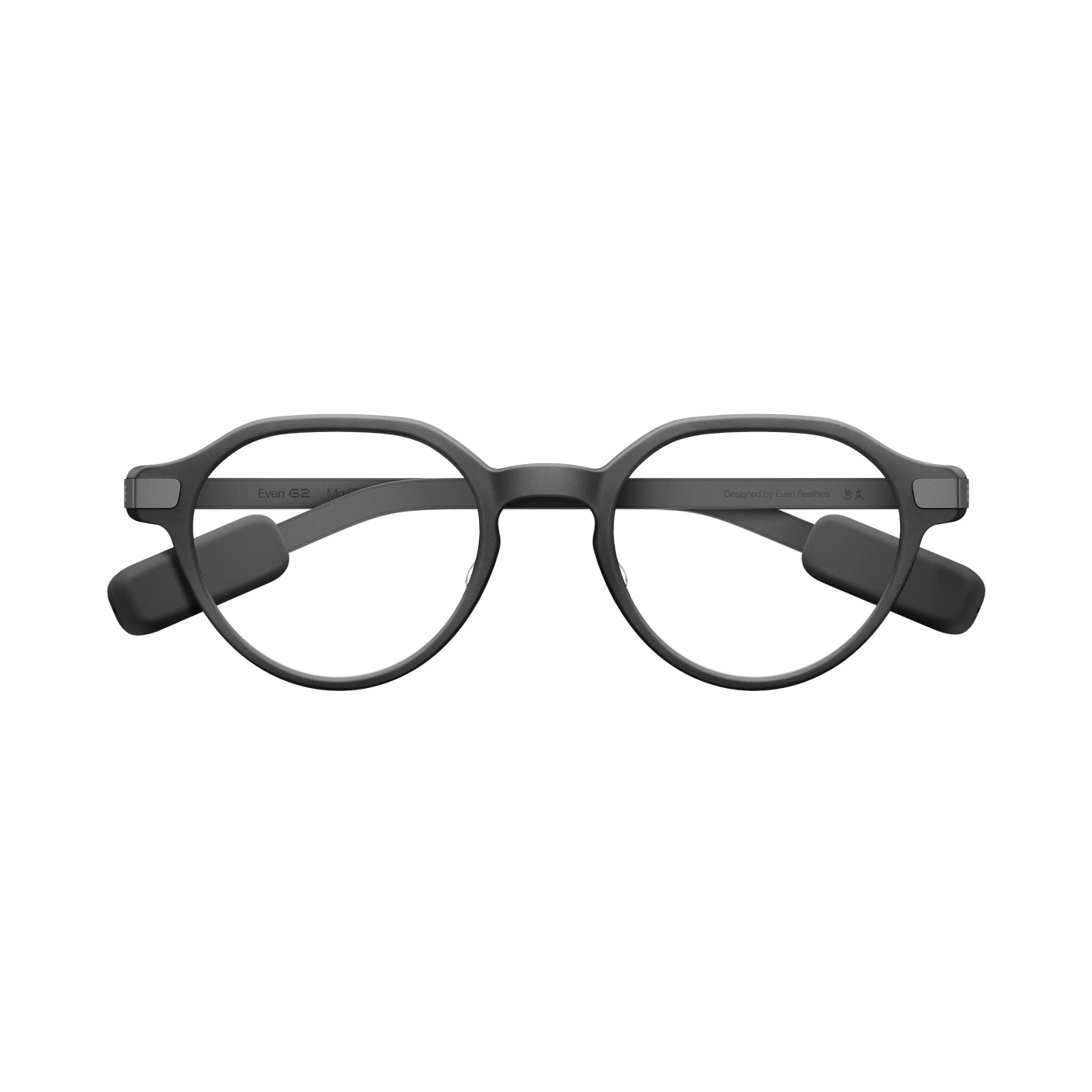
Best for Professionals who want captions in glasses that look like regular eyewear
- Performance
- 8.3
- Ease of use
- 8.2
- Value
- 7.8
Price
From $599 at the Even Realities store when checked
Quoted from the Even G2 pricing page on November 27, 2026:
Product price From $599 View Product Product title Even G2 B
Even G2 is a general display smart glasses product, but Even Realities markets a subtitle mode for live captions, and it is a strong option for people who want captioning glasses that look like premium eyewear. The frame weighs 36g, is made from magnesium and titanium, has no camera and carries an IP65 rating. Four microphones capture speech up to 10 feet away, and Even says AI voice isolation reduces background noise. Battery is the standout: up to two days, with a charging case that holds seven full charges. Prescription lenses from -12.00 to +12.00, including progressives, are bonded to the display waveguide so there is no second lens. Beyond captions, the Conversate feature transcribes conversations into AI summaries, and translation covers 35 languages. The tradeoffs for a caption buyer: Even publishes no accuracy or latency figure, the glasses are designed for productivity as much as accessibility, and you need the Even Realities App on a phone. The older Even G1 shows as sold out on Even's store.
What it does well
- +Lightest binocular-style frame here at 36g, with no camera
- +Longest rated battery among phone-based glasses at up to two days
- +Prescription is bonded into the display lens, with no second lens
Where it falls short
- −Built as general smart glasses, not only for captioning
- −Even does not publish a caption accuracy or latency figure
- −Needs the Even Realities App on iOS or Android
- Battery
- Up to two days, seven charges in case
- Microphones
- Four, up to 10 feet
- Prescription
- -12.00 to +12.00
- Weight
- 36g
- Display brightness
- 1,200 nits
No. 8
Hearview MYVU AirBinocular subtitle glasses built on Meizu's MYVU frame, with a 2,000-nit display in both eyes and a 10-hour battery.
8.1of 10Best for Budget buyers who want captions in both eyes and long battery
- Performance
- 7.8
- Ease of use
- 8.3
- Value
- 8.4
Price
$419 sale price (regular $599) when checked
Quoted from the Hearview MYVU Air pricing page on November 27, 2026:
Sale price $419.00 USD Regular price $599.00 USD
The MYVU Air is the binocular model in Hearview's range, built on the MYVU glasses from the Chinese phone maker Meizu; Hearview's own comparison notes it is also sold as Captify Myvu. Its strengths are the display and the battery. Captions appear in both eyes on a 2,000-nit screen, which Hearview says stays readable in direct sunlight, and the glasses deliver up to 10 hours of typical use on a single charge, the longest single-charge figure among the caption-first glasses that publish one. A dual-microphone beamforming array with noise cancellation picks up speech, and the glasses can connect over Bluetooth to hearing aids, headphones and smartwatches. At $419 on sale from $599, it is the cheapest way on this list to get captions in both eyes. The limits are languages and flexibility: transcription covers 13 languages, against 140+ on Hearview Lite, and Captify's FAQ says the Myvu version has a fixed font size and caption position. It weighs 43g, about 35% more than the Lite, according to Hearview.
What it does well
- +Cheapest binocular option on this list at $419
- +Up to 10 hours per charge, the longest figure among the caption-first glasses that publish one
- +15-day return window
Where it falls short
- −Only 13 caption languages
- −At 43g it is heavier than Hearview Lite
- −Fixed caption font size and position, per Captify's notes on the same Myvu hardware
- Display
- Binocular, 2,000 nits
- Battery
- Up to 10 hours typical use
- Languages
- 13
- Weight
- 43g
- Also sold as
- Captify Myvu
No. 9
 Rokid Glasses
AI and AR glasses with a dual-eye display, a camera and live subtitles focused on translation.
7.5of 10Best for Travelers who want translated subtitles plus a camera and AI assistant
- Performance
- 7.4
- Ease of use
- 7.6
- Value
- 7.4
Price
$619 sale price (regular $739) when checked
Quoted from the Rokid Glasses pricing page on November 27, 2026:
Sale price $619.00 Regular price $739.00
Rokid Glasses are general AI and AR glasses rather than captioning glasses, and they rank last here for that reason. Rokid markets the live subtitles in your field of view mainly for real-time translation, and the product page also lists voice-to-text and meeting transcription with speaker identification and summaries. The hardware is capable: a 1,500-nit dual-eye Micro-LED display, a 12MP Sony camera, a voice assistant and turn-by-turn directions in a 49g frame. Prescription support runs from +6.00 to -16.00 through an official inner Rx frame on a magnetic insert, which is wider than Even G2. Rokid offers 30-day returns and a 1-year limited warranty, and the glasses were $619 on sale from $739 when checked. For a deaf or hard of hearing buyer the gaps matter: Rokid publishes no caption accuracy or latency, and it does not describe the subtitles as an accessibility feature. The built-in camera may also make some people uneasy in private talks. Pick it if you mainly want translation, a camera and AI in one pair.
What it does well
- +30-day returns, the longest window here
- +Wide prescription range through a magnetic insert
- +Adds a camera, navigation and an AI assistant
Where it falls short
- −Subtitles are marketed for translation, not for deaf users
- −No published caption accuracy or latency
- −Camera may be unwelcome in private conversations
- Display
- Binocular Micro-LED, 1,500 nits
- Prescription
- +6.00 to -16.00 (inner Rx frame)
- Weight
- 49g
- Returns
- 30 days
- Warranty
- 1 year
Before you pick a product or a plan
Check whether a phone is required
Captify, XRAI, AirCaps and Hearview all state that their glasses need a paired iPhone or Android phone, and Captify and XRAI put the range at about 10 meters or 30 feet. Even G2 is set up and run through the Even Realities App. XanderGlasses II is the exception: a dedicated Processing Device in the kit runs the captions, so no phone, app or account is needed.
Read accuracy claims with their conditions
Makers publish accuracy under different conditions. XRAI says its offline models reach 98% in quiet, one-to-one conversations, Xander says up to 97% in quiet rooms, and AirCaps claims 97% even in noise on its Pro tier, with 90%+ on the free tier. Microphone count matters in noisy rooms: AirCaps and Even G2 use four microphones and Xander adds a wireless microphone system.
Plan for prescription lenses
Prescription ranges differ widely. Captify Pro supports SPH -20.00 to +6.00, AirCaps -16 to +16 through a $49 lens holder, Rokid +6.00 to -16.00 and Even G2 -12.00 to +12.00. Hearview includes a free prescription insert that your optician fills, and Xander sells lenses separately at $179 to $349 per pair.
Price the subscription, not only the frames
Several makers keep basic captions free and charge for extras. AirCaps Pro costs $20 a month for 60+ languages and higher accuracy, and Captify Premium is listed at $15 a month. XRAI, Hearview Lite and XanderGlasses II say there is no subscription for captioning.
Match battery life to your day
Battery figures range from 3 hours of continuous use on Captify Light to up to 15 hours on the XanderGlasses II kit with swappable batteries. XRAI rates the AR2 at 8+ hours with a case that adds up to 12 recharges, and AirCaps lists up to 8 hours.
Questions readers ask
- Do caption glasses work without a phone?
- Mostly no: XanderGlasses II is the only caption glasses on our list that works without a phone. Its $2,999 kit includes a Processing Device that captions offline with no phone, Wi-Fi or app. AirCaps, XRAI, Captify and Hearview all pair with a phone that does the speech-to-text work, though the XRAI AR2 can caption offline on that phone without internet.
- How accurate are live captions on smart glasses in noisy rooms?
- Makers claim 90% to 98%, but most figures are for quiet conditions. XRAI says its offline models reach 98% in quiet one-to-one talk and recommends its cloud Pro minutes for loud rooms, while AirCaps claims 97% even in noise with four beamforming microphones on its Pro tier. None of these are independent test results, so use the return window: 14 days at Captify and XRAI, 15 at AirCaps.
- Which caption glasses work with prescription lenses?
- Eight of the nine glasses on this list document prescription support. Captify Pro has the widest range at SPH -20.00 to +6.00, AirCaps covers -16 to +16 with a $49 lens holder, Rokid +6.00 to -16.00 and Even G2 -12.00 to +12.00. Hearview Lite includes a free insert for your optician, and Xander sells lenses separately at $179 to $349 per pair.
- Do caption glasses need a subscription?
- No, every pick on this list captions without a subscription. AirCaps keeps unlimited captions free in 9 languages and charges $20 a month for Pro, and Captify lists an optional $15 a month Premium plan. XRAI, Hearview Lite and XanderGlasses II say there is no subscription for captioning.
- What are the cheapest caption glasses?
- Hearview Lite and Captify Light are the cheapest at $399 each when checked in November 2026, both on sale from $499. The Hearview MYVU Air is the cheapest with captions in both eyes at $419.
- Which caption glasses have the longest battery life?
- XanderGlasses II leads for continuous captioning at up to 15 hours with swappable batteries. Among phone-based glasses, Even G2 is rated up to two days, the MYVU Air up to 10 hours, and the XRAI AR2 8+ hours with a case that extends total use to 96 hours.
- Can I wear caption glasses with hearing aids?
- Yes. AirCaps says its glasses are designed to complement hearing aids and sit over or alongside them, adding a text layer to what you hear. The Hearview MYVU Air can also connect over Bluetooth to hearing aids, headphones and smartwatches, according to Hearview.
Sources and price checks
The page behind each price, with the date we read it.
- AirCaps
- Price: https://aircaps.com/shop, checked
- Captify Pro
- Price: https://captify.glass/products/captify-pro?currency=USD, checked
- XRAI AR2
- Price: https://xrai.glass/ar2/, checked
- Hearview Lite
- XanderGlasses II
- Price: https://www.xanderglasses.com/xanderglasses-details, checked
- Captify Light
- Price: https://captify.glass/products/captify-light?currency=USD, checked
- Even G2
- Price: https://www.evenrealities.com/store, checked
- Hearview MYVU Air
- Rokid Glasses
- Price: https://global.rokid.com/products/rokid-glasses, checked
Cite this page
HearSmart. 9 Best Caption Glasses of 2026. Updated November 27, 2026. https://hearsmart.org/best/best-caption-glasses
Spotted an error or a price change? Write to editorial@hearsmart.org
How we work is in our editorial policy. Makers change prices, plans and terms often, so check the price on their site before you buy or upgrade.