Guide · General
Fitness Tracker vs Smartwatch: Which Fits You Best
Fitness tracker vs smartwatch compared on accuracy, battery life, apps, usability and cost, with sourced 2024 to 2026 data and a clear verdict.
By the HearSmart research desk · Updated November 26, 2026 · 14 min read
The most repeated advice in this category is that a smartwatch is the upgrade and a fitness tracker is the compromise. The published evidence supports a narrower and less flattering conclusion. For steps, resting heart rate, weekly activity trends and, with caveats, sleep timing, a cheaper tracker returns numbers close enough to a premium watch, while the extra money buys GPS, apps, cellular links, payments and a bigger screen rather than better sensors.
Accuracy follows the metric and the conditions, not the label on the box. A device sold as a tracker can post a lower step error than a watch costing several times more, and the same watch can drift once heart rate climbs. The fitness tracker vs smartwatch question therefore reduces to two things a buyer can answer alone: which readings will be checked every week, and which device will still be on the wrist at 3 a.m.
Two things the evidence cannot settle are whether a specific model will suit a specific wrist and whether a brand's subscription terms will change after purchase. Both need checking on the maker's own documentation, with the date recorded.
Table of Contents
- Fitness Tracker and Smartwatch at a Glance
- Health Readings You Can Trust Day to Day
- Battery Life and Wear Time Decide the Choice
- Apps, Phone Links and Data Sharing
- Which Device Fits Your Routine
- What the Price Gap Pays For and Pre-Purchase Checks
Fitness Tracker and Smartwatch at a Glance
The boundary between a fitness tracker and a smartwatch is less clear than the names suggest. Both can record activity and display health readings; the practical distinction is how much computing, communication and screen interaction you want on your wrist.
A tracker is a wrist-worn or clip-on device built around activity and physiological monitoring, usually with a small screen or none at all. A smartwatch adds general-purpose functions such as apps, payments and communications to a comparable sensor set. Those categories overlap. Built-in GPS, for example, is a model feature rather than a benefit reserved for watches.
A fitness tracker is the better buy when your priorities are activity records, a smaller device and less frequent charging. A smartwatch is the better buy when notifications, wrist-based apps and communication are part of your daily routine. The premium mainly pays for that broader functionality, rather than establishing that every health reading is better.
Market size does not settle the choice.
The IDC worldwide wearable-device forecast published in March 2023 projected 162.2 million smartwatch shipments in 2023, representing 31.0% of wearable-device shipments, compared with 33.8 million wrist bands at 6.5%. Its longer-term forecast also anticipated a widening shipment gap. These are projections of market reach, not evidence of measurement quality or proof that the larger category suits your needs.
The table compares category-level tendencies. Battery life and price are expressed qualitatively because a single numerical range would obscure differences between models and operating modes.
| Criterion | Fitness tracker | Smartwatch |
|---|---|---|
| Primary purpose | Activity, workouts, sleep and resting heart rate | Notifications, apps, communication, payments and health functions |
| Built-in GPS | Available on some models | Common, but not universal |
| Typical battery life | Generally longer between charges, with runtime affected by operating mode | Generally shorter between charges, especially with GPS or an always-on display |
| Phone and app dependence | Companion app for syncing data | Companion app plus a broader app ecosystem on many models |
| Price range | Generally lower-priced; HearSmart's tracker ranking lists Fitbit Charge 6 from $129.95 | Generally higher-priced, with overlap between budget watches and premium trackers |
Individual models can reverse those tendencies. A premium tracker with built-in GPS can offer more useful route tracking than a budget smartwatch. A fitness-focused smartwatch can also run longer between charges than a feature-heavy watch. Compare the functions you intend to use together, rather than treating the category label as a complete specification.
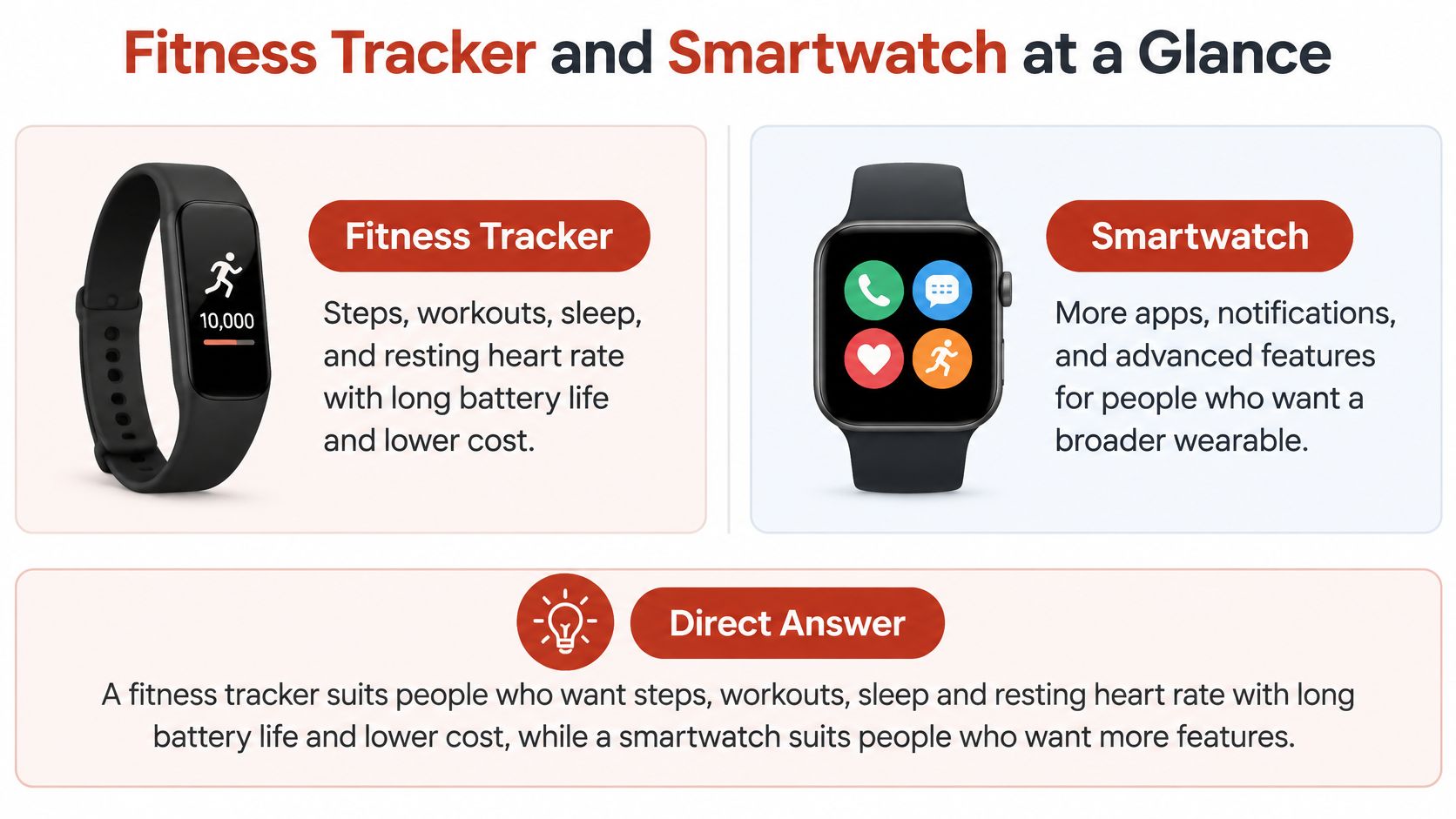
HearSmart compares documented features and published prices without hands-on testing. Its tracker ranking names Fitbit Charge 6 as the top pick, with a score of 8.9. That provides a specific buying reference, not a claim that every tracker offers the same value.
For broader ownership and shipment context, the fitness and wearables statistics collects sourced figures. For an individual purchase, the useful distinction remains narrower: a tracker concentrates on recording activity, while a smartwatch gives those records a larger platform of apps and connected functions.
Health Readings You Can Trust Day to Day
Four studies across eight years, including a 2024 validation of Garmin and Fitbit devices and a 2025 test of a low-cost fitness smartwatch, point to the same split. Counting steps is dependable, resting heart rate is dependable, heart rate during hard effort is directional, and calorie estimates are the weakest number on any screen. The price of the device changes that ranking less than buyers expect.
Steps and resting heart rate hold up best
A 2024 validation study published in Scientific Reports measured steps with a mean absolute percentage error of 1.8% for Garmin and 8.0% for Fitbit, while resting and recovery heart-rate error stayed at or below 3% for both devices. During peak exercise the error rose to about 7% for Garmin and 12% for Fitbit. Daily step counts and resting heart rate are usable as trends; hard-effort heart rate is a rough intensity guide at best.
A 2018 systematic review of wearable-device studies found heart rate, step count, distance and sleep duration carried mean absolute percentage errors of about 0.10, while energy-expenditure estimates reached errors as high as 0.44. Step-count variation ranged from 0.01 on one tested device to 0.42 on the Apple Watch 2, and heart-rate variation from 0.12 on the Xiaomi Mi Band 2 to 0.34 on the Samsung Gear S3. Those numbers describe devices tested in the review's period, yet the ordering of metrics has held in later work.
Step counting was accurate long before the current generation. A 2016 evaluation of 17 wearable devices recorded 99.1% accuracy for the Apple Watch on a 200-step task and 99.5% on a 1,000-step task, while heart-rate accuracy across the tested devices ranged from 99.9% for the Apple Watch to 92.8% for the Motorola Moto 360. Those figures belong to 2016 models and test conditions, and they show that step counting settled early while heart rate did not.
Where a cheap device falls short
A 2025 validation study of a low-cost fitness smartwatch found no significant differences from clinical or manual benchmarks for mean and minimum heart rate, blood oxygen saturation and sleep-stage estimates. The same device significantly underestimated manually counted steps and total sleep duration, underestimated wake time and overestimated maximum heart rate. The sample was 50 participants, with 26 taking part in parts of the validation, so the results are evidence rather than a guarantee for every unit sold.
The implication runs against the upgrade logic. If a low-cost smartwatch matches clinical benchmarks on mean heart rate and sleep stages, the premium on a full smartwatch pays for apps, GPS and data connections rather than for better sensors. For sleep specifically, both formats produce usable stage and duration patterns, so the choice comes down to comfort overnight and battery behavior, and the trade-offs are laid out in HearSmart's ranking of smartwatches for sleep tracking.
| Metric | Reported evidence | Practical use |
|---|---|---|
| Step count | Garmin 1.8% and Fitbit 8.0% mean absolute percentage error (2024 validation); about 0.10 across devices (2018 review) | Weekly activity trends and daily goals |
| Resting heart rate | Error no more than 3% for both Garmin and Fitbit (2024 validation) | Changes tracked over weeks |
| Heart rate during peak exercise | About 7% for Garmin and 12% for Fitbit (2024 validation) | Rough intensity guide, not precise training data |
| Sleep duration | A low-cost smartwatch significantly underestimated total sleep (2025 validation) | Bedtime and wake-time patterns, not exact hours |
| Calories burned | Errors as high as 0.44 in a 2018 review | Direction of change only, never a food target |
What the numbers support: weekly step totals and resting heart rate are dependable enough to act on, peak-exercise heart rate is a rough guide, and calories are not a planning tool.
Read the table row by row and a purchase rule falls out. Trend tracking needs only the top two rows, and both rows measure well across price tiers, so a cheaper tracker covers that use. The rows where error grows, peak effort and calories, stay weak even on expensive hardware.
Any reader can run a partial version of the validation test. Count 100 steps by hand on a familiar walk, compare the total with the device, and repeat on a second route before trusting the daily goal that appears on the screen. A device that passes twice earns trust on the metric that matters most for trend tracking; one that drifts on a flat walk will drift more on stairs and uneven ground.
Battery Life and Wear Time Decide the Choice
A wearable produces a trend only while it stays on the wrist. Sensor specifications and metric counts stop mattering on the nights the device spends on a charger, which is why battery life and charging discipline decide more purchases than accuracy comparisons do.
A 2025 German study of fitness tracker users published in JMIR mHealth and uHealth found that 60.7% of participants used trackers to collect health data, and 70.7% of those users wore them for at least eight hours per day. Sustained wear, not feature count, produced that data.
Sleep tracking needs overnight wear more than any other feature. A device that charges every night delivers no nightly series at all, and one that needs charging in the evening loses the bedtime reading too.
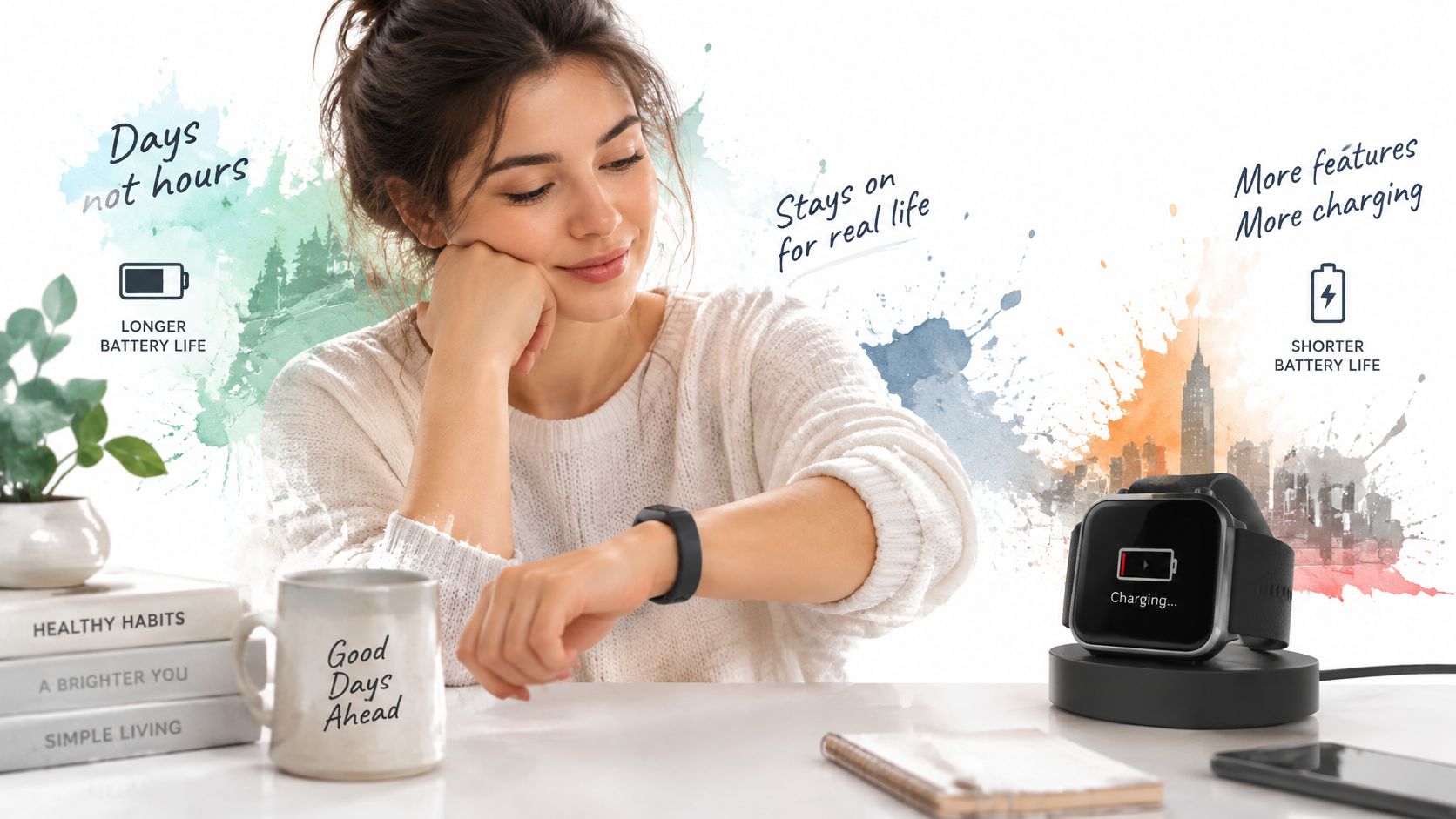
GPS logging, an always-on display and frequent notifications shorten runtime on any model, so the maker's stated runtime for the mode in use, with the date checked, is the only figure worth planning around.
Power source and position change the calculation
A 2018 review of fitness trackers used in clinical research separates rechargeable designs from coin-cell designs and documents wrist-worn versus clip-on builds. The same review found hip-worn devices were generally the most consistently accurate for step measurement because that placement more directly detects walking movement. Form factor and power source belong in the comparison alongside the metric list.
A charging routine that protects the sleep series
- Charge during a fixed daily routine. A shower, a desk session or the drive home keeps the device off the wrist at the same time each day, so the habit survives busy weeks.
- Turn on low-battery alerts and set the threshold above the point where overnight recording stops.
- Read the maker's runtime for the mode you use. GPS and an always-on display can cut a stated figure sharply, and the spec page is the only reliable source.
- Charge ahead of a night you need sleep data rather than the morning after, because the missed night cannot be recovered.
One skipped charge ends a sleep series, and a broken series tells a reader nothing about whether sleep changed.
Apps, Phone Links and Data Sharing
The phone layer is where a wearable's practical cost and data exposure become clearer. A tracker usually centres on one companion app, while a smartwatch adds an app store, notifications, optional cellular service and more accounts tied to the wrist.
That app gap is the more defensible part of the smartwatch premium. A 2024 umbrella review of systematic reviews on wearable accuracy concluded that accuracy varies by device, outcome, user context and reference standard, which makes universal accuracy rankings inappropriate. Its practical conclusion is that a larger screen, GPS, cellular connectivity, notifications and a broad app ecosystem add capability, not necessarily better physiological measurement. For trend tracking, that distinction matters: extra software functions can be useful without making the underlying readings more trustworthy.
Sharing choices also need attention before opting in. People considering health data sharing should check whether data can reach a doctor or public-health body without passing through the cloud, and whether the service separates fully anonymized data from identifiable data. A wearable that exports a file is easier to control than one that streams continuously. The practical question is whether the reader wants a narrow record that can be moved deliberately, or a connected platform that keeps more information flowing between device, phone and cloud.
Six checks to run before comparing prices
- Account requirement. Note whether setup demands an account and whether the device works at all without one.
- Offline tracking. Check whether core step, heart-rate and sleep tracking functions without cloud sync.
- Export formats. Confirm the file types offered and whether the whole history can leave the platform.
- Health-platform links. Check whether data can be written to Apple Health or Google Health Connect.
- Sharing defaults. Look at what is switched on at first launch, before any opt-in screen.
- Subscription walls. Identify which insights, such as recovery scores or detailed sleep analysis, need a recurring payment.
Readers comparing companion software across devices will find app-level detail in the best fitness apps ranking, which follows the same published scoring method used across HearSmart's rankings. Scores weigh performance 40%, ease of use 25% and value 35%, so app-level comparisons should be read as one part of the wider buying decision.
A tracker tied to one companion app suits the reader who wants fewer connections and a smaller data footprint. A smartwatch suits the reader who accepts a wider footprint in exchange for apps, payments and cellular service.
Which Device Fits Your Routine
Ownership is broad enough that most buyers are choosing between a first wearable and an upgrade. Rock Health's 2025 consumer adoption survey reported that 46% of U.S. adults owned a wearable device in 2025, with roughly 4 in 10 respondents owning a smartwatch. That split matters because it shows how normal wrist-based tracking has become, while the smarter, more connected device still sits inside a narrower share of the market. S&P Global Market Intelligence's 451 Research describes wearable adoption as slow and steady, which fits a market where trackers and watches now serve different routines rather than one replacing the other.
| Situation | Better fit | Reason |
|---|---|---|
| Sleep tracking and all-day wear | Fitness tracker | A lighter build and less frequent charging make overnight wear easier |
| Running or cycling with GPS | Smartwatch with built-in GPS | Built-in GPS and workout modes are the functions that justify the higher price |
| Steps and resting heart rate on a budget | Fitness tracker | Those two readings are the most dependable baseline metrics |
| Phone notifications, payments and apps | Smartwatch | A broader software and communications platform is the main differentiator |
| Precise calorie or food targets | Neither | Calorie estimates are the least reliable metric, so only direction of change is useful |
The table points to a simple rule: buy for the action you repeat, not the feature list you admire. A tracker is the better fit when the routine depends on quiet, continuous habits. Nightly sleep, daily steps and resting heart rate work well as trend lines, especially when the device is light enough to forget and charged less often than a watch. For that reader, a smartwatch adds software complexity without improving the metric that matters.
A commuter has a different pattern. Paying for coffee by wrist, reading messages on the move and following a route map without taking out a phone all depend on notifications, contactless payments, GPS and cellular service. Those are the functions behind the smartwatch premium. A tracker can be accurate at steps and still fail this routine, because the missing piece is not sensor quality, it is the platform around the sensor.
The middle case is the largest practical group. A tracker plus a phone covers everyday health tracking, alerts, maps and payments, since the phone already handles most connected tasks. The trade-off is a second device to charge and a sync step, not a missing measurement. That is why a cheaper tracker often remains enough for trend tracking even when a smartwatch looks more capable on paper.
Specific products can shift the verdict. Check the metric you need in the maker's own documentation before deciding. A tracker with thin export options matters to anyone who wants a portable history. A smartwatch whose sleep analysis needs a subscription matters to anyone comparing the cost of nightly data. The right device is the one whose routine fit survives those details.
What the Price Gap Pays For and Pre-Purchase Checks
Prices in this comparison are the seller-published US prices shown on each maker's own store at the time checked. Makers change prices, plans and terms often, so confirm the current figure on the maker's site before buying or upgrading.
On the tracker side, HearSmart's Best Fitness Trackers ranking lists the Fitbit Charge 6 from $129.95, with a score of 8.9, at the time checked. On the smartwatch side, the same sum covers a smaller share of the feature set, because the premium attaches to GPS, app stores, larger screens, cellular options and payments.
Market momentum has not been uniform, and the forecasts say the two categories are heading in different directions. IDC's September 2024 wearable forecast estimated 156.5 million smartwatch shipments in 2024, down 3.0% from the previous year and the category's first projected year-over-year decline, with a forecast recovery to 175.2 million units in 2028. Wrist bands were projected at 35.2 million units in 2024, up 7.8% that year, then falling to 32.1 million by 2028.
What the premium pays for
The higher price covers a larger display, a wider app catalogue, standalone GPS, cellular connectivity and contactless payment hardware. It also usually covers a heavier case and a shorter charging interval, which are the costs a buyer accepts in exchange for those functions. A lower-priced tracker can document the same step, resting heart-rate and sleep readings, so the comparison should be settled on functions rather than on the sensor list.
Four questions before comparing totals
- Full price. Does the total include the band and the charger, or are both sold separately?
- Subscription. Does any feature you plan to use sit behind a monthly or annual fee?
- Warranty and returns. How long is each, and does the return window cover a full week of wear?
- Metrics you read. Does a lower-priced tracker document every reading you check?
Pre-purchase checks in order
- Confirm the metric on the maker page. Look for the specific reading you need, such as resting heart rate, GPS distance or overnight sleep staging, in the published specs rather than in marketing copy.
- Check the price on the maker's site on the day you plan to buy, and record that date next to the figure.
- Confirm phone compatibility. Match the device to iOS or Android support and to the health app you already use.
- Wear it for a full week inside the return window. Confirm it stays charged through the nights you need and that the band stays comfortable enough to keep on.
A cheaper tracker is enough for trend tracking, and a smartwatch justifies its premium only when its extra functions get used every week. Independent comparisons of documented features and published prices, scored on one formula, are collected at HearSmart's wearable guides.
The next step takes a few minutes. Open HearSmart's Best Fitness Trackers ranking, read the spec sheet against the one metric you'll check every week, and confirm the price on the maker's page on the day you buy. If GPS, payments and notifications are weekly functions for you, run the same check against the Best Smartwatches ranking and compare both scores on the same three criteria, performance, ease of use and value, before you order.
Cite this page
HearSmart. Fitness Tracker vs Smartwatch: Which Fits You Best. Updated November 26, 2026. https://hearsmart.org/fitness-tracker-vs-smartwatch
Spotted an error in this guide? Email editorial@hearsmart.org