Guide · General
Latex vs Memory Foam Pillows 2026
Latex vs memory foam pillows compared 2026: measured heat, rebound data, support, durability and published prices, with a clear pick for each sleeper.
By the HearSmart research desk · Updated November 28, 2026 · 13 min read
Latex is not the cooler pillow, and memory foam is not the neck-pain pillow. Shopping sorts the two fills into rival camps, one natural and cool, the other synthetic and hot. The measurements support a narrower claim.
Latex foam recovers far faster than memory foam, and in a controlled pillow-temperature study memory foam warmed the pillow surface more than an orthopedic pillow did. Latex is the more resilient material. Memory foam is the closer-contouring one. Each trade-off belongs to the foam itself. Height, loft and how the pillow is built sit outside that material result, and they decide whether the head stays in line.
The rule that decides most purchases: match the pillow's height and recovery speed to your dominant sleep position first, then use material to fine-tune heat and feel.
Heat, rebound and price are measured facts. Neck-pain superiority is not. A purchase that treats either fill as proven relief is buying a benefit the material benchmark does not establish.
Table of Contents
- Latex vs Memory Foam Pillows Compared at a Glance
- Support and Feel by Sleep Position
- Temperature and Heat Retention
- Cost, Lifespan and Care for Each Pillow Type
- Allergy, Odor and Indoor Air Considerations
- Which Pillow to Choose for Your Situation
Latex vs Memory Foam Pillows Compared at a Glance
Latex pillows recover faster and score higher on resilience. Memory foam holds a closer contour and retained more heat in the only controlled pillow-temperature study in this comparison. Neither material has been shown to be better for chronic neck pain, so the decision turns on sleep position, heat sensitivity and latex allergy status rather than on the fill name.
| Criterion | Latex | Memory foam | Measured basis and year |
|---|---|---|---|
| Support and contouring | Springs back quickly, higher resilience | Slow recovery, close contour around head and neck | Hysteresis-loss ratio 0.19 vs 0.86 (Nottingham compression testing) |
| Feel and responsiveness | Responds quickly to a position change | Slow, can hold a compression impression | Ball rebound 74% vs 9% (Nottingham compression testing) |
| Temperature | Not directly measured in the pillow-temperature study | Rose 3.13°C in 20 minutes vs 1.53°C for an orthopedic pillow | Tohoku Journal of Experimental Medicine, p < 0.001 |
| Durability and density | Low hysteresis means less energy lost per compression cycle | High hysteresis means more energy absorbed on every load | Nottingham compression testing; no head-to-head lifespan trial found |
| Neck-pain evidence | No clear superiority | No clear superiority | 2025 systematic review, limited evidence for any specific pillow |
These are material-level benchmarks, and they do not guarantee how a retail pillow behaves. Density, perforation, cover fabric and pillow geometry change how any individual product performs, and a shredded fill behaves differently from a molded core even when both carry the same material name.
What the compression tests actually measured
Independent compression testing of deproteinized natural-rubber latex foam against polyurethane memory foam recorded a hysteresis-loss ratio of 0.19 for latex versus 0.86 for memory foam, and ball-rebound resilience of 74% against 9%, as reported in the Nottingham repository study of compressive and rebound properties. Lower hysteresis means less energy is dissipated during repeated loading, so latex gives back more of what it absorbs. The same gap explains the durability row above: a foam that dissipates little energy per cycle is under less internal stress each time a sleeper's head compresses it.
In practice, latex springs back the moment a sleeper rolls over. Memory foam holds the shape of the head and neck for a beat, which is exactly the quality that makes it feel contouring and exactly the quality that makes repositioning feel like work.
Where the evidence stops
A 2025 systematic review found only limited evidence that any specific pillow improves chronic neck pain, and no clear superiority for latex, foam or standard pillows, according to the published review record. No head-to-head lifespan trial comparing the two materials in pillows was found either.
This is the gap most buying guides skip. Rebound, hysteresis and surface temperature are measured facts about the two materials. Neck-pain relief is a claim neither material has earned, so it should carry no weight in the decision.
HearSmart's pillow rankings record foam type, density where the seller discloses it, and whether the core is molded or shredded before any material benchmark is applied, because those three details move performance more than the label does.
Support and Feel by Sleep Position
Alignment holds or fails because of height and contact, not because a label says latex or memory foam. In a 2021 cervical-pillow build, lowering the density of deproteinized natural-rubber latex made the foam softer, which increased surface contact area and reduced average peak pressure under a mannequin head, as the Journal of Rubber Research paper on latex cervical pillow design sets out. That result is a pressure map. It is not a verdict on neck pain.
Two latex pillows can load the neck differently enough to feel unlike each other. Density sets how far the foam yields. Geometry sets where the neck sits. Change either one and the pressure pattern changes with it.
Height beats material for alignment
No single neck height transfers from one sleeper, or one position, to the next. Height and sleep position sit alongside material in any honest comparison. A loft that stays neutral on the back can leave a side sleeper's shoulder gap open, or lift a stomach sleeper's head above the spine.
What each sleeper should test for:
- Back sleepers: a pillow that keeps the chin level and the neck neutral at the tested height, not the softest surface available. A pillow that pushes the chin toward the chest is too high regardless of fill.
- Side sleepers: enough height to fill the gap between the ear and the mattress, plus a fill that does not collapse overnight. The guide to the best pillows for side sleepers ranks current options on the same sourced method.
- Stomach sleepers: a thin, low-profile pillow. Memory foam's close contour becomes a liability here if it holds the head higher than the spine wants.
- Combination sleepers: recovery speed matters most. A fill that returns quickly costs less effort to roll against.
Neck pain, material and design
Small, short trials of latex pillows in people with neck pain give mixed results. They are too narrow, and too brief, to rank one fill above the other.
Shape, height, firmness, sleeping position and mattress interaction do more of the alignment work than the material name. A pillow is not a substitute for clinical assessment of persistent neck pain.
Test one pillow in your dominant position for several nights and note morning symptoms before judging it. A single night tells you about novelty, not fit.
Temperature and Heat Retention
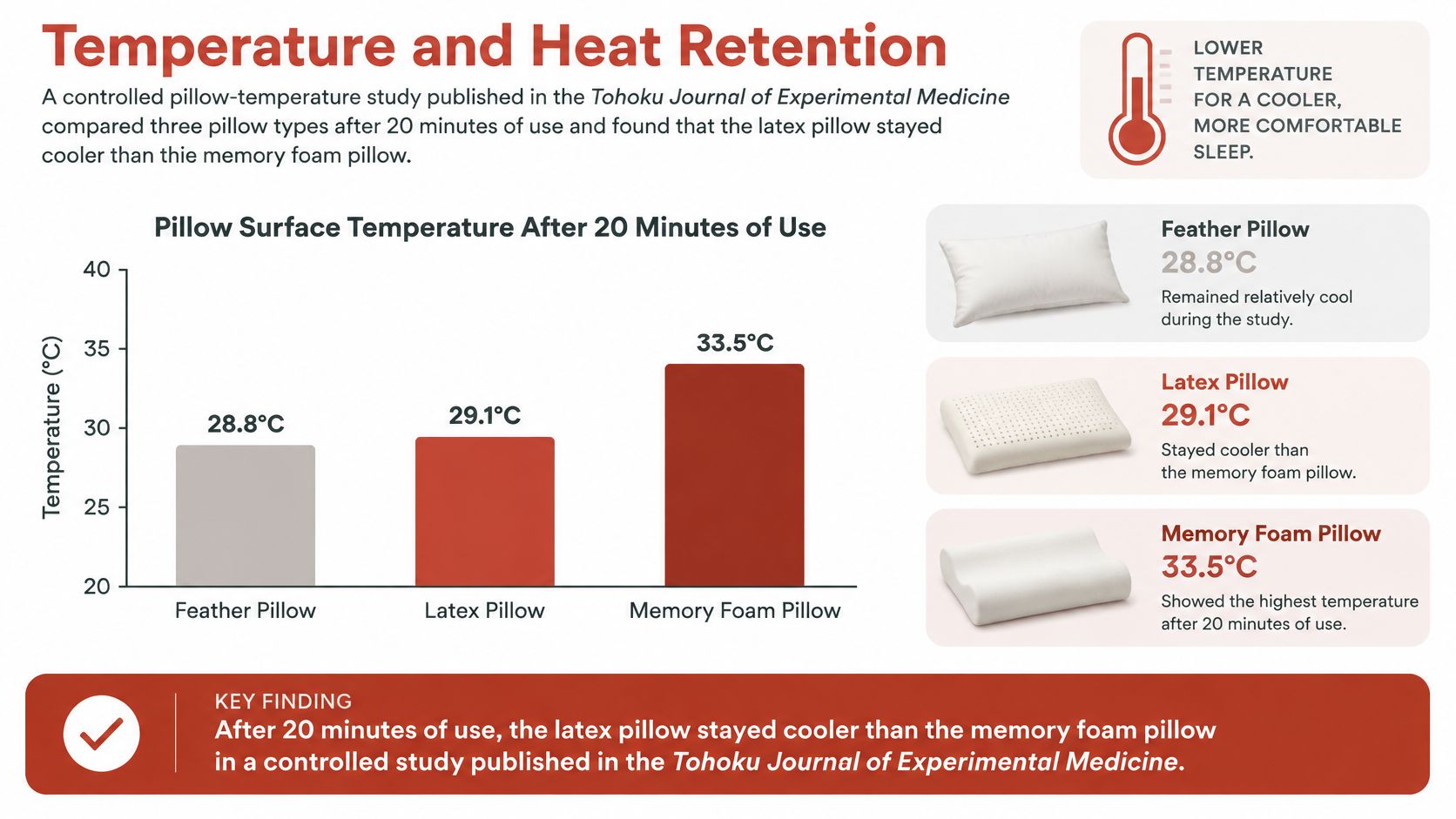
A controlled pillow-temperature study published in the Tohoku Journal of Experimental Medicine put three pillow types under sleepers for 20 minutes. Temperature rose significantly for every pillow, but the memory-foam pillow averaged a 3.13°C increase against 1.53°C for the orthopedic pillow, a 1.60°C gap that was statistically significant at p < 0.001, per the Tohoku Journal of Experimental Medicine temperature study.
That gap is a measured fact. The explanation for it is not. Memory foam's low rebound and close contour leave less room for air to move next to the head and neck, and the material absorbs and holds heat. The study measured temperature change, not airflow, so the airflow account remains the likely mechanism rather than a demonstrated cause.
What the study does not say
Latex was not one of the three pillow types tested, so this study cannot rank latex against memory foam on temperature. Any article that uses it for that comparison is overreading the evidence. The study also did not establish that every memory-foam pillow runs hotter than every alternative, because density, ventilation channels, cover fabric, room conditions and the sleeper all move the result.
The thermal conductivity of 0.13 to 0.15 W·m⁻¹·K⁻¹ reported for natural latex in a 2025 materials comparison is a material property measured on the foam itself. It describes how the material conducts heat, not what a finished pillow's surface will measure at 3 a.m. A bench figure for raw latex and a sleeper trial on memory foam sit in different categories of evidence, and neither one settles how a specific pillow will feel in a specific bedroom.
That distinction matters for the purchase decision. Material data tells you what the foam can do in isolation. Construction decides how much of it reaches the sleeper.
Construction checks that outweigh the label
- Perforated or channeled foam: pin-core holes and cut channels give warm air somewhere to go.
- A breathable or washable cover: a tight synthetic cover can undo a ventilated core.
- Shredded fill: loose fill allows more air movement than a solid molded block.
- Height that doesn't trap the neck: a pillow that crowds the jaw keeps heat where it's least welcome.
- Cooling layers: a gel layer or phase-change cover can change the outcome on a memory-foam pillow, so judge the finished product rather than the foam family.
Sleep on the pillow for a week and note night sweats or morning heat at the neck. That observation beats any cooling claim on the packaging.
Cost, Lifespan and Care for Each Pillow Type
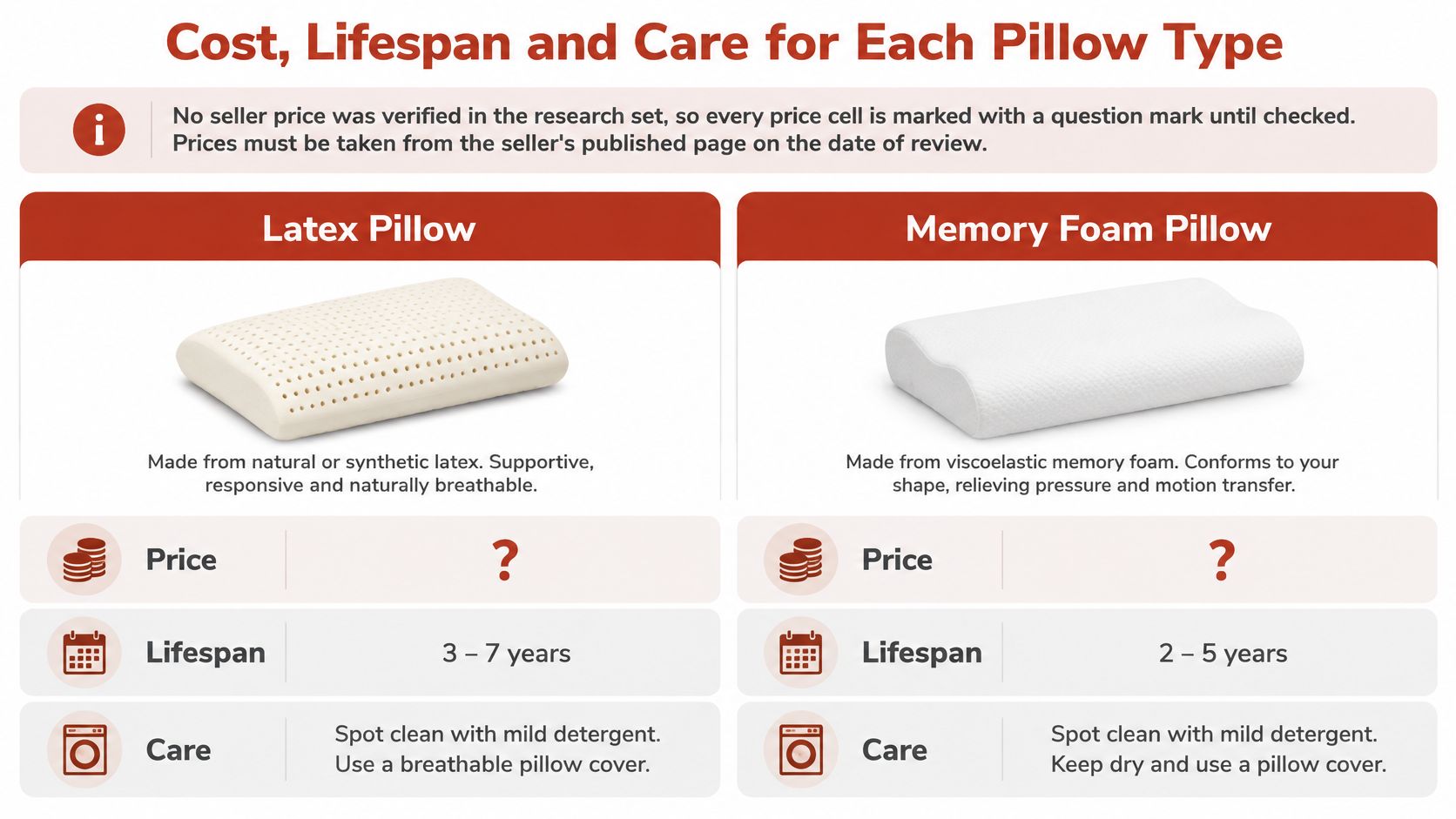
Pillow prices move with size, cover and retailer, so the shelf price is the wrong number to compare. What matters is what the construction buys at each price band, and then the cost per year of ownership.
| Price band | Construction | What the price buys |
|---|---|---|
| Entry | Shredded memory foam | Adjustable fill, lower density, shorter replacement cycle |
| Mid | Molded memory foam | Contouring shape, slower recovery, heat retention risk |
| Upper | Solid latex | Springier feel, higher resilience, denser material |
| Top | Dual-density cervical latex | Zoned firmness, engineered height, documented materials |
| Blend | Blended-mix latex | Possibly lower cost than 100% natural latex; confirm on the seller page |
Blended construction is not a niche. Blended-mix latex pillows accounted for 46.3% of the global latex pillow market by type in the Market.us latex pillow market assessment published in December 2024, which is why the blend row deserves its own line rather than being folded into natural latex.
The material mechanics behind the price bands are well documented. Natural latex foam sits in a density range of roughly 65 to 85 kg/m³, while memory foam shows rebound below 20%, meaning it returns slowly after compression and is built to contour rather than to spring back. Those figures describe material behavior, not the performance of any specific finished pillow.
For context on scale, the global latex sleeping-pillow market was valued at USD 3.095 billion in 2024 and is projected to reach USD 4.084 billion by 2031, according to QY Research's 2025 latex sleeping-pillow market report. A projection is not a price guide, and it doesn't tell a shopper what any single pillow costs.
The cost-per-year calculation
Divide the seller's published price by the number of years you realistically expect to keep the pillow. A cheap pillow replaced every two years can cost more annually than a pricier one that holds its height for five. Compare that annual figure, not the number on the shelf.
Two buyers can pay the same shelf price and end up with very different annual costs.
Lifespan is where honesty matters. No head-to-head trial establishes a lifespan in years for either material, so any fixed figure quoted as fact should be treated as a seller's claim. What the mechanics do support is narrower and still useful: latex's higher resilience means it returns to shape after compression, while lower-density memory foam, with its slow rebound, can hold impressions and flatten over time. That difference in recovery behavior is the closest thing to a lifespan signal the evidence offers, and it favors checking density before trusting any durability promise.
Care routine for either fill
- Fit a washable protector on day one. It keeps sweat and skin oils out of foam that cannot be laundered.
- Wash the cover on the label's schedule and air the core. Neither material should be machine washed or submerged.
- Keep both out of direct sun. UV degrades latex and polyurethane alike.
- Rotate a pillow that isn't zoned. Flipping it spreads compression across the surface instead of letting one spot take every night's load.
- Replace when it stops holding height overnight, not on a calendar date.
That last step is the decision rule. A pillow that still springs back in the morning is earning its keep regardless of its age, and one that stays flat has finished its service whether it is two years old or six.
Buying note: prices are as published by the seller and can change, so read the figure on the product page on the day you order. HearSmart quotes prices word for word from the maker's own store with the date checked.
For anyone pairing a pillow with a new bed, the rankings of the best latex mattress toppers apply the same published scoring method to the layer underneath.
Allergy, Odor and Indoor Air Considerations
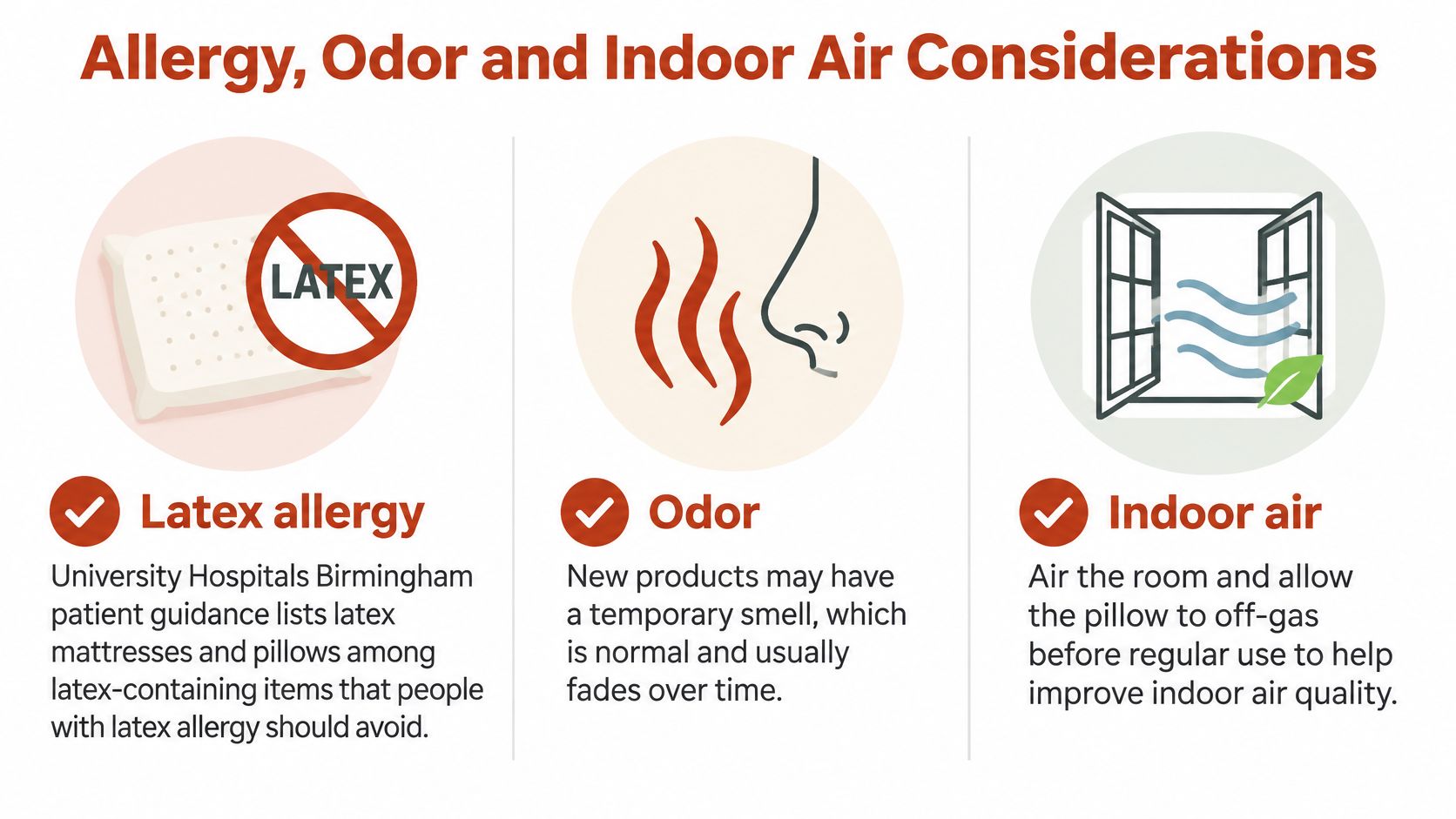
Allergy, odor and indoor air quality answer different questions. A latex allergy is a medical constraint, odor is a sensory reaction, and emissions are a measurement issue with boundaries. Keeping them separate prevents a Pillow from being called healthier on the strength of one narrow result.
Latex allergy
Medical guidance identifies natural-rubber latex pillows as products that people with confirmed latex allergy may need to avoid. The University Hospitals Birmingham patient guidance lists latex mattresses and pillows among latex-containing items, and the Asthma and Allergy Foundation of America latex allergy information discusses foam mattresses and pillows in the same context.
Memory foam is generally polyurethane rather than natural rubber, but the finished product can include latex in a component, a topper or an accessory. Check the material specification and the manufacturer's allergy statement rather than assuming the fill name settles it. A confirmed allergy makes that check part of the purchase decision, not a fine detail.
Deproteinized latex is often presented as the lower-risk route for allergy-sensitive buyers. The available review of deproteinized latex pillow foam research supports a narrower claim: reduction in allergenic material can matter, but reduction is not the same as removal. Treat it as a material process, not a guarantee about every finished pillow.
Odor and indoor air
Consumer coverage often treats memory-foam odor as decisive and natural latex as automatically healthier. The measured picture is less tidy. Emissions depend on the exact product, the testing window and what the test measures.
A study of two new memory-foam mattresses measured modeled average total VOC concentrations of about 20 and 33 micrograms per cubic meter over 32 days in the EPA reference entry for the memory-foam emissions study. The same entry records estimated one-year averages of 2.7 and 4.2 micrograms per cubic meter, with researchers judging the measured emissions unlikely to pose a health risk for the tested products.
Those figures belong to mattresses, not pillows. The result supports a point about short-term emissions from the tested memory-foam products, then stops. It cannot establish that all memory-foam pillows off-gas at the same level, or that latex pillows are cleaner by default.
A separate analytical study of natural-rubber pillows reported multiple emitted compounds and raised toxicological questions. That finding identifies a reason for emissions testing, while leaving real-world exposure and harm during normal pillow use unresolved. The correct conclusion is modest: natural origin and low concern are separate claims.
"Natural" does not mean emission-free. It means the feedstock differs.
Pre-checkout checks
- Independent emissions testing: ask whether the product has been tested by a lab the seller doesn't own.
- Measurement window: how long off-gassing was tracked matters more than the word "low-VOC".
- Washable cover: a cover you can launder handles odor and dust mites better than any material claim.
- Your own sensitivities: asthma, chemical sensitivity and confirmed latex allergy each change the shortlist. A confirmed latex allergy rules out natural-rubber latex pillows entirely.
The practical hierarchy is simple. Allergy status decides whether latex belongs in the home at all. Odor sensitivity decides how much weight to give a washable cover and independent testing. Emissions data decides only what it directly measures, which is why material labels alone should not settle the purchase.
Which Pillow to Choose for Your Situation
The verdict runs by reader type, one pick each.
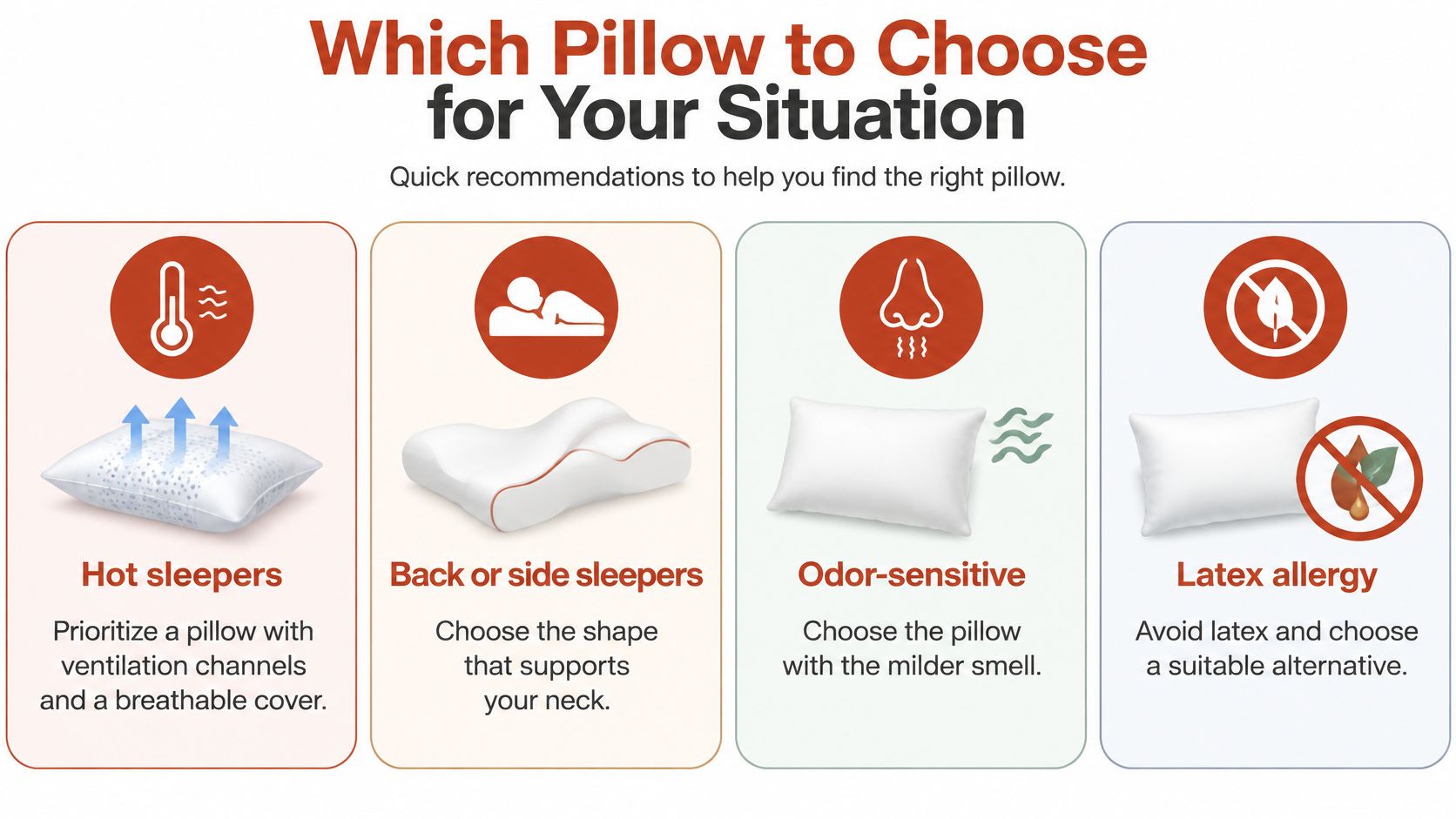
Hot sleepers should choose by construction: ventilation channels, a breathable or washable cover, and a height that doesn't crowd the jaw. The only controlled temperature study here compared memory foam with other pillow types and did not test latex, so heat decisions belong to the specific build, not the material family.
Sleepers who want close contouring at a lower entry price and don't run hot can choose molded memory foam, accepting that it holds impressions longer and may need replacing sooner.
Combination sleepers who change position through the night should favor latex's quick recovery over memory foam's slow return, because rolling against a slow fill takes effort.
People with a confirmed latex allergy should avoid natural-rubber latex and check component lists on memory foam pillows, since latex can appear in a topper or accessory.
Anyone with chronic neck pain should treat material as secondary. No published comparison shows either fill superior for chronic neck pain, and a pillow is not a clinical intervention.
Buyers weighing the layer under the pillow can work through the same criteria in the guide to how to choose a mattress, which covers height, firmness and sleep position before material.
Prices in HearSmart's rankings are the US prices shown on each maker's own store at the time HearSmart checked them, and they can change.
Before ordering, open the seller's page, note the published price and the return window, and confirm the fill, density and cover fabric in writing. Then sleep on the pillow in your dominant position for one week and replace it when it stops holding its height overnight. HearSmart's best pillow rankings and sleep gear coverage list current picks on the same sourced method, with the date each price was checked.
Cite this page
HearSmart. Latex vs Memory Foam Pillows 2026. Updated November 28, 2026. https://hearsmart.org/latex-vs-memory-foam-pillows
Spotted an error in this guide? Email editorial@hearsmart.org