Review · Tech & gadgets
 Ray-Ban Meta Audio review
Meta's first audio-only AI glasses, with open-ear sound, Meta AI and up to 12 hours per charge in 43 gram frames.
By the HearSmart research desk · Updated November 23, 2026
The short answer
Ray-Ban Meta Audio are Meta's first camera-free AI glasses: open-ear speakers, a six-microphone array and Meta AI by voice in 43 gram Clubmaster or Burbank frames, rated for up to 12 hours of mixed use per charge plus up to 48 hours from the case. They start at $349 in the US when checked in November 2026, with Transitions lens versions listed at $429. They suit glasses wearers who want music, calls and a voice assistant in frames they already wear, and anyone who does not want a camera on their face.
- Performance (40%)
- 7.6
- Ease of use (25%)
- 9.2
- Value (35%)
- 9.0
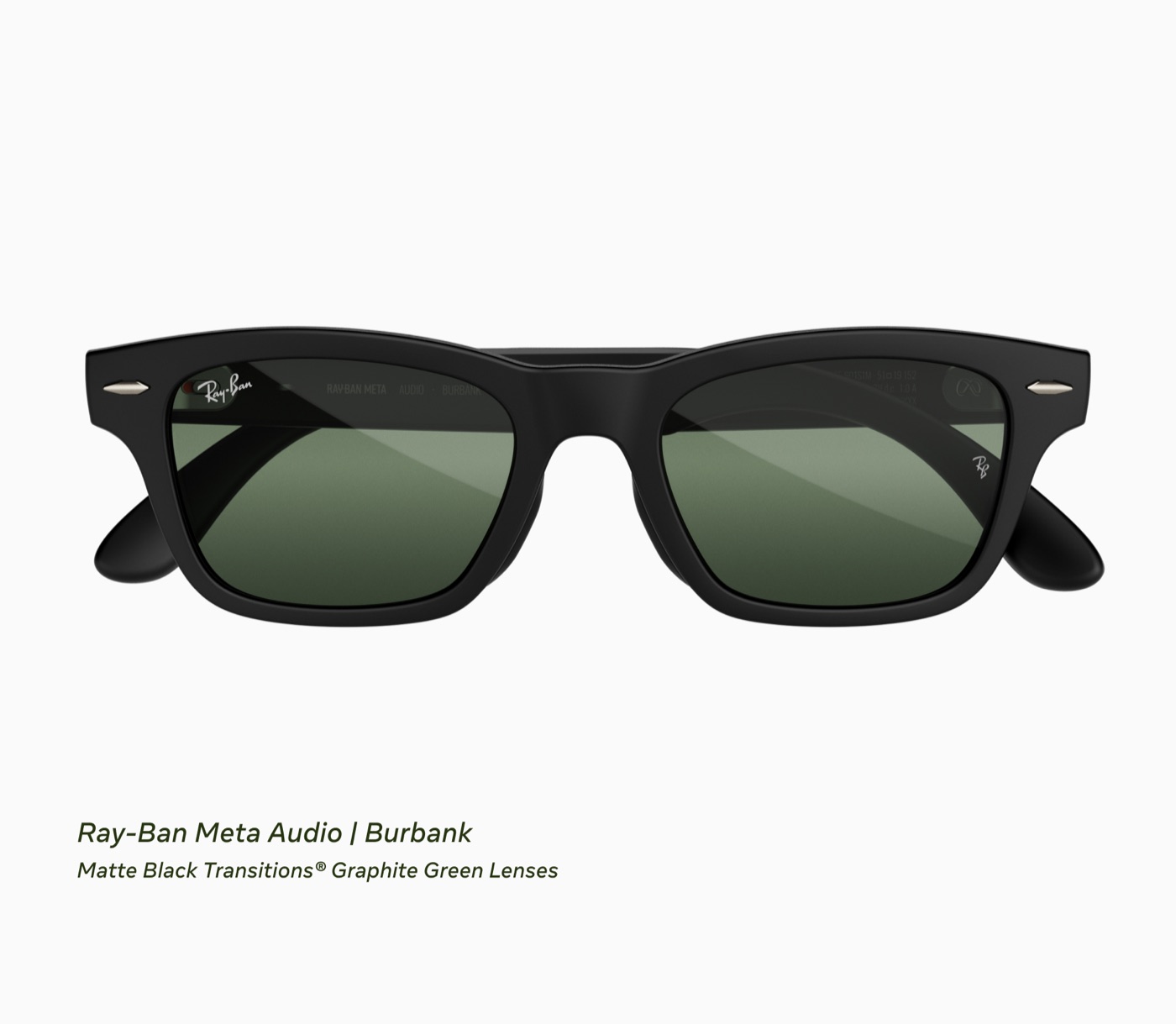
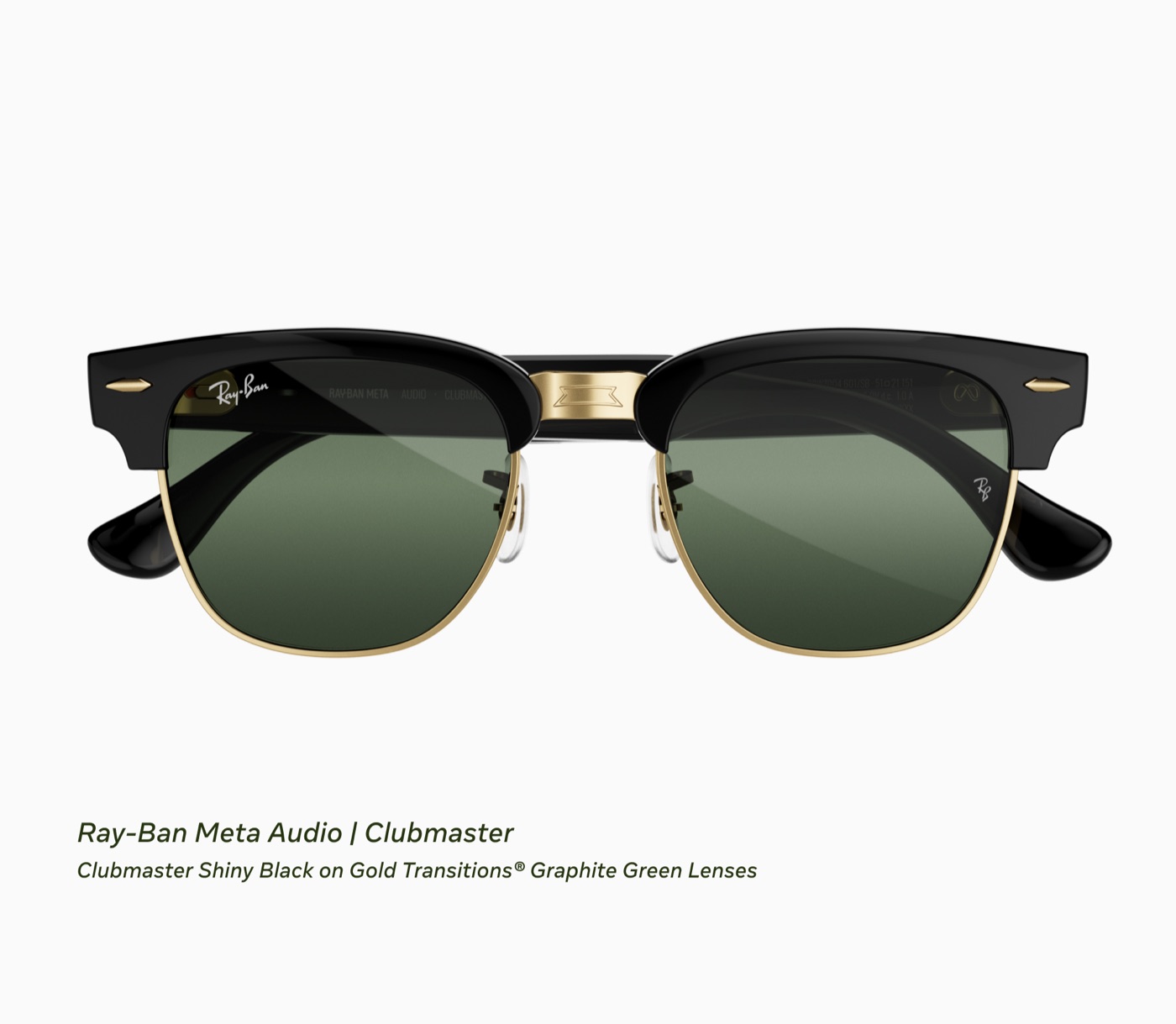
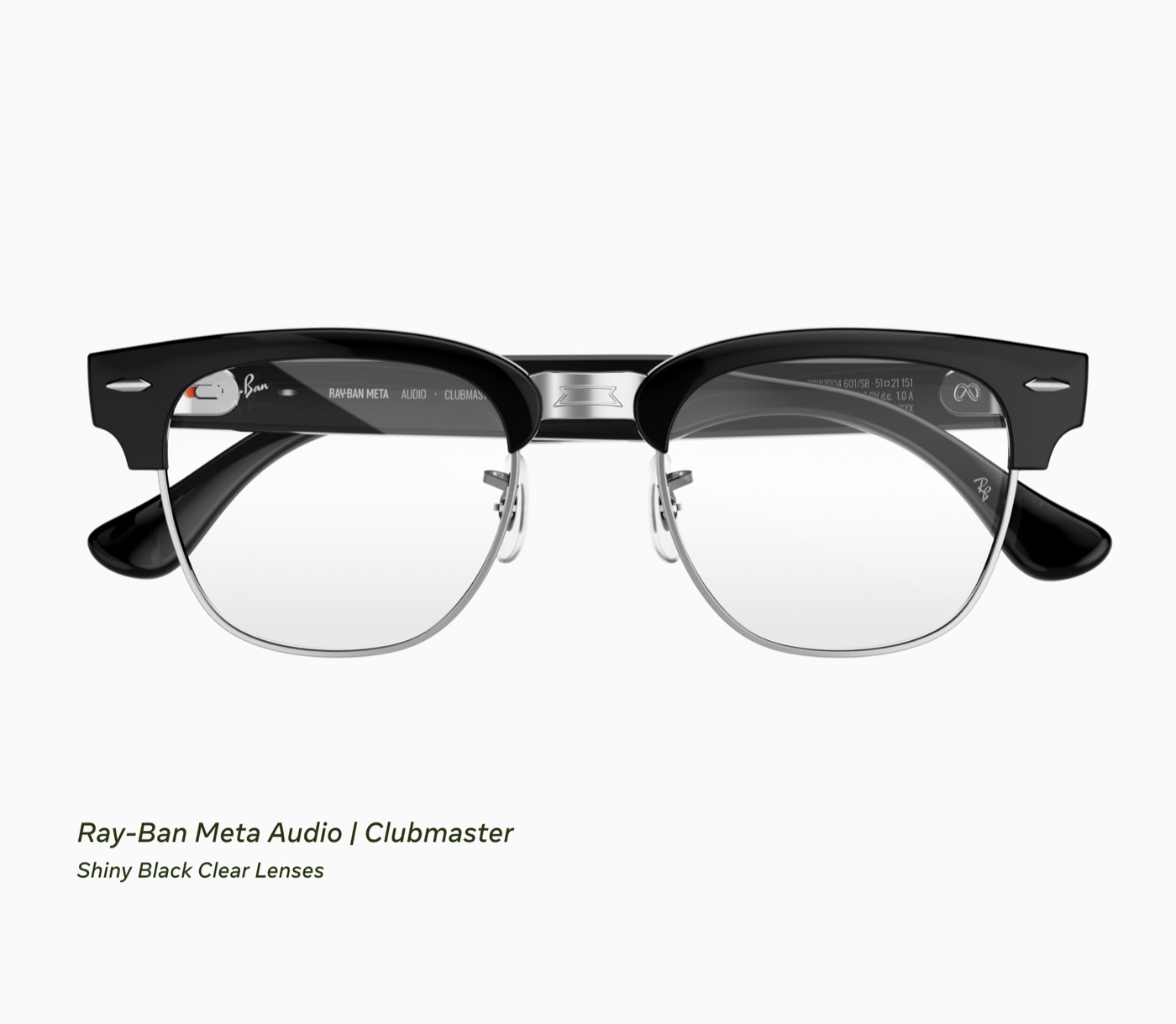
What it looks like
Our verdict
Buy Ray-Ban Meta Audio if you already wear glasses or sunglasses most of the day and want calls, podcasts, directions and Meta AI without earbuds or a camera: at $349 they cost $100 less than Ray-Ban Meta (Gen 3) and Meta rates them for 12 hours of mixed use against 9 hours on Gen 3. Skip them if you want photos, video or visual AI that reads signs and menus, if you need sound that blocks outside noise, or if your main goal is hearing help, since these are not hearing aids. The deciding fact is the camera: if you would never use one, this is the cheapest and longest-running pair in Meta's Ray-Ban line-up.
Overview
Ray-Ban Meta Audio is an audio-only pair of AI glasses made by Meta with EssilorLuxottica. Meta announced it at Connect on September 23, 2026, calling it its first-ever audio glasses, and it began shipping on October 13, 2026. The frames have two open-ear speakers in the temples, six microphones, a touchpad on the right arm, a small action button and an inward-facing notification LED. There is no camera, no outward recording LED and no display. Meta says the 43 gram frames are its lightest and slimmest AI glasses so far.
The line-up has two styles, Clubmaster and Burbank, in 23 color and lens combinations. Ecoustics lists clear, tinted, polarized and Transitions lenses, and both styles accept a wide range of prescriptions. Pricing starts at $349 in the US, £319 in the UK and €349 in the rest of Europe, according to Notebookcheck. The Gadgeteer found the black Clubmaster with G15 Green lenses at $349 on Ray-Ban's US store and the same frame with Clear/Green Graphite Transitions lenses at $429, and ecoustics reports that prescription lenses add about $100.
Battery life is the headline difference. Meta rates the glasses for up to 12 hours on a charge and up to 48 more hours from the included case. That 12 hour figure is mixed use: The Gadgeteer and Engadget both report Meta's separate rating of up to six hours of continuous audio playback, and Engadget's reviewer still had close to 50 percent left after five hours of streaming and a one-hour call. A 50 percent charge takes about 22 minutes in the case, according to The Gadgeteer.
Against the other Meta glasses on this site, Ray-Ban Meta (Gen 3) costs from $449 and adds a 12 MP camera with 3K video but lists up to 9 hours per charge, and Oakley Meta HSTN costs from $399 with up to 8 hours. Outside Meta, the Solos AirGo V2 cost $299 with a camera and swappable fronts, and the Even G2 add a display at $599. If you do not need glasses at all, open earbuds such as the Shokz OpenFit 2 at $179.95 do the same listening job for less.
The limits come from the missing camera and from Meta's software. Visual features such as asking Meta AI about what you are looking at and Live AI are not available, though voice Meta AI, live translation, messaging, calls and walking directions remain. Engadget found the action button can only be set to play music or start Meta AI, so it cannot answer or mute calls. Setup needs a compatible phone, a Meta account and the Meta AI app, some AI functions vary by country and language, and Engadget notes that Meta stores voice recordings from its glasses with no opt-out for US users. Open-ear speakers also let surrounding noise in, so they do not replace sealed earbuds on loud trains or flights.
How it scored
Ray-Ban Meta Audio is the pair for people who like the idea of smart glasses but not the camera. Meta calls it its first audio glasses, and it keeps the parts most owners use every day: open-ear sound for music and podcasts, calls that Meta says capture your voice more clearly than earbuds, and hands-free Meta AI. The frames weigh 43 grams, the lightest and slimmest in Meta's range, and they add professional-adjustable temple tips, adjustable or swappable nose pads and overextension hinges for all-day comfort. Battery is the strongest here at up to 12 hours on a charge, with up to 48 more hours from the included case. There are 23 color and lens combinations across two styles, Clubmaster and Burbank, and both take a wide range of prescriptions. At $349 it is $100 less than Gen 3. You give up photos, video and any display, so it is closer to wearable earbuds than a camera.
Who it is for
People who want music, calls and a voice assistant in their glasses but do not want a camera.
Good fit if
- People who wear prescription glasses all day and want calls, podcasts and music built into those frames instead of carrying earbuds
- Buyers who like the Ray-Ban Meta idea but do not want a camera, for example at work, at school events or in places that restrict recording devices
- Commuters and walkers who want spoken directions and calls while still hearing traffic, since the open-ear speakers leave the ear canal open
- Anyone who found earlier Meta glasses short on battery: Meta rates these for 12 hours of mixed use, 3 hours more than Gen 3
- People who make many calls on the move: Meta says the six-mic array captures your voice more clearly than earbuds
Skip it if
- People who want photos and video from their glasses: Ray-Ban Meta (Gen 3) cost from $449 with a 12 MP camera and 3K video
- Anyone who wants text or notifications in front of their eyes: the Even G2 are also camera-free, weigh 36 grams and add a display, from $599
- Listeners who just want open-ear sound and already have sunglasses they like: the Shokz OpenFit 2 cost $179.95 with up to 11 hours per charge
- People with hearing loss looking for amplification in restaurants or meetings: these are audio glasses, not hearing aids, so an audiologist fitting or an over-the-counter hearing aid is the better route
Specifications
| Price | From $349 (US); £319 (UK); €349 (Europe) | source |
|---|---|---|
| Transitions lens version | $429 (black Clubmaster, Clear/Green Graphite Transitions, Ray-Ban US store) | source |
| Prescription lenses | Supported in both styles; about $100 extra | source |
| Weight | 43 grams (Meta's figure); Engadget weighed its Clubmaster pair at 47 grams | source |
| Battery per charge | Up to 12 hours mixed use; up to 6 hours continuous audio | source |
| Charging case | Up to 48 additional hours, included | source |
| Fast charge | 50 percent in about 22 minutes; no charging cable in the box | source |
| Speakers | Two open-ear speakers in the temples | source |
| Microphones | Six: two on the front of the frame, four on the arms | source |
| Connectivity | Bluetooth 5.3, Wi-Fi 6 | source |
| Water resistance | IPX4 | source |
| Camera and display | None | source |
| Styles | Clubmaster and Burbank, 23 color and lens combinations | source |
| Lens options | Clear, tinted, polarized, Transitions and prescription | source |
| Fit | Adjustable temple tips, overextension hinges; adjustable nose pads (Clubmaster), three interchangeable pad sizes (Burbank) | source |
| Requirements | Compatible phone, Meta account, Meta AI app, internet access for AI features | source |
Price
From $349 at Meta.
You can pre-order a pair today starting at $349 USD and they ship October 13.
Quoted from the vendor pricing page on November 9, 2026.
Plans and pricing
| Plan | Price | What is included | Source |
|---|---|---|---|
| Clubmaster, standard lenses (for example black with G15 Green) | $349one-time | Glasses; Charging case with up to 48 extra hours | Checked Nov 23, 2026 |
| Clubmaster, Transitions lenses (black with Clear/Green Graphite Transitions) | $429one-time | Glasses with light-adaptive lenses; Charging case | Checked Nov 23, 2026 |
| Burbank, standard lenses (black with clear lenses) | $349one-time | Glasses; Charging case; Three interchangeable nose pad sizes | Checked Nov 23, 2026 |
| Burbank, Transitions lenses | $429one-time | Glasses with light-adaptive lenses; Charging case | Checked Nov 23, 2026 |
| Prescription lenses (either style) | About $100 on top of the frame priceone-time | Optical prescription lenses in Clubmaster or Burbank | Checked Nov 23, 2026 |
Key features
Open-ear speakers and six microphones
Two speakers in the temples play music, podcasts and calls without anything in the ear. Engadget reports two mics on the front of the frame and four on the arms, replacing the nose pad mics of earlier models, and Meta says calls capture your voice more clearly than earbuds.
12 hours of mixed use
Meta rates the glasses for up to 12 hours per charge and the case for up to 48 more. Continuous audio playback is rated at up to six hours, so heavy listeners should plan on the case midday. A 50 percent charge takes about 22 minutes.
Meta AI by voice
Say "Hey Meta" or press the action button on the right temple to ask questions, set reminders, send messages, get walking directions or run live translation. Notebookcheck reports Meta's statement that the glasses are not always listening. Meta says its Muse agent is coming to its glasses in a later update.
No camera
There is no camera and no outward recording light, which removes the main reason venues and bystanders object to smart glasses. It also removes photos, video, Live AI and questions about what you are looking at.
Prescription-ready Ray-Ban frames
Clubmaster and Burbank come in 23 color and lens combinations, including polarized and Transitions lenses, and both take a wide range of prescriptions. Temple tips can be adjusted by an optician, and Burbank ships with three nose pad sizes.
Limited action button
Engadget found the action button has only two settings on this model: play recommended music or start Meta AI. It cannot be set to answer or mute calls, unlike some uses on Meta's other frames.
Strengths and weaknesses
What we like
- Up to 12 hours of mixed use per charge, against 9 hours for Ray-Ban Meta (Gen 3) and 8 hours for Oakley Meta HSTN
- At $349 it is the cheapest Ray-Ban Meta model, $100 below Gen 3
- 43 grams by Meta's figure, its lightest AI glasses, and Engadget found the weight sits less on the nose than on camera models
- No camera, so no recording worries for the wearer or people nearby
- Six-mic array; Engadget's reviewer was told calls sounded clearer than on second-generation AirPods Pro
- Takes prescriptions in both styles, with polarized and Transitions options among 23 combinations
- Fast top-up: about 50 percent in 22 minutes in the included case
What could be better
- Continuous audio playback is rated at only up to 6 hours; the 12 hour figure is mixed use
- No visual AI: Meta AI cannot read a sign or menu or describe what you see
- Transitions versions cost $429 and prescriptions add about $100, so a fully configured pair can pass $500
- Action button limited to two functions and cannot answer or mute calls
- IPX4 only, so splashes and sweat but not rain-soaked runs or swimming
- Requires a Meta account and the Meta AI app, and Meta keeps voice recordings with no US opt-out according to Engadget
Key facts
- Price: From $349
- Weight: 43 grams
- Battery: Up to 12 hours, 48 more with case
- Camera: None
Where it ranks
Ray-Ban Meta Audio is No. 3 in our Best Smart Glasses verdict.
Alternatives to consider
- Ray-Ban Meta (Gen 3): From $449 with a 12 MP camera, 3K video and visual Meta AI, for buyers who want to capture what they see, at the cost of 3 fewer hours per charge.
- Oakley Meta HSTN: From $399 with a camera and an IPX4 sport-leaning Oakley frame, up to 8 hours per charge.
- Even G2: Also camera-free but adds a display and translation in 35 languages, 36 grams, from $599.
- Solos AirGo V2: $299 audio glasses with swappable frame fronts, rated 10 hours of music and IP54.
- Shokz OpenFit 2: $179.95 open earbuds with up to 11 hours per charge and IP55, if you want open-ear sound without buying new frames.
Questions readers ask
Is Ray-Ban Meta Audio worth it?
It is worth it for people who already wear glasses all day and want calls, music and Meta AI in them without a camera: at $349 it is $100 cheaper than Ray-Ban Meta (Gen 3) and rated for 12 hours of mixed use. It is harder to justify if you already own good sunglasses and earbuds, or if you want photos and video.
Does Ray-Ban Meta Audio have a camera?
No, Ray-Ban Meta Audio has no camera and no display. Meta calls it its first audio glasses, and the features that rely on the camera, such as photos, video and Live AI, are not available.
How long does the Ray-Ban Meta Audio battery last?
Meta rates the glasses for up to 12 hours of mixed use per charge and up to 6 hours of continuous audio, with up to 48 more hours from the included case. A 50 percent charge takes about 22 minutes, according to The Gadgeteer.
How much does Ray-Ban Meta Audio cost?
Ray-Ban Meta Audio starts at $349 in the US. Transitions lens versions of Clubmaster and Burbank were listed at $429, and prescription lenses add about $100, according to ecoustics. Notebookcheck lists £319 in the UK and €349 elsewhere in Europe.
Ray-Ban Meta Audio vs Ray-Ban Meta (Gen 3): which should I buy?
Buy Gen 3 only if you want a camera: it costs from $449 and adds a 12 MP camera with 3K video and visual Meta AI. Ray-Ban Meta Audio costs $100 less, weighs 43 grams and is rated for 12 hours per charge against 9 hours on Gen 3.
Can I get Ray-Ban Meta Audio with prescription lenses?
Yes, both the Clubmaster and Burbank styles support a wide range of optical prescriptions, according to Meta. Ecoustics reports prescription lenses add about $100 to the price.
Are Ray-Ban Meta Audio glasses waterproof?
No, they are rated IPX4, which covers splashes and sweat but not submersion. Do not wear them swimming or in heavy rain for long periods.
Can Ray-Ban Meta Audio work as hearing aids?
No, they are audio glasses for music, calls and Meta AI, not hearing aids. People with hearing loss should look at FDA-registered over-the-counter or prescription hearing aids, and HearingTracker notes that even Meta's camera models are not designed to compensate for hearing loss.
Sources we checked
- Meta Newsroom: Introducing Ray-Ban Meta Audio and More AI Glasses Styles, checked November 23, 2026
- Engadget: Ray-Ban Meta Audio glasses review, No camera, no problem, checked November 23, 2026
- The Gadgeteer: Ray-Ban Meta Audio's 12-hour battery claim isn't 12 hours of music, checked November 23, 2026
- ecoustics: Ray-Ban Meta Audio Glasses Drop the Camera and Suddenly Make More Sense, checked November 23, 2026
- TechCrunch: Meta introduces camera-free AI glasses, checked November 23, 2026
- Notebookcheck: Meta launches new Ray-Ban glasses without cameras, checked November 23, 2026
- Digital Trends: Ray-Ban Meta Audio glasses ditch the creepy camera, look pretty, and cost $349, checked November 23, 2026
- Tom's Guide: Testing Ray-Ban Meta Audio glasses for 72 hours, checked November 23, 2026
- HearingTracker: Meta Ray-Ban glasses in HearAdvisor testing, checked November 23, 2026
- HearSmart: Best Smart Glasses (rival prices and battery figures), checked November 23, 2026
Deep review last updated November 23, 2026. We recheck prices and specs against these pages; send corrections to the address below.
Alternatives we scored
Cite this page
HearSmart. Ray-Ban Meta Audio review. Updated November 23, 2026. https://hearsmart.org/review/ray-ban-meta-audio
Visit meta.com · Questions or corrections: editorial@hearsmart.org