Guide · General
Best Top Load Washers of 2026: Capacity, Water and Price
Compare the best top load washers of 2026 by capacity, water use, cleaning results and published US price, with sourced efficiency data.
By the HearSmart research desk · Updated November 20, 2026 · 14 min read

The best top-load washer for a given home is the one whose water use and failure risk match how that home does laundry. Tub size and cycle count don't rank it, and the largest machine on the showroom floor is often the wrong buy for the household paying the water bill.
Most advice starts with capacity. Buy the biggest drum the room will take, the argument runs, and the loads get fewer. The arithmetic doesn't hold: a big tub paired with a high water factor costs more every week than a smaller efficient machine, and the defects that end a washer's working life rarely have anything to do with capacity.
Four published figures decide the purchase. Capacity class sets which federal efficiency threshold a model has to clear. Water factor and energy factor turn into a yearly bill once local rates go in. Laboratory cleaning results show what the wash action removes. Owner-reported failure shares show which problems appear in the first five years. Each can be checked before money changes hands, and none of them is a brand reputation score.
Table of Contents
- Which Top-Load Washer Fits Your Home
- How Top-Load Washers Differ in Design
- Capacity Classes and What Cubic Feet Measure
- Water and Energy Use Per Load and Per Year
- Cleaning Results and Reliability Problems
- Purchase Price, Running Cost and Daily Use
- Matching Top-Load Washers to Real Households
- Confirm Your Top-Load Washer Choice Before Buying
Which Top-Load Washer Fits Your Home
For most households the right top-load washer is the one whose design and capacity class match the main laundry priority, not the one with the largest tub or the longest cycle list. Size and cycle count are showroom metrics: neither predicts the water bill, and neither predicts which repair ends the machine's life.
The category splits into two designs with different economics. Conventional agitator machines push clothes through a full tub of water; high-efficiency impeller machines tumble clothes over a low disc and spin harder to extract water. A household buying on price lands on one design, a household buying on running cost lands on the other, and the two rarely sit at the same price point.
| Household priority | Start with | Check first |
|---|---|---|
| Lowest water and energy use | High-efficiency impeller top-loader | Water factor and modified energy factor |
| Lowest upfront price | Conventional agitator top-loader | Tub capacity and warranty terms |
| Largest loads | Standard top-loader with a tub of 1.6 cubic feet or more | Advertised capacity against the DOE measurement |
| Fewer tangled loads | Impeller top-loader with owner-reported tangling data | Tangling and balling complaint shares |
| Stain removal | Models with published laboratory cleaning results | Stain-removal test scores |
Three of those five checks are federal or laboratory measurements that any buyer can pull up, and the fourth is a volume measured under a fixed procedure. The fifth, price, is the one that moves. HearSmart's ratings rest on the documented features and published prices on each maker's own pages, never on hands-on testing, which is why the reading of each specification matters more than any single score.
The verdict that follows depends on two local variables no ranking can supply: what water costs where the reader lives, and how many loads the household runs in a week. A four-person household and a single occupant buying the same machine get different value from it.
How Top-Load Washers Differ in Design
By 1940, electric washing machines sat in roughly 60% of the country's 25 million electrically wired homes, and in 1947 General Electric introduced its first top-loading automatic model, according to a published timeline of washing machine history. The vertical-axis layout those machines established is still the one sold today.
The format still holds the market. Top-load washing machines represented 59.21% of the U.S. washing-machine market in 2025, according to Mordor Intelligence's United States washing machine analysis.
Within that share sit two constructions that behave differently.
A conventional agitator top-loader turns a central post through a full tub of water to work the load, and it draws the most water per load of any top-load design.
A high-efficiency impeller top-loader replaces the post with a low-profile disc, tumbles the load across it, and spins at higher speeds to fling water out, which cuts water per load and leaves less moisture for the dryer to remove.
Both load from above, and in many models garments can still be added after the cycle has started.
The distinction that matters: the real choice is agitator or impeller construction, not top load versus front load. Impeller models keep the waist-height loading position and change only how the machine handles water.
Three checks cover the design question for any model on a shortlist.
- Construction. An agitator suits heavy soil and a familiar wash action; an impeller suits water savings and bulky items that need room to move.
- Tub size in cubic feet. Read it against the class threshold rather than against the biggest number in the aisle.
- Spin speed. A faster final spin leaves less water in the fabric, and the dryer then uses less energy to finish the load.
Capacity Classes and What Cubic Feet Measure
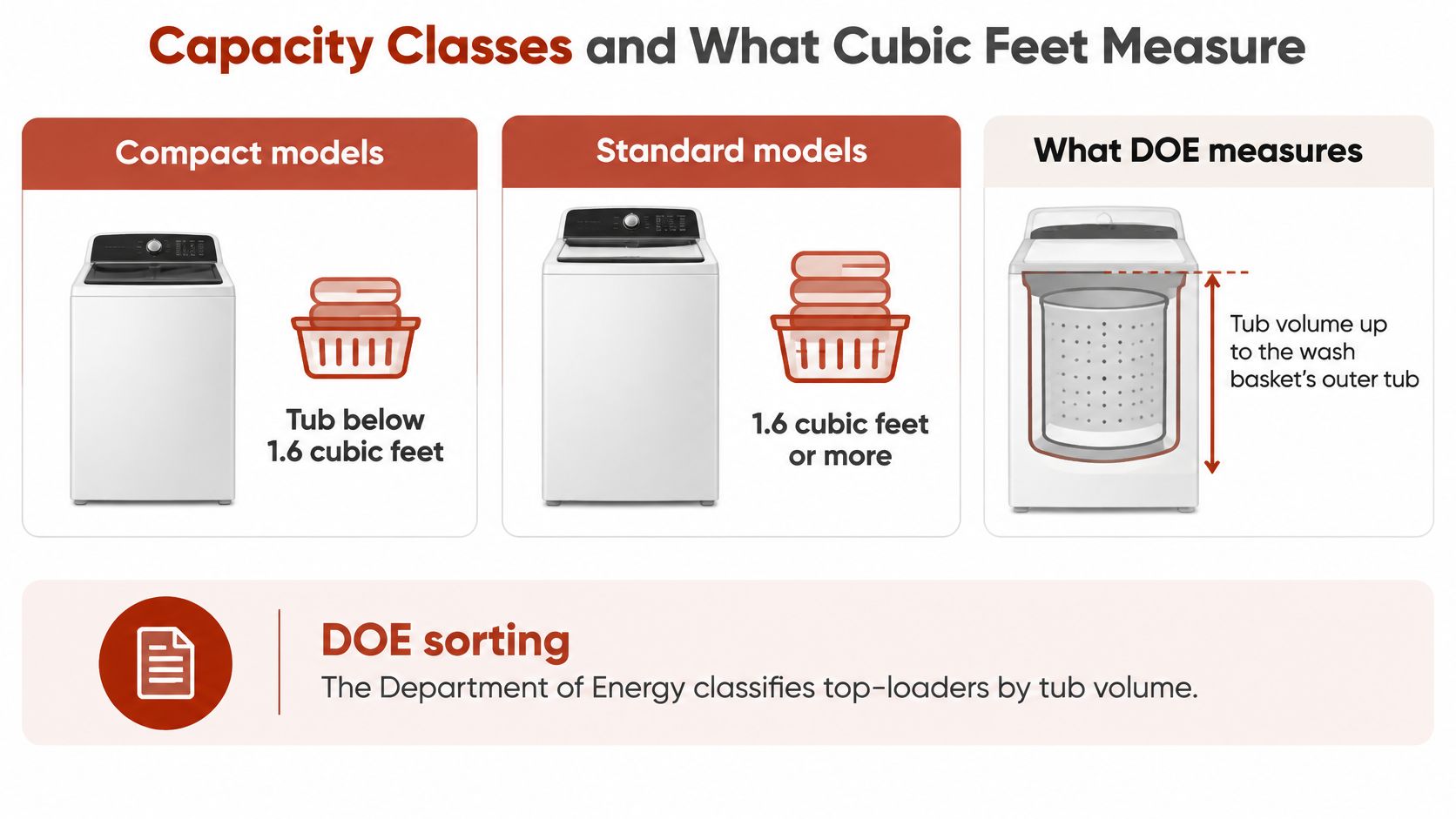
The Department of Energy sorts residential top-loaders by tub volume before it applies any efficiency test, and that sorting decides which threshold a model has to clear. A compact top-loader has a tub below 1.6 cubic feet; a standard top-loader has 1.6 cubic feet or more, per the DOE's federal clothes washer standards published in 2024, which set the values that apply to machines manufactured from January 1, 2018.
That cubic-foot figure is a tub volume, not a garment count. DOE guidance measures the clothes-container volume up to the highest horizontal plane a clothes load could occupy without passing the designated fill level, taken with the lid open, and defines the top edge as the highest point of the innermost tub diameter at the tub-cover area, according to the department's washer test-procedure guidance. Bulky-item settings, agitator or impeller geometry and the load limit printed in the manual can all shrink what the rating delivers in practice.
Two Metrics Worth Learning Before Comparing Models
Modified energy factor relates tub capacity to total energy use, expressed as cubic feet per kilowatt-hour per cycle, and a higher figure is better. Water factor divides weighted water consumption by tub capacity, expressed as gallons per cycle per cubic foot, and a lower figure is better. Both are defined in ENERGY STAR's clothes washer specification, and because both divide by capacity, a 3.0 cubic-foot machine and a 5.5 cubic-foot machine can be compared without adjusting by hand.
| Class | Tub volume | Minimum modified energy factor | Maximum water factor |
|---|---|---|---|
| Compact top-loader | below 1.6 cubic feet | 1.15 | 12.0 |
| Standard top-loader | 1.6 cubic feet or more | 1.57 | 6.5 |
Values are cubic feet per kilowatt-hour per cycle and gallons per cycle per cubic foot, for machines manufactured from January 1, 2018.
The thresholds are floors, not targets, and a larger tub isn't automatically the better buy. A 5.5 cubic-foot machine sitting at the standard-class water ceiling uses more water per cycle than a 4.0 cubic-foot model with a much lower water factor, and the gap compounds across a year of laundry. Two machines with identical cubic-foot ratings can also differ in usable room once the load limit and the wash-action hardware are taken into account, so the manual's stated limit is worth reading before the model is ordered.
The thresholds above apply to machines built from 2018 until the amended rules take hold. DOE's later standard uses different metrics on a different timeline, and mixing the two sets of numbers is the most common comparison error in this category.
Water and Energy Use Per Load and Per Year
Two top-loaders can look identical on the showroom floor and differ by thousands of gallons a year. Independent laboratory testing puts high-efficiency top-loaders at about 13 gallons per load, against roughly 16 to 24 gallons for conventional top-load agitator models on an average-sized load, according to Consumer Reports' testing of high-efficiency top-load washers. The same testing measured high-capacity HE top-loaders at approximately 5.5 cubic feet, with normal and heavy cycles running 35 to 105 minutes.
The federal program lands on a similar spread. For a full-sized washer, ENERGY STAR's clothes washer guidance gives an illustrative 14 gallons per load for a certified model against 20 gallons for a standard machine, with certified washers using about 20% less energy and 30% less water than regular models. The same guidance reports certified front-loaders using about 50% less energy and water than top-load agitator machines, and front-loaders staying about 25% more energy- and water-efficient than top-load impeller models.
The Yearly Arithmetic
At 300 loads a year, a 7-gallon gap per load comes to 2,100 gallons, and a 6-gallon gap comes to 1,800 gallons. Multiply the household's own figure by the local all-in water and sewer rate. At $6 per 1,000 gallons, the 2,100-gallon gap costs about $12.60 a year for supply alone, and many utilities bill sewer at a comparable rate on top. A single occupant running one load a week sees a fraction of that.
Energy follows the same shape. Divide tub capacity by the published energy factor to get kilowatt-hours per cycle, including the energy used to heat the water. An illustrative 4.5 cubic-foot model rated exactly at the standard-class floor works out to just under 2.9 kilowatt-hours per cycle; multiply by annual loads and the local electricity rate for the yearly figure. The result only means something when both models are rated under the same test method.
A washer's spin cycle decides how much work the dryer inherits. Water and energy figures for the washer understate the household's real saving if the dryer is inefficient, which is why the choice between heat pump and condenser drying belongs in the same decision.
What Moves the Figure Away From the Label
Cycle selection, soil level, load size and optional deep-fill settings all change consumption. A deep-fill option on an impeller machine can erase much of its advantage on the cycles where it runs, and a heavy-duty cycle on an agitator machine can push water use past the top of its tested range. The label figure describes the default cycle; the machine's real cost reflects the cycles the household selects.
Why 2028 Changes the Comparison
DOE's 2024 rulemaking for residential clothes washers replaces the modified energy factor and water factor with an energy-efficiency ratio in pounds per kilowatt-hour per cycle and a water-efficiency ratio in pounds per gallon per cycle, under the department's 2024 rulemaking notice. Compliance is scheduled for machines manufactured on or after March 1, 2028, which means washers built before and after that date will carry ratings on different scales. A 2027 model and a 2029 model can't be ranked against each other on the same numbers, so any comparison should stay within one framework.
Cleaning Results and Reliability Problems
Cleaning claims are cheap, and a single number on a box settles nothing. A defensible comparison measures four things under one test protocol: how much soil comes out, how much energy the washed load still needs in the dryer, how the fabric survives, and how the machine behaves on a wood floor and at the drain.
How a Cleaning Result Is Measured
A laboratory cleaning score starts with fabric swatches stained with known soils, including red wine, cocoa and carbon, and a spectrocolorimeter reading the stain's lightness before and after the wash rather than a technician's judgment. Residual moisture after the final spin converts into the energy the dryer will need. Fabric gentleness comes from measured change in the swatch itself. Vibration is recorded as transmitted to a wood floor, and noise is logged during filling, washing, draining and spinning. Published results built this way are worth more than any cycle name.
What 108,608 Machines Reveal About Failure
Reliability evidence at that scale exists. Consumer Reports' reliability survey covered 108,608 washing machines purchased new between 2015 and 2025, according to Consumer Reports' laundry reliability survey, and it separates top-load agitators from high-efficiency top-loaders rather than scoring washers as one category.
The complaint pattern in that owner evidence is worth more than a brand average, as the survey's reliability findings show.
| Complaint | Share of reported machines | Type of problem |
|---|---|---|
| Tangled or balled-up clothes | 10% | Everyday performance |
| Odor | 8% | Maintenance |
| Mold or mildew | 7% | Maintenance |
| Poor cleaning | 5% | Everyday performance |
| Drainage failure | 5% | Repair |
| Excessive vibration | 5% | Repair |
Each row means something different to a buyer. Tangling and balled-up clothes reflect wash action, which is why impeller machines with a gentler tumble and agitator machines with a strong post produce different daily experiences. Odor and mold are moisture problems, tied to a lid left shut over a wet tub or a dispenser that never dries. Drainage and vibration are repairs, and a drainage failure takes the machine out of service until a technician arrives.
Read the shares as a population, not a brand. They describe all reported machines from 2015 to 2025 and should be read next to the survey's agitator and impeller split, not as a score for any one maker.
For a shortlisted model, three things matter beyond the reputation of the badge: whether parts are stocked locally, which repair the complaint pattern points to, and how long the machine would be unusable if that repair were needed. A statistically reliable washer that tangles every second load still fails its household.
Purchase Price, Running Cost and Daily Use
Price is the easiest figure to get wrong, because it's the only one that expires. Prices in the ranking are the US prices shown on each maker's own store at the time HearSmart checked them, and sellers change them without notice, so the date a price was recorded belongs next to the number.
Turn the Two Factors Into a Yearly Bill
The running cost model takes four steps. Multiply the water factor by tub capacity to get gallons per cycle. Multiply that by annual loads for yearly water volume, then by the local all-in rate for the annual water bill. Divide tub capacity by the energy factor for kilowatt-hours per cycle, multiply by annual loads, then by the electricity rate. Add the two yearly figures together, multiply that sum by five, and add the purchase price to get the five-year total.
That last distinction matters. The purchase price is paid once, so it enters the total once; only the yearly water and energy costs repeat. A machine that looks expensive on the showroom floor often costs less over five years than a cheaper one with a loose water factor, because the cheaper machine pays its premium back load by load. The inversion is common in the compact class, where the water ceiling is looser than it is for standard machines, and it's the single strongest argument for costing out a washer rather than comparing sticker prices.
What Daily Use Adds
Ease of use is scored on fit, comfort, setup and day-to-day use, taken from manuals, support pages and published specifications. Those sources answer the questions a showroom can't.
- Lid height and tub opening. A deep tub with a high lid is harder to reach into for shorter users than a wide, shallow opening.
- Cycle options. A delicate cycle and a bulky-item setting are the two most households use; a long list of specialty cycles rarely earns its premium.
- Noise and footprint. Spin noise travels in an apartment, and installation clearance matters more than the exterior dimensions suggest.
- Warranty length and coverage. A long parts warranty that excludes labour is a different offer from a shorter one that covers both.
The cost arithmetic and the usability checks often pull in opposite directions, making a shortlist of three models a realistic starting point. Run the five-year total on all three, then read the manual for the winner before deciding.
Matching Top-Load Washers to Real Households
Four situations cover most buyers, and each ends in one specification to verify.
A single person or couple running about one load a week buys 52 cycles a year. A 7-gallon gap per load comes to roughly 364 gallons annually, small enough that tub size and warranty terms carry more weight than efficiency. A compact or standard agitator machine often keeps the upfront cost down, and the tub volume should be checked against the actual weekly laundry pile.
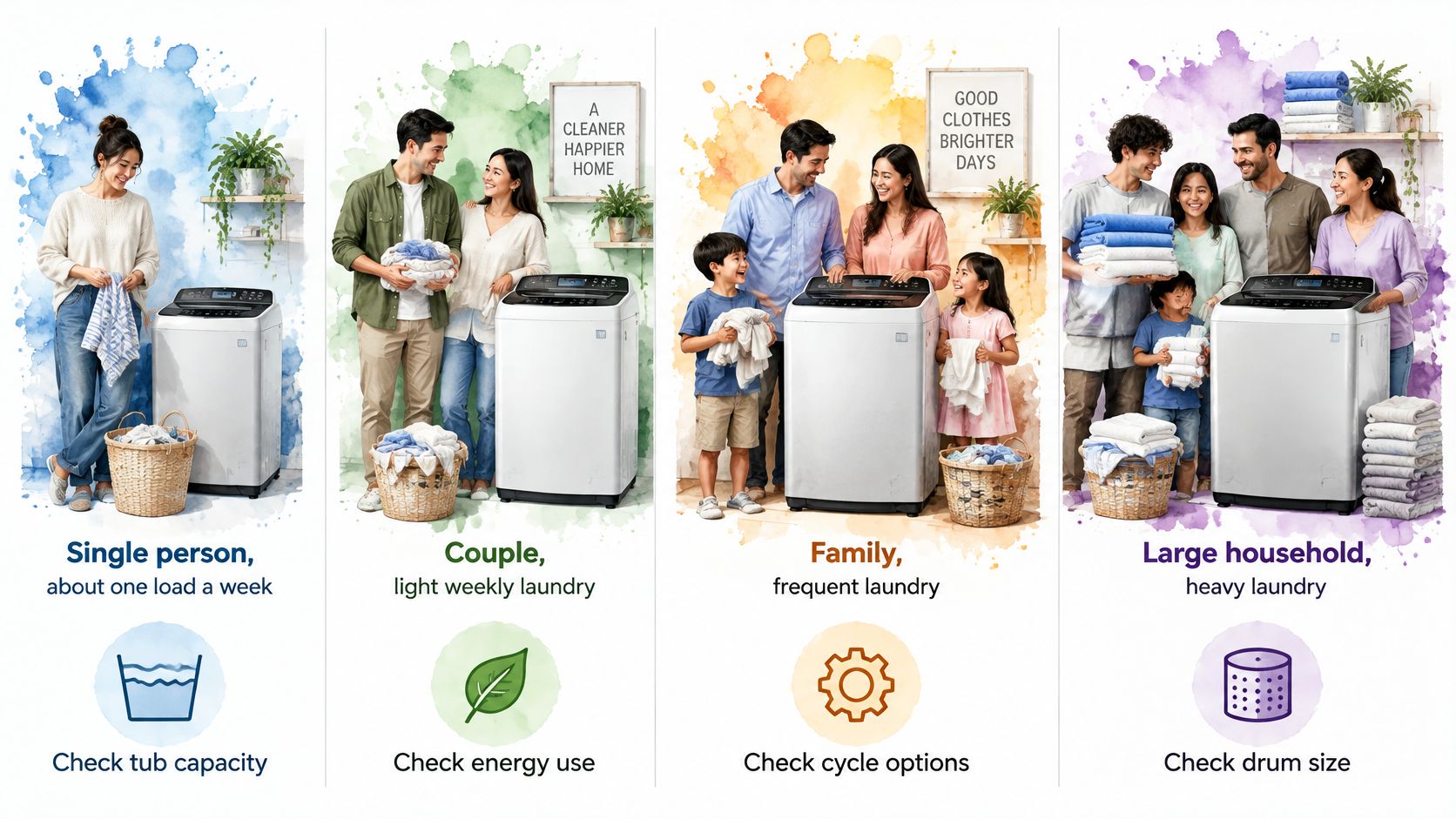
A family of four running six loads a week reaches the 300-load year where water factor dominates the arithmetic. A high-efficiency impeller top-loader in the standard class fits that profile, and the water factor should be checked against the standard-class ceiling before the price is compared. Extraction performance only pays off in the dryer, which is why choosing an efficient dryer belongs in the same decision.
A household with heavy soils, workwear or sports gear needs the opposite emphasis. Published laboratory stain results and vibration data outrank the energy label, and a standard-class tub with a documented cleaning result is the right starting point. For anyone who can't absorb a long repair delay, such as a renter with one machine or an older user living alone, the drainage and vibration rows in the complaint table matter more than any brand average, and parts availability should be confirmed before purchase.
A top-loader is often the better practical choice even when it isn't the most efficient one, because waist-height loading and a short learning curve have real value that a water bill doesn't capture.
Confirm Your Top-Load Washer Choice Before Buying
Six checks settle the decision, in this order.
- Set the main priority: water use, capacity, cleaning results or repair risk.
- Confirm the capacity class and tub size against the household's typical weekly laundry volume.
- Compare each shortlisted model's water factor and energy factor against the federal thresholds for its class.
- Check the published cleaning results and the complaint evidence for each model.
- Calculate yearly water and electricity cost using local rates and the household's load count.
- Record the seller's price and the date it was checked. Appliance prices move often, and a figure noted today may be wrong by the time delivery is booked.
If the purchase can wait a few weeks, timing matters too. The seasonal discount pattern that applies across large appliances is laid out in HearSmart's guide to the best time of year to buy a refrigerator, and the same sale calendar is worth checking before paying full price for a washer.
Every household's winner is different. The right choice is the one whose water use and failure pattern match the priority set in step one, and a machine that ranks second on a spec sheet can be first for a specific home.
Compare shortlisted models against HearSmart's published best lists and statistics pages before ordering, then confirm current specifications, price and warranty terms on each manufacturer's own page on the day of purchase. Numbers move: efficiency standards get revised, sellers reprice, and a model sized for a four-person household is oversized for one person running a weekly load.
Spotted an error in this guide? Email editorial@hearsmart.org